Invoice late fees: how to charge fairly

Nnabuike Okoroafor ·
On this page · 9 sections
A client is three weeks past the due date, and you are wondering whether you can add something to the bill for the wait. Invoice late fees are a fair thing to want. Done well, they are a calm, agreed term that both sides knew about before the work began. Done badly, they are a surprise charge on an overdue invoice that the client disputes and you never collect.
This guide covers the version that causes least friction: agree it first, word it plainly, calculate it correctly, check the rules where you work, and decide in advance when you will waive it.
General information, not legal advice. Rules on late fees and interest vary by country and by US state, and they change; check the official pages linked below, and ask a lawyer before you rely on a fee.
The habit that matters most: agree the late fee before the work#
In practice, a late fee is best treated as part of your agreement. It causes least friction when the client accepted it before you started, in a signed agreement, an accepted proposal or a written reply to your terms. Printed for the first time on an overdue invoice, it is a new charge the client never agreed to, and likely to be disputed.
So the order is:
- Put it in your contract or terms before the job starts.
- Repeat it on every invoice in the terms section, so nobody is surprised.
- Apply it only as written. Same rate, same start day, same base amount.
If you already have an overdue invoice and no late-fee term, adding one now is unlikely to go down well. Chase the payment instead (our overdue invoice email sequence has the wording), and add the term to your agreement for the next job. If you are about to let a business client pay by invoice on terms for the first time, our guide to offering pay by invoice without too much risk covers the other terms worth agreeing in writing at the same time.
Flat fee, percentage or interest: which late fee to use#
There are three common shapes. None is a standard you have to follow. Figures often described as standard late fees for invoices are habits, and the rules where you work may limit what you can charge.
| Type | How it works | Example term | Suits |
|---|---|---|---|
| Flat fee | One fixed charge once the invoice is late | $25.00 if unpaid 7 days after the due date | Small invoices, where a percentage is pennies |
| Percentage per month | A share of the unpaid balance for each month (or part month) late | 1.5% a month on the unpaid balance | Mid-size work billed monthly |
| Annual interest, daily | An annual rate, charged per day late | 8% a year, calculated daily | Larger invoices, where a daily figure is fairer |
A few choices sit inside each type, and your terms should settle every one:
- When it starts. On the day after the due date, or after a grace period such as 7 days.
- What it is charged on. The unpaid balance, not the original total, once part has been paid.
- How often. Once, monthly, or daily.
- Simple or compounding. Simple means interest only on the unpaid invoice, never on earlier interest. It is easier to explain and easier for a client to check.
How to calculate a late fee, with worked examples#
These are our own illustrative numbers, not recommended rates. Every fee counts from the due date, so if your terms are Net 30 or EOM, work out that date first. To run your own numbers, the late fee calculator shows the working for a flat fee, monthly interest or daily interest.
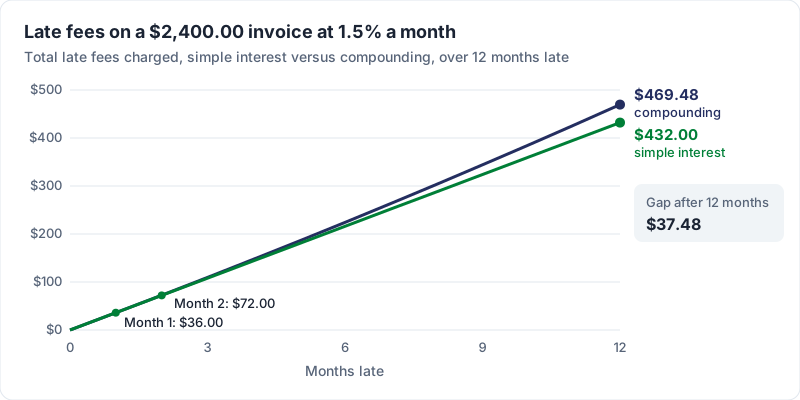
Example 1: percentage per month. Invoice 014 for $2,400.00, due 1 October. Your terms say 1.5% a month on the unpaid balance.
| Month late | Fee that month | Total late fees |
|---|---|---|
| 1 | $36.00 | $36.00 |
| 2 | $36.00 | $72.00 |
After 12 months of simple interest, the fees would be $432.00. If the 1.5% compounded monthly, they would be $469.48. That gap is why simple interest is the safer default.
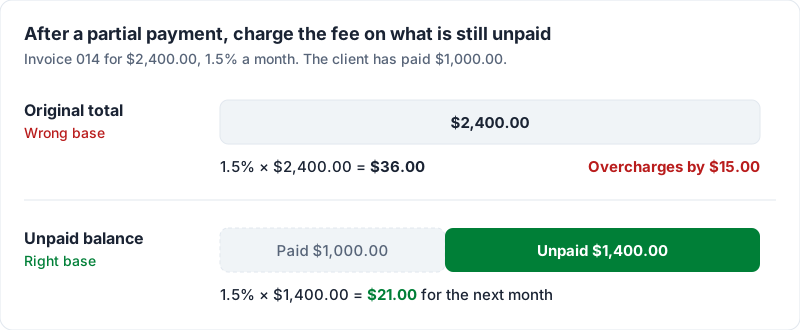
Example 2: after a partial payment. The client pays $1,000.00 of the $2,400.00. The unpaid balance is now $1,400.00, so the next month's fee is 1.5% of $1,400.00, which is $21.00. Charging on the original $2,400.00 would overcharge.
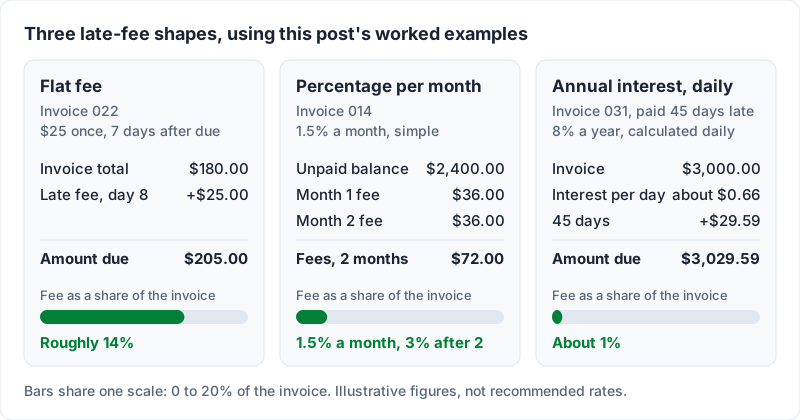
Example 3: flat fee. Invoice 022 for $180.00. Your terms say $25.00 once, if unpaid 7 days after the due date. On day 8 the amount due becomes $205.00. A flat fee this size on a small invoice is roughly 14%, so check it does not look out of proportion.
Example 4: annual interest, calculated daily. Invoice 031 for $3,000.00 is paid 45 days late. Your terms say 8% a year, calculated daily, on the unpaid balance. That is $3,000.00 × 8% ÷ 365, about $0.66 a day, and $29.59 for 45 days, so the amount due becomes $3,029.59.
Side by side, three of these shapes show why the shape matters as much as the rate:
A note on “per month or part of a month”: under that wording, an invoice 3 days late pays a full month. Say so plainly if your terms work that way.
Invoice late payment fee wording you can adapt#
Keep it short and specific: the rate, when it starts and what it is charged on. Fill in the brackets with what you actually agreed. For the other lines in a terms box (payment, deposits, ownership and thank-you notes), see these invoice terms and conditions examples, which also come as a free Word file and a plain text file. Both are general information, not legal or tax advice, and leave the late fee as a placeholder for you to fill in.
In your contract or terms:
Invoices are due [14] days from the invoice date. If an invoice is not paid in full by its due date, [Your business] may charge a late fee of [1.5%] per month on the unpaid balance, starting [7] days after the due date, until it is paid. Late fees are simple interest and are not charged on earlier late fees.
On each invoice, as a late payment clause:
Due [15 November 2026]. Unpaid balances after [22 November 2026] incur a late fee of [1.5%] per month, as set out in our agreement dated [date].
When you apply it, on the invoice that charges the fee:
Late fee on invoice [014] (due [1 October 2026]): [1.5%] of the unpaid balance of [$2,400.00] for [October]. Charged under clause [6] of our agreement dated [date].
Many businesses avoid the words “penalty” and “fine” in their terms, and describe a late fee as covering the cost of waiting. Whether a particular charge can be enforced is a legal question that depends on where you and your client are, so ask a lawyer before you set a large one.
Where to check the rules on late fees and interest#
Rules on late fees and interest differ by country, by US state and by type of client, and they change, so we do not summarise them. Here is where to look, with what the official pages said when we read them on 23 October 2026:
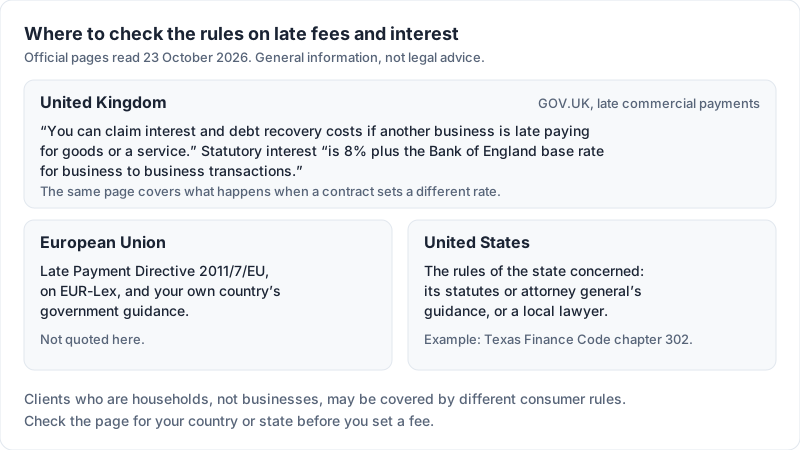
- United Kingdom. GOV.UK's guide to late commercial payments says: “You can claim interest and debt recovery costs if another business is late paying for goods or a service.” Its page on charging interest says: “The interest you can charge if another business is late paying for goods or a service is ‘statutory interest’ - this is 8% plus the Bank of England base rate for business to business transactions. You cannot claim statutory interest if there’s a different rate of interest in a contract.” The fixed sums for recovery costs are on its debt recovery costs page, and the law itself is the Late Payment of Commercial Debts (Interest) Act 1998.
- European Union. The EU's Late Payment Directive (2011/7/EU) is published on EUR-Lex; we do not quote it here. Your own government's guidance on late payment is the practical place to start.
- United States. Check the rules of the state concerned, through its statutes or its attorney general's guidance, or ask a local lawyer. Texas, for example, publishes its rules on interest in Finance Code chapter 302.
- Elsewhere. Your government's business or consumer guidance.
If your clients are households rather than businesses, such as tutoring families, different consumer rules may apply. Check them before you set any fee, and keep it modest.
When to waive a late fee#
Decide this in advance, so it is a policy rather than a mood. Reasonable times to waive:
- The delay was your fault: a wrong amount, a missing PO number, an invoice sent to the wrong person.
- The client told you before the due date and agreed a new date, then kept it.
- It is the first late payment from a client with a long record of paying on time.
- The fee is tiny next to the relationship and the time a dispute would cost.
If you waive, say so in writing, once: “We have waived the late fee on invoice 014 this time. The terms in our agreement still apply to future invoices.” That makes clear the waiver is a one-off, without making it a fight.
One freelance consultant in a public online discussion described how it went for them:
I tried to be flexible and did not impose late fees until a couple of weeks ago when my client had still not paid any of the outstanding balance.
(Quotes in this post come from public online discussions we read while researching invoicing. The people quoted are not Charming customers.)
The honest trade-off: invoice late fees are easy to write and hard to collect#
A late fee does not move money by itself. A client ignoring a $2,400.00 invoice can ignore a $36.00 fee too. Collecting it takes the same chasing as the original debt, plus something extra to dispute. Noticing early does more: a weekly check of your open invoices shows which ones are slipping before a fee is even in question. A reminder before the due date helps too; invoice reminders has a schedule and wording to copy. Some businesses try a carrot instead; discounts on an invoice works out what an early-payment discount costs.
Fees also change the tone. Some clients read a late-fee clause as professional; others read it as distrust, especially in small, personal working relationships. Someone in a public discussion put the firm view this way:
The late payment percentage is a penalty, not a financing option.
That is a fair feeling, and it is one reason many businesses describe a late fee as covering the cost of waiting rather than as a penalty.
Often the levers that do more work are earlier in the process: a deposit before you start (see how deposit invoices work), shorter terms for new clients (how to choose payment terms), a calm follow-up schedule, and pausing new work once an invoice is well overdue. A late fee is best as a backstop behind those, not the main plan. If a client has stopped responding altogether, what to do when a client is not paying covers the next steps. And if the real problem is cash flow while you wait, read what invoice factoring costs before you sign with a factor.
How to show a late fee in Charming Invoices#
Charming Invoices has no late-fee feature. It does not calculate interest, or add fees automatically when an invoice becomes overdue. If you charge a late fee, you work it out (our free late fee calculator does the arithmetic) and add it yourself.
What it does have, on every plan: a Terms section on each invoice for your late payment clause, and default terms you save on your business profile, which are copied onto each new invoice. Once an invoice is issued it is a frozen snapshot and cannot be edited, so the clean way to charge the fee is a separate invoice with one line, such as “Late fee on invoice 014 (due 1 October 2026), 1.5% of $2,400.00”, quantity 1, unit price $36.00. Tax is set per invoice, so a separate invoice also lets you decide whether tax applies to the fee, which depends on your local rules. Payment tracking is manual: when the client pays, you mark it paid.
In short#
Agree invoice late fees in writing before the work, repeat the clause on each invoice, charge simple interest on the unpaid balance, and check the rules where you and your client are. Decide when you will waive it. Then treat it as a backstop, not the plan.
When you are ready, create a free invoice with your late payment clause in the terms.
Free downloads
No sign-up and no email address. More on the free templates page.
- Download .docx: Invoice terms and notes examples for Word
Invoice terms and notes examples for Word
Word .docxExample wording to adapt for the Terms and Notes boxes on your invoice. General information, not legal or tax advice.
- Download .txt: Invoice terms and notes examples as plain text
Invoice terms and notes examples as plain text
Text .txtThe same terms and notes examples as a plain text file, to paste into any invoice. General information, not legal or tax advice.