Pay by invoice: meaning, and how to offer it to clients

Nnabuike Okoroafor ·
On this page · 12 sections
You have met “pay by invoice” from one of two sides. Either you saw it as an option at a checkout, next to the card button, and wondered what you were agreeing to. Or a business client has asked you, “Can we pay by invoice?”, and you are not sure whether saying yes is a favour, a risk or simply how business clients pay.
Both are fair questions. Pay by invoice means the buyer gets the goods or the work first and pays later, against an invoice with a due date, instead of paying at the moment of purchase. This guide explains what that means for the buyer, using Amazon Business as a dated example, then spends most of its time on the seller's side: what offering pay by invoice costs you, worked through on one $4,000.00 order, and how to offer it without carrying more risk than you can afford.
This is general information, not legal, tax or credit advice.
What “pay by invoice” means#
To pay by invoice (also written “pay with invoice” or “pay via invoice”) is to buy now and settle the bill later, by the due date printed on an invoice. Nothing is charged at checkout. The seller ships the order or does the work, sends an invoice with payment terms such as Net 30, and the buyer's accounts team pays it, usually by bank transfer or check.
In short:
- It is a business-to-business habit. Companies buy this way because their accounts teams approve and pay invoices in batches, often against a purchase order, rather than putting every purchase on a card.
- It is a form of credit from the seller. The seller has delivered and is waiting to be paid. Accountants call this trade credit; Amazon calls its version a “credit line”.
- It is usually free for the buyer if they pay on time. The cost lands on the seller, as waiting and as risk.
- It is not the same as “buy now, pay later”. With buy now, pay later, a finance company pays the seller up front and collects from the buyer. With pay by invoice, the seller waits.
How pay by invoice works, step by step#
The details vary with each agreement, but the shape is nearly always the same:
- The client orders on terms. A quote, contract or purchase order sets the price and the payment terms. No card is charged.
- You deliver, then invoice. The invoice carries the client's PO number, the due date and how to pay.
- Their accounts team approves it. They match the invoice to the purchase order and to proof of delivery, then schedule it for a payment run before the due date.
- They pay, with a reference. Usually by bank transfer or check, quoting your invoice number. Larger clients often send a remittance advice: a note listing which invoices a payment covers.
- You match the payment and mark it paid. If the due date passes, you follow up.
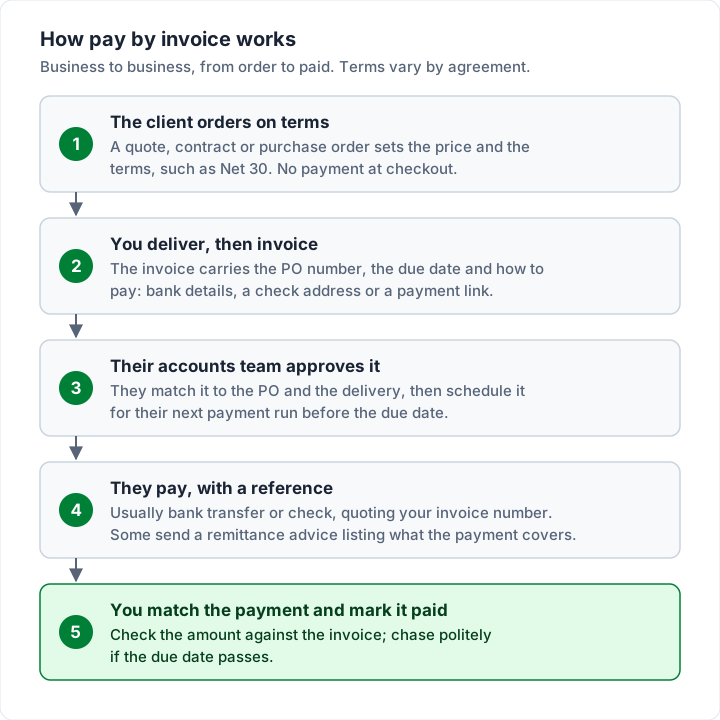
If you are the buyer, the steps are the same from the other side: order, receive the invoice, approve it, pay it by the due date with the invoice number as your reference. What “Net 30” and other terms mean, and how to count the days, is covered in our guide to Net 30 and other invoice payment terms, and the invoice due date calculator works out the date for you.
Amazon Business Pay by Invoice, now Business Credit Account#
Many people search “Amazon pay by invoice” because Amazon Business offered a checkout option with that name. As of 23 October 2026, Amazon's old Pay by Invoice pages redirect to a page called Business Credit Account, and the US page says in so many words: “Pay by Invoice is now Business Credit Account”.
Here is what Amazon's own US page, Business Credit Account, said on 23 October 2026:
- It is invite-only. “Business Credit Account is an invite-only feature”, and organizations “must first be invited to activate a Business Credit Account credit line.”
- The standard term is 30 days. Amazon describes “standard 30-day payment terms with no upfront fees or minimum spend requirements”, and says eligible customers can defer payment “without any interest or fees”.
- Longer terms need a Prime Business plan. The page says “Get 45- or 60-day payment terms with eligible Prime Business membership plans upon approval.”
- The invoice comes after the order. “Upon receiving your order, Amazon Business will send you an invoice with standard payment terms and due date details.”
- Admins choose who can use it. Once active, “administrators can set it as the default payment for groups and buyers can use Business Credit Account at checkout.”
Amazon's UK page, reached from the old Pay by Invoice address, describes the same invite-only feature with “30-day payment terms without any interest or fees” for eligible customers. Terms, eligibility and limits are Amazon's to set and can change, so check the page for your country before relying on any of this.
How to pay an Amazon Business invoice. Amazon's guide How to pay your invoice lists two routes. For ACH direct debit, go to Business Settings, then Your Invoices, and select Make a Payment; Amazon notes that “If making payments through the Amazon Business portal, you do not have to send a remittance.” For check, EFT or wire, follow the “Remit To instructions on the invoice PDF” and send a remittance advice with your Amazon Business account number and the full invoice and credit memo numbers.
That remittance step is worth copying for your own invoices. A big buyer pays many invoices at once, and a payment you cannot match to an invoice is a payment you cannot mark paid.
Pay by invoice vs card, PayPal and buy now, pay later#
Pay by invoice is one of several ways a business buyer can pay. Here is how they compare from the seller's side. The card and buy now, pay later rates are Stripe's US standard pricing from its pricing page, as of 23 October 2026; other providers charge their own rates.
| Pay by invoice, on terms | Card at checkout | PayPal | Buy now, pay later | |
|---|---|---|---|---|
| When you are paid | By the due date, if the client pays on time | At purchase; payout timing set by your provider | At purchase, into your PayPal balance | At purchase; the provider collects from the buyer |
| Fee to you | None from a direct bank transfer (your bank may charge) | Example: 2.9% + 30¢ per US domestic card on Stripe | PayPal's own rates | Example: 5.99% + 30¢ for Klarna on Stripe |
| Who waits for the money | You | Nobody | Nobody | The finance provider |
| Paperwork | Invoice, PO, remittance | A receipt | A receipt or PayPal invoice | A receipt |
| Typical buyer | Companies with an accounts team | Anyone | Consumers, small businesses | Consumers |
Stripe's own docs describe buy now, pay later methods such as Klarna and Affirm as letting customers split payments “while your business gets paid up front”. That is the key difference: buy now, pay later moves the waiting to a lender, and pay by invoice leaves it with you.
For what each of these costs on real invoice sizes, see what card payments on an invoice cost. For the full list of ways clients can pay you, our guide to invoice payment methods compares them.
Should you let clients pay by invoice?#
If your clients are businesses, you may have little choice: many will only pay that way. The real question is which clients, how much, and on what terms. Here is the trade-off:
| What you gain | What it costs you |
|---|---|
| You can sell to companies that cannot or will not pay by card | You wait 30 days or more for money you have already earned |
| No card fee on large orders | You carry the risk that the client pays late, or not at all |
| Larger orders and repeat business from accounts teams | You chase payment yourself when the due date passes |
| A paper trail (PO, invoice, remittance) that suits their auditors | Your own costs, such as materials or subcontractors, are paid before you are |
A card fee is visible on every payment. The cost of terms is invisible until a client pays late, and it compounds: for invoices of the same size, one client on Net 30 who takes 90 days ties up as much cash as three who pay on time.
Worked example: $4,000.00 on Net 30 vs paid by card#
Here is one illustrative order, with dates and amounts made up for the example. You send a $4,000.00 invoice on Monday 2 November 2026. On Net 30 it is due on Wednesday 2 December 2026.
| How the client pays | Fee to you | You receive | Cash arrives |
|---|---|---|---|
| Bank transfer on Net 30, paid on time | $0.00 from the transfer itself | $4,000.00 | 2 December, 30 days after you invoiced |
| Bank transfer on Net 30, paid 15 days late | $0.00 | $4,000.00 | 17 December, 45 days after |
| Card at the order, through a Stripe Payment Link | $116.30 (2.9% of $4,000.00 is $116.00, plus $0.30) | $3,883.70 | Within days, on your provider's payout schedule |
| A Stripe invoice on Net 30, paid by ACH Direct Debit (Invoicing Starter) | $21.00 ($5.00 ACH, capped, plus $16.00 at 0.4%) | $3,979.00 | By the due date, if paid on time |
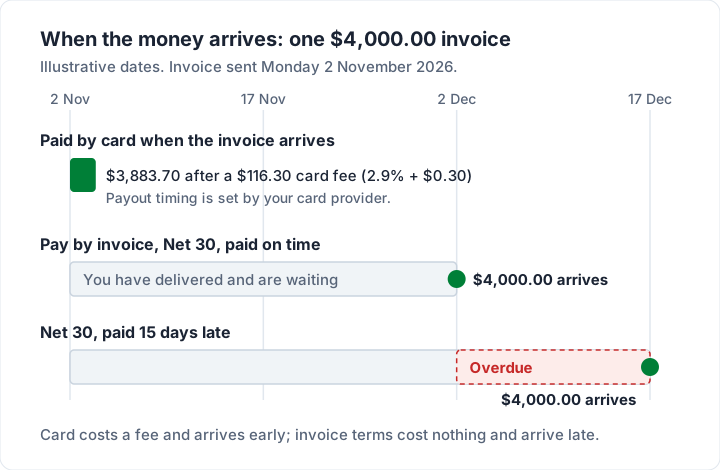
So the price of offering terms on this order is not $116.30. It is 30 to 45 days of waiting for $4,000.00, plus the chance that the 45 becomes 90. Whether that is a good trade depends on your cash: if you can comfortably wait, terms win a business client at no fee; if you cannot, ask for a deposit, shorter terms or a card payment on the first order.
If the waiting itself is the problem, some businesses sell or borrow against unpaid invoices. That has its own costs, explained in our guide to invoice factoring.
How to offer pay by invoice without too much risk#
None of these steps is a legal requirement or a guarantee. They are the habits that make terms safer, and a client that pushes back on all of them is telling you something.
- Decide who gets terms. Many sellers offer pay by invoice only to established businesses, or after a first order paid up front. Asking a new client for trade references, or checking a business credit report, is common practice.
- Set a limit per client. Decide how much you can afford to have outstanding with one client, and invoice in stages above that.
- Put the terms in writing before you start. The quote or contract should state the terms, for example Net 30, and what happens if the work changes.
- Take a deposit on first or large orders. It cuts the amount at risk and tests how the client pays. Our guide to deposit invoices shows how to credit it on the final bill.
- Ask for a purchase order number. Many accounts teams cannot pay an invoice without one. See where a PO number goes on an invoice.
- Bill the right legal entity. Address the invoice to the company, not the person you dealt with; our guide to invoicing a company covers what to ask for.
- Invoice on delivery, with a real date. “Net 30” is clearer with the date printed next to it.
- Follow up on day one of overdue. A polite, prompt reminder works better than a cross one a month later; our overdue invoice follow-up emails give you the wording.
The deposit point comes up again and again in public discussions of slow-paying clients. Replying to an agency owner whose biggest client paid late, one commenter on a public small-business forum (not a Charming customer) suggested:
There's a simple solution here: instead of billing in arrears, that client goes on the "cash up front, or at least a significant enough deposit to mitigate risk" list.
Late fees and interest are not a template setting. Before you add one, ask a lawyer or your accountant what applies where you and your client are. Our guide to late fees on invoices links the official pages.
What to put on an invoice your client will pay by transfer#
An invoice paid on terms has to survive an accounts team: it is read by someone who was not part of the deal, matched against a PO and keyed into a payment run. These are the parts that make it payable without an email back to you:
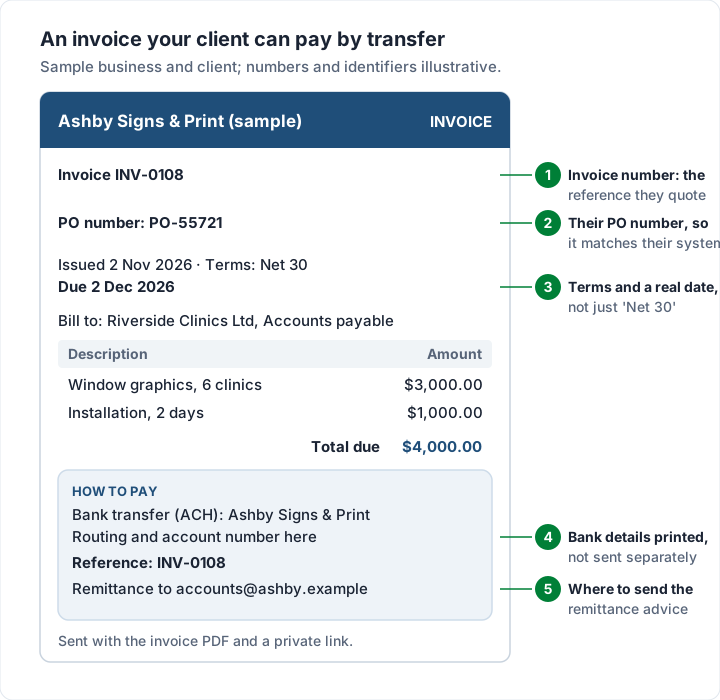
- An invoice number the client can quote as the payment reference.
- Their PO number, exactly as they issued it.
- The terms and the due date, both: “Net 30, due 2 December 2026”.
- Your bank details, printed on the invoice rather than sent in a separate email. Changed bank details arriving by email are a common fraud, so many accounts teams will not act on them.
- Where to send a remittance advice, if you want one.
- Your legal business name and address, and any tax ID you put on your invoices.
Once the money arrives, our guide to paid invoices covers how to record it and what a paid invoice should show.
Offering pay by invoice in a payments tool#
If you invoice through a payment platform, “pay by invoice” is often a setting. In Stripe, for example, you choose between charging a saved payment method automatically and emailing the invoice so the client pays it by the due date, by card, bank debit or bank transfer. Stripe charges its Invoicing fee and the payment fee when the invoice is paid. Our walkthrough of how a Stripe invoice works shows both options and the costs. Online stores have their own version: our guide to Shopify invoices covers Shopify's B2B payment terms for business customers. On WooCommerce, our WooCommerce invoice guide describes two routes: a pay link or an offline payment method.
Software and ticketing companies use the same idea in reverse: their checkout pages often offer “pay by invoice” to larger customers who cannot pay by card, sometimes only above a minimum order. If you are the buyer in that case, the vendor will send an invoice with its own terms, and the steps above apply.
Offering pay by invoice with Charming#
Charming Invoices is built for the invoice side of this, not the payment side. Here is what it does, checked in our code on 23 October 2026:
- Terms, due date and PO number on every invoice. Each invoice has an issue date, a due date, a PO number field and a terms field. You can set default terms per business, and they are copied onto each new invoice.
- Your bank details print on the invoice. Each business has a free-text bank details box and a payment link field, printed in the invoice's payment section. While an invoice is unpaid, the client's private invoice page shows an “Open payment link” button to your own link, such as a Stripe or PayPal link.
- Deposits. You can bill a deposit up front and credit it on the final invoice (the credit is applied after tax).
- Overdue invoices flagged. An issued invoice past its due date shows as overdue, so you know when to follow up. Charming does not send reminders; set a calendar reminder for the due date.
- Client statements. A PDF statement for one client lists every open invoice as of a date, with days overdue and ageing (current, 1-30, 31-60, 61-90 and 90+). It is useful when an accounts team asks what is outstanding, and our guide to what an invoice statement should show walks through one.
- Invoice numbers assign themselves, in a gapless sequence per business, so the reference on the invoice is always unique.
The catches, plainly. Charming takes no payments and processes no cards. It does not know when a client has paid: you record each payment, including part payments, or mark the invoice paid. It does not run credit checks, add late fees or interest, email invoices or chase anyone for you. The statement shows open invoices only, not a full payment history. Invoices on the free plan carry a small “Sent with Charming Invoices” line; the free plan has unlimited invoices and clients for 1 business.
If you are about to send your first invoice on terms, create a free invoice with the PO number, the due date and your bank details on it, download the PDF and send it your way.
Pay by invoice questions#
What does pay by invoice mean?#
It means paying after delivery, against an invoice with a due date, instead of at the moment of purchase. The buyer gets the goods or service first and pays later, usually by bank transfer or check, within agreed terms such as Net 30.
Is pay by invoice safe?#
For the buyer, it is generally the lower-risk option, because you pay after you have received what you ordered. Check that the invoice is genuine before paying: fake invoices are a common scam, so confirm unexpected invoices and any change of bank details with the supplier directly. For the seller, the risk is non-payment; the checklist above is how sellers usually manage it.
Is pay by invoice a form of credit?#
In plain business terms, yes. The seller delivers first and accepts payment later, and Amazon describes its version as a credit line. How any particular arrangement is treated under the law is a question for a lawyer.
Can I charge late fees on a pay by invoice order?#
That is a question for a lawyer or accountant where you operate, and for your written terms. Our guide to late fees on invoices links the official pages.
How do I pay by invoice on Amazon?#
As of 23 October 2026, Amazon's Pay by Invoice is called Business Credit Account and is invite-only. If your organization has it, a buyer chooses it at checkout, and the invoice is paid later by ACH direct debit from the Amazon Business portal, or by check, EFT or wire following the Remit To instructions on the invoice PDF.
The short version#
Pay by invoice means delivering first and being paid later, by a due date on an invoice. Business buyers expect it, Amazon Business offers its own version as Business Credit Account, and for the seller it costs no fee but plenty of waiting and some risk. On a $4,000.00 order, a card costs $116.30 and pays within days; Net 30 costs nothing on paper and pays in 30 days, or 45, or later.
Offer terms to clients you trust, take a deposit from those you do not know yet, put the PO number, the due date and your bank details on every invoice, and follow up the day it is overdue.
Sources, all checked 23 October 2026: Amazon Business, Business Credit Account (US); Amazon Business, Business Credit Account (UK), from the former Pay by Invoice page; Amazon Business, How to pay your invoice; Stripe pricing; Stripe docs, Payment methods for Invoicing; Stripe Invoicing pricing.