Bookkeeping invoice template: monthly fee, catch-up, extras

Nnabuike Okoroafor ·
On this page · 9 sections
You keep other people's books tidy, and your own invoices should be the easiest part of the month. Yet a bookkeeping invoice has a quirk a general template does not plan for: this month's package is often billed in advance, while last month's extras (the transactions over the limit, the payroll runs) can only be billed afterwards, once you know what they were.
This page gives you a bookkeeping invoice template to start from (a bookkeeper invoice template for billing your own clients) and two invoices filled in with real arithmetic: a monthly package with last month's extras in their own subtotal, and a catch-up job billed by the hour with a fixed year-end item and a deposit credited. If you searched for an accountant invoice template, the layout is the same.
This post is about invoicing your own clients. If you want someone else to send invoices for your business, see how to let a bookkeeper or teammate invoice for you instead.
General information, not legal or tax advice. Nothing here is accounting or tax advice, and it does not cover how your clients should treat your fees.
Bookkeeping invoice template: which file to use#
There is a free bookkeeping invoice template for Excel and one for Word, with no sign-up. Both have bookkeeping lines printed in advance (a month heading for the package, the monthly package, last month's extras by count, payroll pay runs, catch-up hours and a year-end package) with every rate left blank, and a “Deposit received” line before the balance due. More free files, including general and hourly invoice templates, are on the free Word and Excel invoice templates page.
| Your billing | Best file | Why it fits |
|---|---|---|
| A monthly package plus extras, or a catch-up job with a deposit | bookkeeping-invoice-template.xlsx (Excel) | 15 lines that calculate, a fixed discount, one tax rate, a “Deposit received” row, and a due date worked out from the payment terms |
| The same lines, typed by hand | bookkeeping-invoice-template.docx (Word) | The bookkeeping lines already printed; you type the totals yourself |
| Catch-up or clean-up work where you want the hours totalled | hourly-invoice-template.xlsx (Excel) | A Date column, hours times an hourly rate, and a Total hours line, all calculated |
The Excel files calculate every amount and total. The Word files do not. If you mostly bill time, the hourly invoice template page has a filled sample, and the Excel invoice template with formulas guide walks through each cell. For advisory work priced like consulting, the consulting invoice template covers hourly, retainer and fixed-fee layouts.
How bookkeepers price: package, hourly or fixed project#
Bookkeeping work tends to come in a few shapes, and each one produces a different invoice line. The table shows what the line says, not what to charge: we do not quote typical rates.
| Pricing model | When it fits | What the invoice line says |
|---|---|---|
| Monthly package (fixed fee) | Ongoing monthly work with a known scope | “Monthly bookkeeping: 2 bank and 1 card account reconciled, up to 150 transactions”, quantity 1 month |
| Usage extras | Work that varies month to month | “Transactions over the package limit (188 of 150)”, or payroll per payslip |
| Hourly | Catch-up, clean-up, or work with no clear scope yet | “Catch-up bookkeeping, Jan to Jun 2026”, quantity in hours |
| Fixed project | A defined piece of work with a clear end | “Year-end close package”, quantity 1 |
| Prepaid retainer | The client pays a sum up front and you draw it down | Each piece of work, then the opening balance, what was drawn and what remains |
A retainer needs its own layout, because the invoice reports a balance as well as a charge. The drawdown retainer invoice guide shows one in full, and how a retainer draw works on an invoice covers it for consultants.
Billing in advance or in arrears#
Billing in advance means you invoice for a period before or as it starts: on 1 October you bill the October package. Billing in arrears means you invoice after the work is done: on 1 October you bill September's extras.
You can combine the two on one invoice. The package is fixed, so it can be billed up front. The extras depend on what happened, so they are billed once the month has closed. Put each in its own section with its own subtotal, and name the month in each section heading, so nobody reads the September extras as an October charge.
If you prefer to bill everything in arrears, the same layout works with both sections naming the previous month. The point is that each line says which month it covers.
Scope and extras on a bookkeeper invoice template#
A bookkeeping bill is easiest to pay when the client can see what the fee covers and what it does not. The invoice cannot fix an unclear agreement, but it can make the agreed scope visible every month.
- Name the limit in the package line. “Up to 150 transactions” or “2 bank and 1 card account” on the line itself reminds the client what the fee buys.
- Show the overage as a count. “188 of 150” is checkable; “additional transactions” is not.
- Bill payroll per payslip or per pay run, with the count: “2 pay runs, 6 employees”.
- Agree out-of-scope work before you do it. A new bank account, a move to new software or a backlog of old months is a separate job with its own price.
Many bookkeepers work from an engagement letter that sets the scope, and the invoice refers to it. In a small-business forum (one of the public discussions we read for our research; the people quoted are not Charming customers), one commenter replied to someone whose biggest client wanted out-of-scope “small tweaks”:
clienst don't always understand how much and how long things will take. Once you've priced it up, I think present it to them - and agree a price.
That is the habit the extras section relies on: by the time a line appears under “Extras”, the client has already seen the price. For how much detail to put on each line, see how much detail to show on an invoice.
Sample 1: a monthly invoice with last month's extras#
Tallyhouse Bookkeeping (sample business) keeps the books for Quillon Coffee Roasters (sample client) on a monthly package billed in advance. Transactions over the limit and payroll are billed the following month.
Every name and rate below is illustrative, not a market rate. No tax line is shown: this post does not cover whether bookkeeping services are taxable, so check your state or country's tax agency, or ask an accountant.
- Invoice: INV-0207, dated Thursday 1 October 2026, due Thursday 15 October 2026 (14 days)
- From: Tallyhouse Bookkeeping (sample business)
- To: Quillon Coffee Roasters (sample client), 22 Sample Street
| Line | Qty | Unit | Rate | Amount |
|---|---|---|---|---|
| Monthly package: October 2026 | ||||
| Monthly bookkeeping: 2 bank and 1 card account reconciled, up to 150 transactions | 1 | month | 450.00 | 450.00 |
| Subtotal | 450.00 | |||
| Extras: September 2026 | ||||
| Transactions over the package limit (188 of 150) | 38 | transactions | 1.50 | 57.00 |
| Payroll processing: 2 pay runs, 6 employees | 12 | payslips | 6.50 | 78.00 |
| Subtotal | 135.00 | |||
| Subtotal | 585.00 | |||
| Total due | 585.00 |
The arithmetic: 188 − 150 = 38 extra transactions, and 38 × 1.50 = 57.00. Two pay runs for six employees is 12 payslips, and 12 × 6.50 = 78.00. The extras come to 57.00 + 78.00 = 135.00, and with the 450.00 package the total is 585.00.
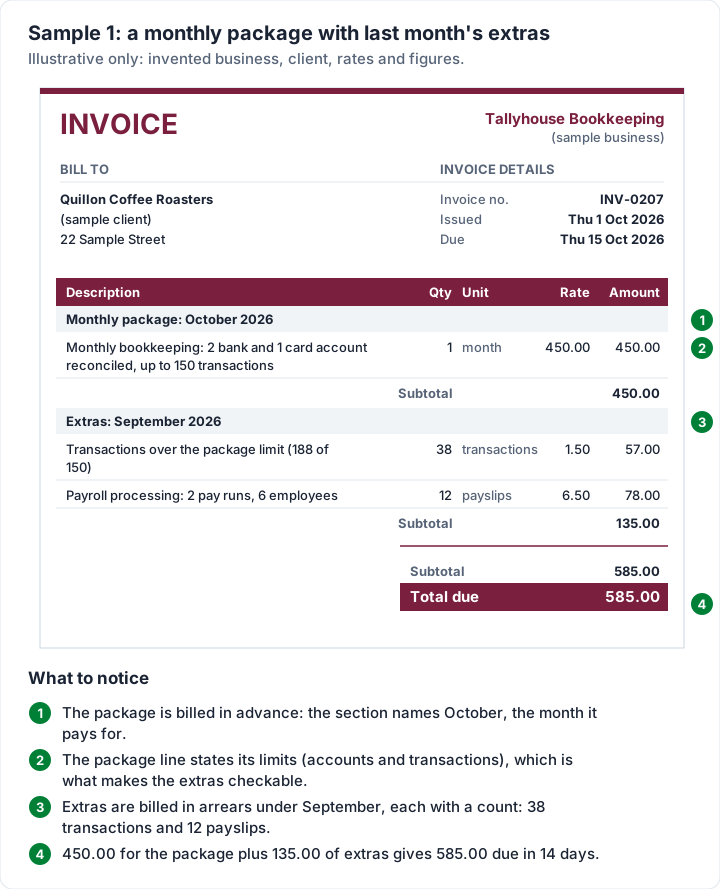
The due date is 14 days after the invoice date, and both fall on a Thursday. How to calculate an invoice due date covers net terms if you use them instead.
Sample 2: a catch-up job with a deposit#
Catch-up (or clean-up) bookkeeping means bringing books that have fallen behind up to date: categorising and reconciling months of transactions in one go. It is hard to price before you see the mess, so it is often billed by the hour, sometimes with a deposit up front.
Quillon Coffee Roasters asked Tallyhouse to catch up January to June 2026, plus a fixed-price year-end package to hand to their accountant. They paid a 500.00 deposit when the work was agreed.
- Invoice: INV-0211, dated Friday 16 October 2026, due Friday 30 October 2026 (14 days)
- From: Tallyhouse Bookkeeping (sample business)
- To: Quillon Coffee Roasters (sample client), 22 Sample Street
| Line | Qty | Unit | Rate | Amount |
|---|---|---|---|---|
| Catch-up bookkeeping, Jan to Jun 2026: categorise and reconcile | 14.5 | hrs | 65.00 | 942.50 |
| Year-end close package: adjusting entries list and reports for your accountant | 1 | package | 350.00 | 350.00 |
| Total hours | 14.5 | |||
| Subtotal | 1,292.50 | |||
| Deposit received | −500.00 | |||
| Total due | 792.50 |
The arithmetic: 14.5 × 65.00 = 942.50, plus 350.00 for the year-end package, is 1,292.50. Taking off the 500.00 deposit leaves 792.50. The total hours line counts only the line billed in hours, so it shows 14.5, not 15.5. The “year-end close package” is a description of the bookkeeper's own service in this sample, not advice on what a year-end should include.
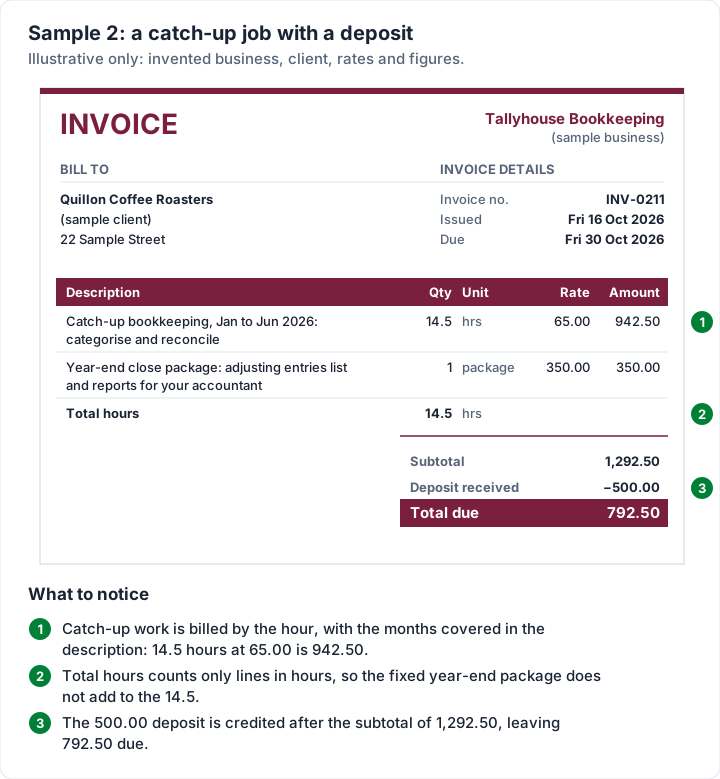
If you track hours in a separate app, turning tracked hours into an invoice compares the ways to get them onto the bill. For deposits, see how the deposit shows on the final invoice.
Accountant, CPA and tax preparer invoices#
An accounting invoice template, in the sense people search for it, is the invoice an accounting or bookkeeping practice sends its own clients. The structure is the same as the samples above: a fixed fee or hours per service, extras on their own lines, the period covered, a due date and how to pay.
This post does not cover professional rules for CPAs, enrolled agents, chartered accountants or tax preparers, including rules on how fees are set or disclosed; check with your licensing or professional body. If you came looking for how invoices are recorded in a set of books, that is a different topic: see invoices in accounting.
Bookkeeping invoices in Charming Invoices#
First, plainly: Charming is not bookkeeping software. It has no ledger, no bank feeds, no reconciliation and no accounting integration. For your clients' books, and your own, use accounting software such as QuickBooks Online, Xero or Wave. For task lists, deadlines and client document requests, practice-management tools such as Financial Cents, Jetpack Workflow or TaxDome are built for that.
What Charming does is make the invoices, checked in the code:
- Sections with subtotals. Give lines a section such as “Monthly package: October 2026” and “Extras: September 2026”, and switch on “Group lines by section”. It is on by default in the Contractor and Timesheet templates, and available on all 60.
- The Timesheet template groups time entries by week or project, with hours per group and a total hours line. Total hours counts only lines whose unit is h, hr, hrs, hour or hours.
- The Retainer template prints the opening balance, what this invoice took from the retainer and the remaining balance. You enter the opening balance; Charming does not hold the money.
- Deposits. Type the amount in “Deposit already received”, and the invoice prints “Deposit received” before the total due.
- Recurring monthly invoices with a start and an optional end date, on the paid plans (from Individual, $29 once). The catch: each one arrives as a draft for you to review and issue. Nothing goes to the client automatically, and the draft has the same fixed lines every month, so last month's extras are typed in by hand before you issue it. How recurring invoices work explains the drafts.
- Client statements with ageing, a statement of open invoices for a client who is behind.
- Overdue invoices are flagged, so you can see what is still owed. Charming does not send reminders; set a calendar reminder or use your own email.
- Teammates for a junior bookkeeper who drafts invoices: up to 5 on Team ($79 once), unlimited on Pro ($12 a month or $99 a year). Free and Individual are for one person.
- CSV export of your invoices, for your own books. It is a file, not a live connection.
The catches:
- No time tracking. Type the hours yourself, or bring them from a time tracker.
- No client portal, engagement letters or e-signature.
- No invoice emails. Issue the invoice, then download the PDF or copy its private link and send it however you like.
- No card payments through Charming. You add bank details and a payment link of your own; the client pays you directly, and you mark the invoice paid.
- 1 business on the free plan; unlimited businesses on the paid plans. Lifetime plans are final sale.
- Free invoices carry a small “Sent with Charming Invoices” line in the footer. Paid plans hide it by default, and you can switch it back on.
If that fits your practice, create a free invoice and try Sample 1 with one of your own clients.
Bookkeeping invoice questions#
What should a bookkeeping invoice include?#
Your details and the client's, an invoice number, the invoice and due dates, the period each line covers, the package with its limits, any extras with counts, hours and rate for hourly work, deposits or retainer balances, the total and how to pay.
Should bookkeepers bill monthly in advance?#
It suits a fixed monthly package, because the fee is known in advance; extras are then billed the following month, in arrears. Whatever you choose, name the month on every line so the client knows which period each charge covers.
How do you invoice catch-up bookkeeping?#
Usually by the hour, with the months covered in the line description, as in Sample 2. A fixed item such as a year-end package goes on its own line, and any deposit is credited before the total due.
How do you show work outside the package?#
In its own section, named for the month it happened, with a count for each extra: transactions over the limit, payslips, hours. Agree the price before doing the work, so the line is no surprise.
Is there a free bookkeeper invoice template?#
Yes. There is a bookkeeping invoice template for Excel, which calculates, and one for Word, which does not, both free with no sign-up. They have the monthly package, extras, catch-up hours and a year-end package printed in advance with the rates left blank. The hourly Excel file on the same page suits catch-up work if you want the hours totalled.
What is an accounting invoice template?#
Usually, the invoice an accounting or bookkeeping practice sends its clients: services, fees or hours, the period covered, the total and payment terms. The samples on this page are two worked examples.
Free downloads
No sign-up and no email address. More on the free templates page.
- Download .xlsx: Bookkeeping invoice template for Excel
Bookkeeping invoice template for Excel
Excel .xlsxFor bookkeepers: a monthly package, last month's extras and catch-up hours.
- Download .docx: Bookkeeping invoice template for Word
Bookkeeping invoice template for Word
Word .docxFor bookkeepers: a monthly package, last month's extras and catch-up hours.