Artist invoice template for commissions and art sales

Nnabuike Okoroafor ·
On this page · 11 sections
A painting is finished, a collector wants it, or a magazine needs an illustration by Friday. A generic artist invoice template asks for a description and a price, and that is where the trouble starts. An artwork invoice has to say exactly what was sold (the object, its size, medium and edition, how it travels) and, just as important, what was not sold, such as the right to reproduce the image.
This post gives you a free artist invoice template, a field-by-field list of what an artist invoice should include, and two artist invoice samples with numbers that add up: a commissioned painting billed as a deposit and then a balance with framing and shipping, and an editorial illustration billed with a usage licence. It covers fine art, commissions, prints and illustration. For brand and logo work, our graphic design invoice samples are the better fit; performing artists should read our musician invoice template instead.
General information, not legal or tax advice. Where copyright comes up, we quote and link the official text. Licence and commission wording here is plain business language, not legal drafting; rules vary by country, so ask a lawyer or an accountant about your own situation.
Free artist invoice template: which file to use#
There is no artist-specific download on our free Word and Excel invoice templates page, so we say so plainly. Two of the free invoice files there work well for art, with no sign-up:
| File | Calculates? | Fits an art invoice when... |
|---|---|---|
| invoice-template.xlsx (Excel) | Yes: line amounts, a discount, one tax rate, the total, amount paid, balance due and the due date | You bill an artwork plus framing, crating and shipping and want the arithmetic done for you |
| invoice-template.docx (Word) | No, you type every total | A short invoice: one artwork or one illustration with its licence |
The Word service template on the same page is built for trades (it asks for a “Site address” and “Date(s) of work”), so it is a poor fit for an artwork sale. If you use the plain Word file, check every total by hand, because Word does not calculate.
If you want the invoice to look like part of your practice rather than a spreadsheet, Charming's templates do that; the details are near the end.
What an artist invoice should include#
Start with the basics every invoice needs: your details and the buyer's, an invoice number, the invoice and due dates, the total and how to pay. Then describe the work as precisely as a catalogue would.
| Line or field | Example wording | Why it matters |
|---|---|---|
| Artwork title and year | “‘Heron at Low Water’, 2026” | Identifies the exact piece |
| Medium and size | “Oil on canvas, 24 x 36 in” | Distinguishes the original from any print of it |
| Original, print or licence | “(original)” or “Giclée print, edition of 50, no. 12/50” | Says what kind of thing was sold |
| Framing | “Float frame, oak (client's choice)” | An extra the buyer chose, priced on its own |
| Crating and shipping | “Crating and insured shipping” | Delivery costs kept apart from the price of the art |
| Deposit already paid | “Deposit received” with a minus sign | A credit, not a charge |
| What is not included | “This invoice is for the original painting ...” (example wording) | Says what was sold and points to the agreed terms |
| Due date and payment details | “Due 5 Nov 2026”, bank details or a payment link | The answer to “how do I pay you?” |
If you sell one artwork for cash at a show, you may also need a bill of sale and an invoice; that guide explains when a buyer needs each.
Commissions: deposit, balance and what each invoice says#
Commissions usually take weeks, and materials are bought up front. Many artists take a deposit before starting and bill the balance when the work is finished, with framing and shipping added at the end. There is no standard deposit percentage; the 50% in the sample below is an example. Agree the deposit, when the balance is due and what happens if the commission is cancelled before you start.
Each of the two invoices has a job:
- The deposit invoice bills the deposit and shows its base (“50% of 2,800.00”), so the client can see how it relates to the agreed price.
- The balance invoice bills the whole artwork, adds the extras, and credits the deposit already paid, so the total due is what is left.
Our guide to deposit and balance invoices shows the same pattern for other trades.
If a commission is cancelled. Some artists agree in advance that the deposit is kept, or that a cancellation fee is due, if the client cancels partway through. That is a business term for your agreement, and the invoice then bills it on one line that names the agreement and the stage reached. Writers call this a kill fee; our guide to kill fees and rights lines on an invoice shows the wording. Whether such a term holds up in a dispute is a question for a lawyer where you work.
Sample artist invoice 1: a commissioned painting, deposit then balance#
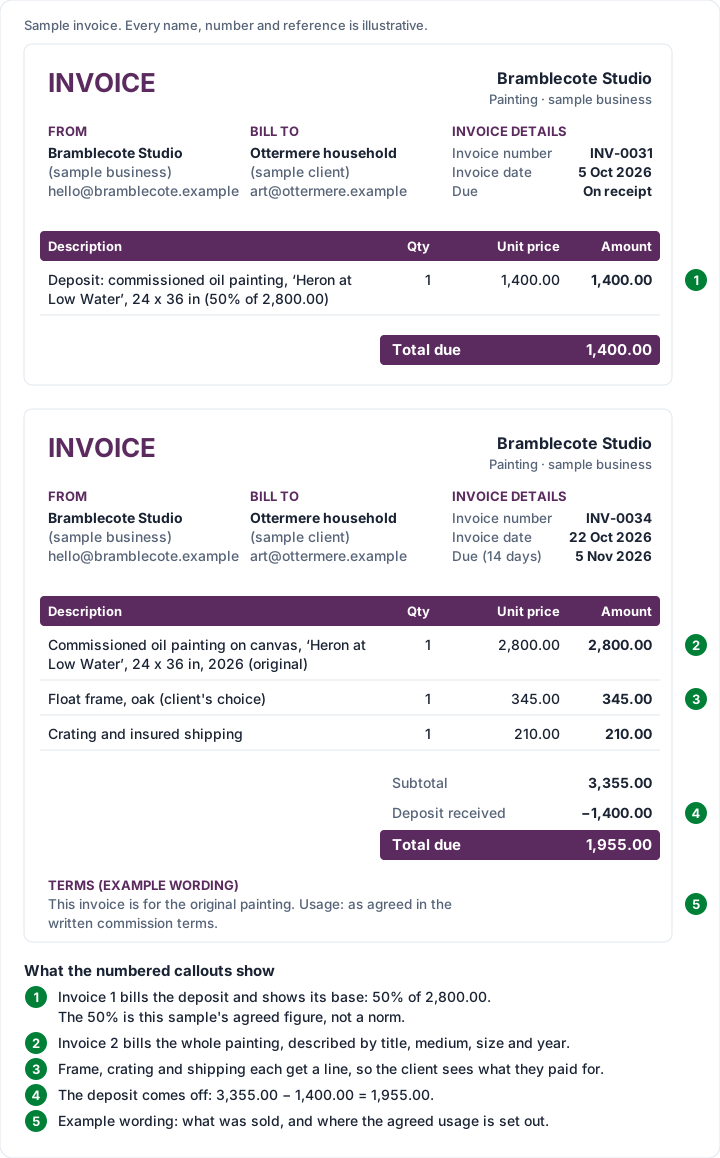
Bramblecote Studio (sample business) agreed a commission of 2,800.00 with the Ottermere household (sample client) for an oil painting on canvas, 24 x 36 in, with a 50% deposit before work started. The painting title is invented.
Invoice 1, the deposit, dated Monday 5 October 2026, due on receipt:
| Line | Qty | Rate | Amount |
|---|---|---|---|
| Deposit: commissioned oil painting, “Heron at Low Water”, 24 x 36 in (50% of 2,800.00) | 1 | 1,400.00 | 1,400.00 |
| Total due | 1,400.00 |
Invoice 2, the balance, dated Thursday 22 October 2026, due in 14 days: Thursday 5 November 2026.
| Line | Qty | Unit | Rate | Amount |
|---|---|---|---|---|
| Commissioned oil painting on canvas, “Heron at Low Water”, 24 x 36 in, 2026 (original) | 1 | piece | 2,800.00 | 2,800.00 |
| Float frame, oak (client's choice) | 1 | each | 345.00 | 345.00 |
| Crating and insured shipping | 1 | 210.00 | 210.00 | |
| Subtotal | 3,355.00 | |||
| Deposit received 5 Oct 2026 | −1,400.00 | |||
| Total due | 1,955.00 |
The arithmetic, checked: 50% of 2,800.00 = 1,400.00; 2,800.00 + 345.00 + 210.00 = 3,355.00; 3,355.00 − 1,400.00 = 1,955.00 still due. Every name and price is illustrative, not a rate guide.
Under the totals, the balance invoice carries a short terms note. This is example wording, a plain business statement of what the invoice covers, not a legal clause to rely on:
- “This invoice is for the original painting. Usage: as agreed in the written commission terms.”
No sales tax line. Whether a sale of art, a frame or shipping is taxable depends on where you and the buyer are, and the answer can differ for an original, a print and a digital file. Rules vary; check your state or country's tax agency, or ask an accountant, before you add a rate.
Selling the artwork is not selling the copyright#
It is easy to assume that buying a painting includes the right to reproduce it. US law addresses exactly this point. Section 202 of the US Copyright Act (17 U.S.C. § 202, “Ownership of copyright as distinct from ownership of material object”), in the Title 17 text published by the US Copyright Office, as of 28 October 2026, says:
Ownership of a copyright, or of any of the exclusive rights under a copyright, is distinct from ownership of any material object in which the work is embodied. Transfer of ownership of any material object, including the copy or phonorecord in which the work is first fixed, does not of itself convey any rights in the copyrighted work embodied in the object; nor, in the absence of an agreement, does transfer of ownership of a copyright or of any exclusive rights under a copyright convey property rights in any material object.
That is US law; other countries have their own rules. The US Copyright Office's Circular 1, Copyright Basics covers transfers and licences, and our photography invoice template post quotes the parts about transfers in writing and shows usage licence wording for images.
In practice: decide what the buyer may do with the image, write it in your agreement, and make the invoice repeat it. Our guide to what an invoice and a contract each do explains why the invoice should not be the first place a term appears. For anything beyond a plain sale, such as selling or licensing reproduction rights, ask a lawyer.
Sample artist invoice 2: an illustration with a usage licence#
Illustration is usually sold the other way round: the client wants to use the image, not own the original. So the licence is part of what is being bought, and many illustrators price it on its own line.
Bramblecote Studio (sample business) is billing Fernlight Quarterly (sample client), a magazine, for one full-page illustration. The invoice is dated Tuesday 27 October 2026, due in 21 days: Tuesday 17 November 2026.
| Line | Qty | Unit | Rate | Amount |
|---|---|---|---|---|
| Editorial illustration, “Night ferry”, full page, digital | 1 | piece | 650.00 | 650.00 |
| Usage licence: one-time print and online use in the Winter 2026 issue, North America, non-exclusive, 12 months online | 1 | licence | 250.00 | 250.00 |
| Extra revision round (beyond the 2 included) | 1 | round | 75.00 | 75.00 |
| Total due | 975.00 |
The arithmetic, checked: 650.00 + 250.00 + 75.00 = 975.00. The licence terms are illustrative practice wording, not a template to rely on, and the prices are not a rate guide.
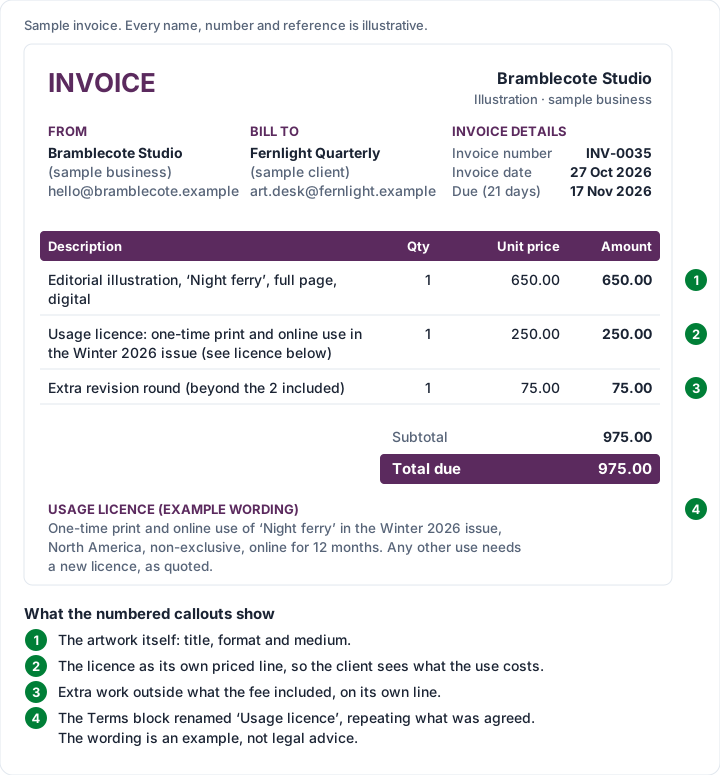
A licence line is easier to agree when it names four things: the use (print, online, packaging), the territory, the term and whether it is exclusive. If the client later wants more, that is a new licence and a new line, not a dispute about the old invoice.
Delivering the file. Many illustrators send a low-resolution or watermarked proof for approval and the final file after payment. In the public online discussions we read while researching invoicing (the people quoted are not Charming customers), a commenter in a videography forum, writing about clients who want final files before the last payment, put the risk this way:
Anyone can screen record a private link, and many people undervalue the work done in the media/art space.
They mean a preview link to the work, not an invoice. Whatever you decide, say on the invoice or in your agreement when the final file is delivered. And price the work properly in the first place; our piece on how designers undercut their own rate is written for designers, but the pricing mistakes apply to illustrators too.
Prints, editions and art fairs#
Prints and editions. Put the edition on the line: “Giclée print, ‘Heron at Low Water’, 12 x 18 in, edition of 50, no. 12/50, signed”. One line per print keeps the edition numbers checkable if a buyer orders several.
Sales on the spot. At a fair or an open studio, the buyer usually pays there and then. An invoice marked paid, or a receipt, gives them a record; our guide to a receipt for a paid invoice shows both. If the buyer pays by card through your card reader, that payment happens outside Charming; record it on the invoice afterwards.
Galleries and consignment. If a gallery sells your work on consignment, the gallery often handles the sale to the buyer and pays you your share under your agreement with it. That is a different document trail from the invoices in this post, and a gallery management tool or your agreement sets it out.
Sales tax on prints and fair sales. As with originals, the rules vary by place and sometimes by event. Check your state or country's tax agency, or ask an accountant.
Commission scams aimed at artists#
Fake commissions turn up in illustrators’ inboxes often enough to have their own forum threads. A common version is the overpayment scheme: the “client” pays more than the invoice and asks for the difference back, fast. In a public forum thread about scam emails sent to illustrators, one artist (again, not a Charming customer) pointed out a giveaway:
My website has my name on it—if you already explored my work and 'were impressed', you'd already know my first name to add to your boilerplate email!
A generic greeting, praise without specifics and a payment that arrives before any agreement are worth a second look. Our guide on how to spot a fake invoice covers the overpayment pattern and what to do.
Artist invoices in Charming#
We make Charming Invoices, so here is what it does for artists and illustrators, with the limits next to each feature.
- Templates that suit art. Elegant (“Centred Garamond letterhead with fine rules and warm tones.”), Editorial (“Magazine-style serif display type with a two-column header.”) and Photographer (“Dark gallery band, gold accents and a usage-licence block for image rights.”) are 3 of the 60 templates on every plan, including the free one. Your logo, any brand colour, 30 fonts and a full-page letterhead replace the samples.
- A usage licence block. Rename the Terms block to “Usage licence”, as the Photographer template does, and write your licence there (up to 5,000 characters). The label applies to the whole business, and the wording is yours: Charming does not draft licences or check them.
- Deposits. Enter the deposit received on the balance invoice and it is credited as “Deposit received”, with the total due below, as in sample 1. You type the amount; the two invoices are not linked.
- A Unit column for “piece”, “print” or “licence”. It is off by default, so turn it on.
- Collectors abroad. 16 currencies, one currency per invoice.
- Sending and getting paid. Issue the invoice, then download the PDF or copy its private link (your client opens it without an account) and send it however you like, with your bank details and a payment link of your own. You can see when the client viewed the link, and an issued invoice past its due date is flagged as overdue. Charming does not send reminders; set a calendar reminder or use your own email. See how to list bank details on an invoice for the wording.
- On paid plans, AI drafting turns a sentence into line items, and a saved line-item library keeps “Crating and insured shipping” ready to reuse.
The limits. Charming does not take card payments and has no shop or checkout: buyers pay you directly, and you record the payment or mark the invoice paid yourself. It does not deliver or watermark image files, issue certificates of authenticity, write contracts or collect signatures, track consignments or gallery commissions, calculate sales tax by location or keep an inventory of your artworks. For those, an online store, a contract tool or a gallery management tool is the category to look at. There is no artist starter kit, so you type your own lines the first time.
Plans. Free is $0 forever, with no invoice limit, for 1 business, and its invoices carry a small “Sent with Charming Invoices” line; paid plans hide it by default. Individual is $29 once, Team $79 once and Pro $12 a month or $99 a year; the lifetime plans are final sale. Our page on invoicing for creative freelancers has more, the pricing page compares plans, and you can create a free invoice and rebuild sample 1 with your own artwork.
Questions about artist invoices#
What should an artist invoice include?#
Your details and the buyer's, an invoice number, the invoice and due dates, the artwork's title, year, medium and size, whether it is an original, a print (with edition number) or a licence, framing, crating and shipping on their own lines, any deposit credited, the total due, how to pay, and a note on what is not included.
How much deposit should I take for a commission?#
There is no standard figure. Many artists take a deposit before starting, and the amount, when the balance is due and what happens on cancellation are terms to agree with the client in writing. The 50% in sample 1 is only an example.
Does the buyer of a painting get the copyright?#
In the US, section 202 of the Copyright Act, quoted in full above, says that ownership of a copyright “is distinct from ownership of any material object in which the work is embodied.” Other countries have their own rules. Write down what the buyer may do with the image and ask a lawyer about anything beyond a plain sale.
How do I invoice a print rather than an original?#
Name it as a print on the line, with the process, size, edition size and number (“edition of 50, no. 12/50”) and whether it is signed. An original says “(original)” and its medium.
Do I charge sales tax on art?#
It depends on where you and the buyer are and on what is sold (an original, a print, a digital file, framing, shipping). Rules vary; check your state or country's tax agency, or ask an accountant.
Is there a free artist invoice template?#
There is no artist-specific file on our downloads page. The Excel invoice template calculates and suits an artwork with framing and shipping; the plain Word template suits a short invoice. Both are free with no sign-up, and Charming's free plan makes branded PDF invoices.
The short version#
Describe the artwork the way a catalogue would, put framing, crating and shipping on their own lines, bill a commission as a deposit and then a balance that credits it, and price a licence as its own line with the use, territory, term and exclusivity named. For copyright, the official text is quoted above; ask a lawyer for anything beyond a plain sale.