Freelance writer invoice, line by line

Nnabuike Okoroafor ·
On this page · 9 sections
Some writers go years without writing invoices. Content sites and marketplaces pay them automatically, and then one day a magazine, an agency or a company marketing team says “send us an invoice” and nobody explains what that means.
This guide is the freelance writer invoice in detail: how to bill per word, per article, per hour or on retainer, how to describe a piece so an accounts team can match it to an assignment, where kill fees, revision rounds and rights belong, how to bill expenses, what publications and agencies need before they will pay, and what to do when an editorial client is late. It applies to editors and copywriters too. A full example invoice is near the end.
General information, not legal or tax advice. Where a rule is mentioned, we quote and link the official page; ask an accountant or lawyer about your own situation.
If you need the general picture of invoicing as a freelancer first (your first invoice, choosing terms, keeping records), start with how to invoice as a freelancer. If your writing work is really advisory, such as content strategy sold by the hour, how to invoice for consulting services fits better. For a ready-made layout with a filled-in sample, there is also a free independent contractor invoice template that shows where W-9 and 1099-NEC fit in.
What a freelance writer invoice needs on top of the basics#
Every invoice needs the usual fields: your details, the client's, a unique number, the issue and due dates, line items, a total and how to pay you. Writing adds a few things that a generic invoice skips:
- The piece, by name. The working title, the publication or channel, and the assignment date or brief reference.
- The unit you agreed. Words, articles, hours or a monthly retainer, with the count and the rate.
- The client's reference. A purchase order number, assignment number or the commissioning editor's name. Some clients' systems cannot pay an invoice without one; PO numbers on an invoice covers why.
- What the fee covers. Revision rounds included, and the rights you agreed to grant.
- Anything outside the fee. Extra revisions, kill fees and approved expenses, each on its own line.
Per word, per article, per hour or retainer#
The invoice should mirror the agreement in the same unit and the same words. If the commission says “1,500 words at $0.40 a word”, the invoice shows 1,500 words at $0.40, not a lump sum of $600.00. Here is how each model reads on the page.
| Billing model | Quantity column | Rate column | Confirm before you invoice |
|---|---|---|---|
| Per word | Word count | Rate per word | Which count: assigned, delivered or published |
| Per article | 1 per piece | Flat fee | What counts as finished, and how many revisions |
| Per hour | Hours | Hourly rate | Any cap, and whether research and calls count |
| Retainer | 1 per month | Monthly fee | What the month includes, and what happens to unused work |
Per word#
The question that causes the most friction is which word count you bill. Three numbers can exist for one article: the length the editor assigned, the length you delivered, and the length that ran after cuts. Agree which one counts before you start. Billing the assigned length, or the delivered length up to a cap, is a fair arrangement to ask for, because cuts made by the publication are not the writer's decision. Translators have their own version, source words or target words, and the translator invoice template shows how to put either on the invoice.
Put the count in the quantity column and the word in the description or a unit column, so the line reads as arithmetic anyone can check: “1,850 words × $0.40 = $740.00”.
Per article#
A flat fee per piece is quantity 1 and the agreed fee. The description carries the detail instead: title, approximate length and the number of revision rounds the fee includes. Blog packages work the same way: one line per post, or one line for the batch with the titles listed.
Per hour#
Hourly billing suits editing, interviews and research-heavy work where the length of the output says little about the effort. Group the hours by task (research, drafting, client calls) rather than listing every session, and state the rate on each line.
Retainer#
A monthly retainer for a set amount of writing is one line per month, with the month and the scope in the description: “Retainer, November 2026: 4 blog posts and 1 newsletter”. If the scope changes in a given month, change the line that month rather than sending last month's invoice again with a new date.
Describing the deliverable so nobody has to ask#
The person who approves your invoice in an agency or publication is often not the editor who commissioned you. They match invoices to assignments, and a vague line sends the invoice back to the editor for a check, which costs you days. Compare these:
| Vague | Specific |
|---|---|
| Writing services | Feature article, “The last ferry to Arran”, Coast Monthly, commissioned 2 Oct 2026, 1,850 words |
| Copywriting | Homepage and 3 product pages, website relaunch, 2 revision rounds included |
| Editing | Copyedit, “Q3 member report”, 12,400 words, one pass to house style |
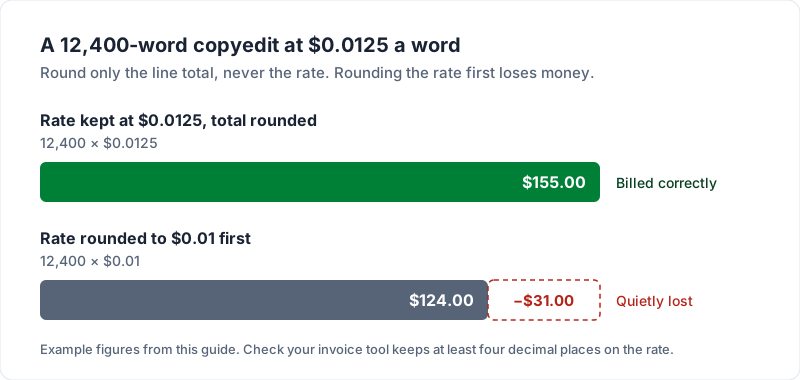
Editor invoices follow the same rule. Name the kind of edit, because developmental editing, copyediting and proofreading are different jobs at different rates. Per-word editing rates are often small numbers, such as $0.0125 a word, so check that your invoice tool keeps enough decimal places and rounds only the line total. A 12,400-word copyedit at $0.0125 a word is $155.00, and a tool that rounds the rate to $0.01 first would bill $124.00.
Copywriter invoices usually bill by project or by asset (a landing page, an email sequence, a set of ads). Name each asset, and say which round of revisions the line covers, so a later round can be billed without an argument.
Revision rounds, kill fees and rights lines#
These three items are agreed in the contract or commission. They also belong on the invoice, because the invoice is the document an accounts team actually reads.
Revision rounds. Say how many rounds the fee includes in the line description (“2 revision rounds included”). Bill any extra round as its own line, by the hour or at a flat fee, with the date it was requested. A charge that appears for the first time on the invoice reads as a surprise, so mention the extra round in an email when the client asks for it.
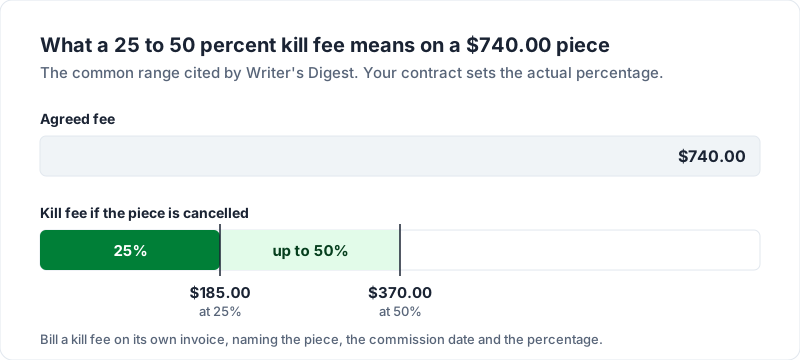
Kill fees. A kill fee is what a client pays when it cancels a commissioned piece and does not use it. Robert Lee Brewer of Writer's Digest puts the most common range he has seen at 25 to 50 percent of the original fee, and the Association of Health Care Journalists gives the same range. The percentage that applies to you is whatever your contract says. Invoice a kill fee on its own invoice, named plainly:
Kill fee, “The last ferry to Arran”, commissioned 2 Oct 2026, cancelled 20 Oct 2026. 25% of agreed fee of $740.00, per the commission dated 2 Oct 2026.
Rights and usage. Put the rights in writing in the commission or contract, and use the invoice to repeat them, not to set them. Who owns a piece, and what a work-for-hire or rights clause does, are legal questions. For US readers, the Copyright Office's Circular 1, Copyright Basics (revised September 2021) says, as of 23 October 2026: “The copyright in a work initially belongs to the author(s) who created that work.” It also warns that “The concept of work made for hire can be complicated and has serious consequences for both the individual who creates the work and the hiring party who is considered to be the author and copyright owner of the work.” If your contract uses that label, read it, and ask a lawyer, before you describe the rights on an invoice.
A short usage line in the invoice notes keeps both sides aligned:
Fee covers first North American serial rights in print and online for 90 days, as set out in the commission dated 2 Oct 2026. All other rights remain with the author.
Copyright and contract law differ between countries and change. If a contract asks you to assign all rights, that is worth one conversation with a lawyer or a writers' organisation before you sign.
Billing expenses#
Writers have fewer expenses than most trades, but they do come up: interview transcription, travel to a location, image licences the client asked you to source, paywalled research. Three habits keep them from becoming a dispute.
- Agree them first. An email saying “travel to Leeds, up to $120.00, billed at cost” is enough.
- One line each, at cost. “Transcription, 2 interviews, receipt attached” rather than “Expenses”.
- Attach the receipts. An accounts team will ask for them anyway.
How expenses are treated for tax depends on where you and your client are; check with an accountant or your tax authority.
Invoicing agencies and publications#
Larger clients pay through an accounts payable process, and the invoice is only one part of it. Before your first freelance writer invoice to a new publication or agency, ask the commissioning editor these five questions:
- Who should the invoice be addressed to, and to which email address or portal does it go?
- Is there a purchase order or assignment number I should quote?
- Do you need any forms first? In the US that usually means a Form W-9. The IRS says: “Use Form W-9 to provide your correct Taxpayer Identification Number (TIN) to the person who is required to file an information return with the IRS” (as of 23 October 2026). Other countries have their own equivalents.
- Do you pay on acceptance or on publication? Writer's Digest names both as common terms. On publication can mean a long wait, because the run date depends on the editorial calendar.
- What are your payment terms, and on which days do you run payments?
Some clients ask suppliers to register in a vendor portal, or pay freelancers through a third-party invoicing company, instead of taking invoices by email. Read the terms when you register, including any processing fee taken from your payment. If a portal or payment service charges you a fee, that is a cost to raise when you agree the rate, not after the work is done.
When an editorial client pays late#
Before you assume the client will not pay, look for a process problem: an invoice sent to the editor instead of accounts, a missing PO number, a run date that slipped. Check the basics first, then follow up.
- Write to the right person. Accounts for the payment, the editor for anything about the piece. Copy the editor on the first reminder if accounts has gone quiet.
- Quote the invoice number, amount and due date in the subject line, and attach the invoice again.
- Keep it factual. The overdue invoice email, step by step has wording for each stage.
Some places have rules on paying freelancers. Two official pages, quoted as of 23 October 2026: New York City's Department of Consumer and Worker Protection says “New York City’s Freelance Isn’t Free Act, the first law of its kind in the country, gives freelance workers the right to a written contract, timely payment, and freedom from retaliation.” In the UK, GOV.UK's page on late commercial payments says: “If you do not agree a payment date, the law says the payment is late 30 days after either:” the customer gets the invoice, or “you deliver the goods or provide the service (if this is later)”. These rules differ by country, state and city and change over time, so read the official page for where you and the client are, or ask a lawyer, before you rely on one. For setting terms in the first place, see invoice payment terms, in plain English.
A worked freelance writer invoice#
Here is a complete example with illustrative numbers. The writer, client and rates are invented.
Invoice 2026-031 from Ada Brennan, freelance writer, to Coast Monthly Ltd, Accounts Payable. Issued 21 October 2026, due 20 November 2026 (Net 30). PO 88412. Commissioning editor: R. Osei.
| Description | Qty | Unit | Rate | Amount |
|---|---|---|---|---|
| Feature article, “The last ferry to Arran”, commissioned 2 Oct 2026, 2 revision rounds included | 1,850 | words | $0.40 | $740.00 |
| Sidebar, “Five crossings worth the wait”, flat fee | 1 | piece | $150.00 | $150.00 |
| Third revision round, requested 16 Oct 2026 | 1.5 | hours | $60.00 | $90.00 |
| Interview transcription, 2 interviews, at cost, receipt attached | 1 | item | $36.50 | $36.50 |
| Total due (USD) | $1,016.50 |
Notes on the invoice: “Fee covers first North American serial rights in print and online for 90 days, per the commission dated 2 Oct 2026. All other rights remain with the author. Payment by bank transfer; please quote 2026-031.”
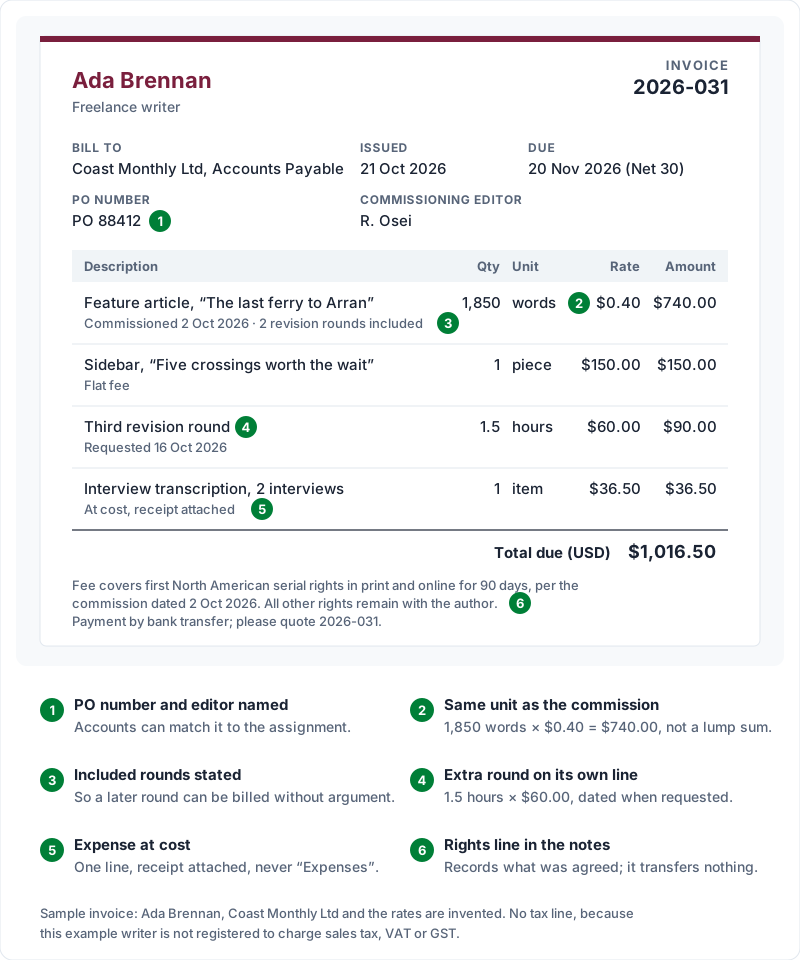
There is no tax line because this example writer is not registered to charge sales tax, VAT or GST. If you are registered, check your tax authority's guidance on what the tax line shows.
Doing this in Charming Invoices. On a new invoice, “Start from a kit” offers a “Freelance writing” kit that inserts one line, “Article — per word/piece”, with the price left at 0.00 on purpose so you type your own rate. The unit price accepts up to four decimal places and the line total uses the full rate, so 12,400 words at $0.0125 a word come to $155.00. The rate column on the PDF and the client's page rounds to the cent, though, so it shows $0.01: put the exact rate in the line description, such as “Copyedit, 12,400 words at $0.0125 a word”. A Unit column, hidden by default, can be switched on in your template so “words” prints next to the count, and the PO number has its own field in the header. The catches: Charming does not take card payments, you record payments and mark it paid yourself, it does not submit invoices to a client's vendor portal, and invoices on the free plan print a small “Sent with Charming Invoices” line in the footer.
What this guide does not settle#
An invoice describes an agreement; it cannot fix a weak one. Rates, word-count rules, kill fees and rights are settled in the commission or contract before you write a word. If they are missing, the fix is a clearer contract for the next piece, not a longer invoice for this one.
If you want to send the example above with your own name on it, create a free invoice and start from the writing kit.