Translator invoice template, with 3 filled-in samples

Nnabuike Okoroafor ·
On this page · 11 sections
Most invoices count one thing. A translator invoice template has to cope with several: source words or target words, pages for a certified document, weighted words from a translation-memory analysis, hours and half-days for interpreting. When the client counts the job one way and you count it another, the invoice is where the argument starts.
This post gives you the free files, the fields a translation invoice needs, and three filled-in samples with numbers that add up: a certified translation for a private client, an agency job billed on a weighted word count, and an interpreting half-day. It also explains what “certified” adds to the invoice, quoting the official and professional sources rather than guessing.
General information, not legal or tax advice. Where a rule is mentioned, we quote and link the official page; ask an accountant or lawyer about your own situation.
Free translator invoice template: which file to use#
Our free templates page has Excel and Word invoice templates, with no sign-up. None is translation-specific; the samples below show how each one fits.
| File | Calculates? | Best for |
|---|---|---|
| invoice-template.xlsx (Excel) | Yes: line amounts, tax, total, balance due, due date | Per-word and per-page jobs, weighted word counts, mixed lines |
| hourly-invoice-template.xlsx (Excel) | Yes, plus a Total hours cell | Interpreting or editing billed purely by the hour |
| invoice-template.docx (Word) | No, you type every total | A one-page certified job with three or four lines |
| service-invoice-template.docx (Word) | No, you type every total | A job with a description-of-work box and a “Less deposit paid” line |
One catch for per-word rates in the Excel files. The Rate column is formatted to 2 decimals, so a rate of 0.115 displays as 0.12. The Amount formula still uses the real value (quantity times rate, rounded to the cent), so the total is right, but the client sees a rate that does not match. Widen the decimals on the Rate column, or bill per 1,000 words instead (see below).
Our guides to the Excel invoice template with formulas and the free Word invoice template cover each file in more detail.
What a translation invoice should show#
Every invoice needs your details, the client's, an invoice number, dates, totals and how to pay; the field-by-field invoice checklist covers those. A translation invoice adds the details below, which are the ones a project manager or a private client will check first.
| Field | Example wording | Why it matters |
|---|---|---|
| Language pair | “Spanish to English” | The rate usually depends on it |
| Document or project | “User manual, v3.2, 46 pages” | The client matches the invoice to the job |
| Unit and count | “3,140 source words” or “3 pages” | Says which count you billed on |
| Rate | “0.12 per word” or “38.00 per page” | Per word, per page, per hour or per document |
| Minimum charge | “Per-document minimum” | Short documents cost the same set-up time |
| Rush | “48-hour turnaround, 25%” | A surcharge shown as its own line |
| Certification and copies | “Signed certification statement”, “Printed copies, posted” | Separate deliverables, priced separately |
| Formatting / DTP | “Formatting, 2 hours” | Layout work outside the word count |
| Client reference | “PO PRJ-2291” | Agencies often need it to approve payment |
| Due date and payment details | “Due 2 Dec 2026”, IBAN or payment link | The question every unpaid invoice comes back to |
Agencies usually ask for more references and supplier details than private clients do. Our guide on how to invoice a company covers purchase orders, accounts-payable inboxes and what gets an invoice approved.
Per word, per page, per hour or a minimum fee#
Per word. The most common unit for document translation. The question is which word count. The source count is known before you start, so you can quote it and invoice it exactly. The target count is only known once you deliver, and it will differ from the source, sometimes by a lot depending on the language pair. Neither is “right”; agree the count in your quote and name it on every line (“3,140 source words”), so nobody has to ask.
Per page. Common for certified documents such as birth certificates, diplomas and transcripts, where the word count is small but the layout, stamps and handwriting take time. Say what a page means if you use it (a source page, or a set number of words).
Per hour. Interpreting, editing, proofreading, terminology work and formatting usually go by the hour. Our guide on how consultants structure an invoice covers hourly lines, rounding and timesheets.
A minimum fee. A one-page document still needs a quote, a file check, a review and an invoice. Many translators set a minimum per job or per document. Show it as a line called what it is (“per-document minimum”), not as an unexplained round number.
Fractions of a cent. If your rate is 0.115 per word, round nothing until the line total, and make sure the template prints the rate you agreed. The freelance writer invoice, line by line shows how rounding a per-word rate too early under-bills. One clean fix: quote per 1,000 words. A rate of 0.115 per word is 115.00 per 1,000 words, and 3,140 words becomes a quantity of 3.14. The line total is the same (361.10 either way) and the printed rate matches the agreed one exactly.
Sample 1: certified translation for a private client#
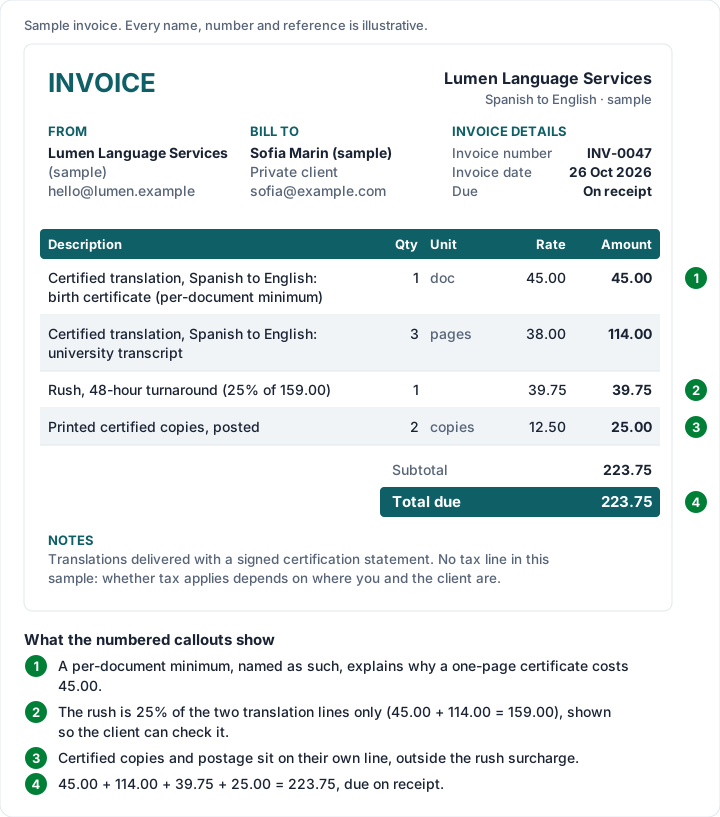
An invented translator, Lumen Language Services, translated a birth certificate and a three-page university transcript from Spanish into English for a private individual, with a 48-hour turnaround and two printed certified copies sent by post. Delivered and invoiced on Monday 26 October 2026, due on receipt.
| Description | Qty | Unit | Rate | Amount |
|---|---|---|---|---|
| Certified translation, Spanish to English: birth certificate (per-document minimum) | 1 | doc | 45.00 | 45.00 |
| Certified translation, Spanish to English: university transcript | 3 | pages | 38.00 | 114.00 |
| Rush, 48-hour turnaround (25% of 159.00) | 1 | 39.75 | 39.75 | |
| Printed certified copies, posted | 2 | copies | 12.50 | 25.00 |
| Total due | 223.75 |
The arithmetic, checked: 3 × 38.00 = 114.00; 45.00 + 114.00 = 159.00; 25% of 159.00 = 39.75; 2 × 12.50 = 25.00; 159.00 + 39.75 + 25.00 = 223.75. There is no tax line: whether tax applies depends on where you and the client are, and rules vary. All names, prices and the 25% rush rate are illustrative, not a rate guide.
Three details worth copying:
- The language pair on every translation line. The client may file this invoice with an application; the line itself says what was translated and into what.
- The rush as a percentage of named lines. “25% of 159.00” lets the client check it, and makes clear the copies were not surcharged.
- Copies and postage as their own line. If the client asks for a third copy later, you add one line, not a new negotiation.
Private clients you have not worked with before often pay before delivery. If you take payment up front for part or all of the job, our guide to deposit and balance invoices shows how the final invoice credits what was paid.
Sample 2: agency job on a weighted word count#
Agencies often send a CAT-tool analysis with the purchase order: the words are split into bands by how closely they match the agency's translation memory, and each band is billed at a percentage of the full rate. The template pages we read for this post name these bands, but none showed one with numbers. Here is one.
The same invented translator billed an invented localisation agency in euros for a German-to-English user manual. Invoice dated Monday 2 November 2026, 30-day terms, due Wednesday 2 December 2026, reference PO PRJ-2291 (illustrative).
| Description | Qty | Unit | Rate (EUR) | Amount (EUR) |
|---|---|---|---|---|
| German to English, user manual: new words | 3,140 | words | 0.12 | 376.80 |
| Fuzzy matches 75–99% (billed at 50%) | 1,020 | words | 0.06 | 61.20 |
| 100% matches and repetitions (billed at 25%) | 800 | words | 0.03 | 24.00 |
| Formatting / DTP | 2 | hrs | 40.00 | 80.00 |
| Total | 542.00 |
The arithmetic, checked: 3,140 × 0.12 = 376.80; 1,020 × 0.06 = 61.20; 800 × 0.03 = 24.00; 2 × 40.00 = 80.00; 376.80 + 61.20 + 24.00 + 80.00 = 542.00. The source text had 4,960 words in all (3,140 + 1,020 + 800). Billed at the full 0.12 with no matches discounted, the words alone would come to 595.20; weighted, they come to 462.00, a difference of 133.20.
The 50% and 25% bands are this sample's agreed figures, not a standard. Every agency has its own grid, and some translators do not accept match discounts at all. Whatever you agree, put the bands on the invoice exactly as they appear in the client's analysis, so their project manager can tick each line against it.
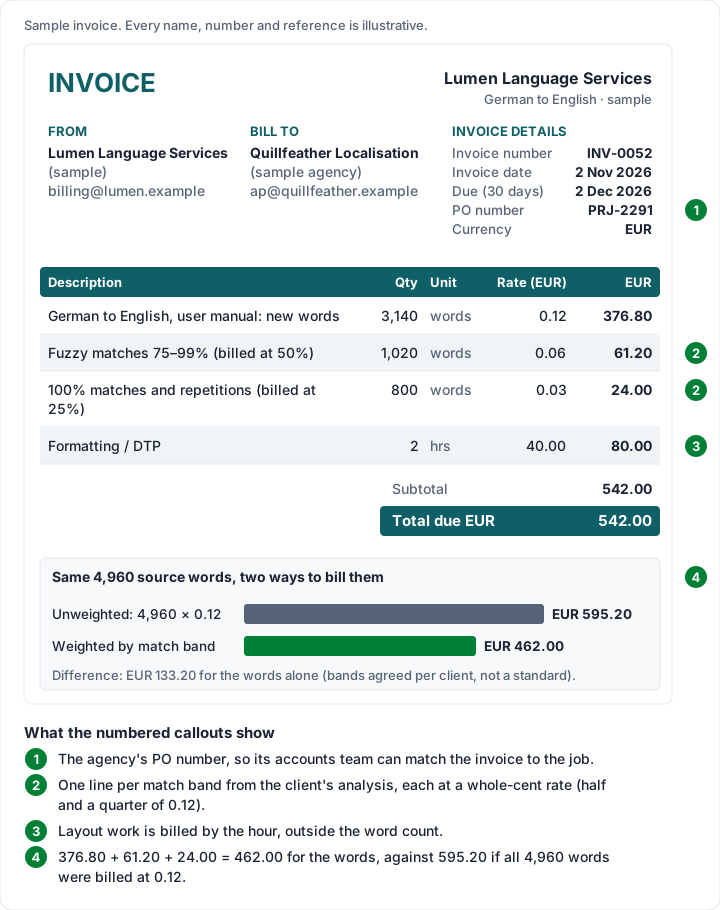
The rates here are whole cents on purpose: 0.06 and 0.03 print exactly. If your grid gives a rate like 0.084, either bill that band per 1,000 words (84.00 per 1,000) or check that your template shows the extra decimals.
Sample 3: interpreting half-day#
Interpreting is a different invoice from translation. There is no word count; there is a booking, a minimum, time over the minimum, travel and expenses. Bolting “interpreter” onto a per-word template does not fit.
An invented interpreter provided consecutive Portuguese/English interpreting at a meeting for an invented company on Tuesday 17 November 2026. The meeting ran half an hour over the 3-hour half-day. Invoice dated Thursday 19 November 2026, 15-day terms, due Friday 4 December 2026.
| Description | Qty | Unit | Rate | Amount |
|---|---|---|---|---|
| Consecutive interpreting, Portuguese/English, half-day (up to 3 hours), 17 Nov 2026 | 1 | half-day | 240.00 | 240.00 |
| Additional time beyond 3 hours | 0.5 | hrs | 85.00 | 42.50 |
| Travel time | 0.5 | hrs | 85.00 | 42.50 |
| Parking (receipt attached) | 1 | 18.00 | 18.00 | |
| Total | 343.00 |
The arithmetic, checked: 0.5 × 85.00 = 42.50 (twice); 240.00 + 42.50 + 42.50 + 18.00 = 343.00. Names and rates are illustrative.
A few things that keep an interpreting invoice from being queried:
- Name the mode and the language pair. Consecutive, simultaneous, remote or on site, and in which languages.
- State the minimum in the line itself. “Half-day (up to 3 hours)” explains why a 2-hour meeting is billed at 240.00.
- Keep extra time and travel apart. Both are hours, but they answer different questions from the client.
- Expenses at cost, with the receipt. Say “receipt attached” and attach it.
Cancellations. Many interpreters charge a cancellation fee agreed in their booking terms when an assignment is cancelled at short notice. That is a plain business term: if you use one, put the amount or percentage and the notice period in the booking confirmation, and invoice it on its own line, quoting that confirmation. Whether a particular fee can be enforced is a question for a lawyer where you work.
What “certified translation” means on the invoice#
A certified translation is a translation plus a signed statement. On an invoice that statement is a separate deliverable, which is why sample 1 prices the certified documents differently from ordinary per-word work. Here is what the official and professional sources say, as of 28 October 2026.
For documents submitted to US immigration authorities, the rule is in the Code of Federal Regulations, 8 CFR 103.2(b)(3), “Translations.” (read on eCFR, which showed the text as up to date as of 26 October 2026):
Any document containing foreign language submitted to USCIS shall be accompanied by a full English language translation which the translator has certified as complete and accurate, and by the translator's certification that he or she is competent to translate from the foreign language into English.
The American Translators Association explains the practice on its page What is a certified translation?, under “What are the basics of a certified translation?”:
In the United States, anyone can certify a translation. A translator does not need to be certified in order to provide a certified translation.
On notarisation, the same page says, under “What is the difference between a certified translation and a notarized translation?”:
A notary public only legally acknowledges, or notarizes, the identity of the individual signing the certification statement.
For the invoice, that means three things you can show plainly: the translation, the signed certification statement, and any notarisation or printed copies, each on its own line if you price them separately. Whether a particular document needs certification, notarisation or anything else depends on who will receive it. That is the end user's requirement to check, not something to promise on an invoice.
Invoicing translation clients in other countries#
Translators bill across borders more than most freelancers. Four things to settle before the first invoice:
- Currency. Agree it in the quote. Sample 2 is in euros because the agency pays in euros; invoicing in your own currency is the other option. Whoever invoices or pays in a currency that is not their own carries the exchange-rate risk.
- Language. Some clients ask for an invoice in their language, or in two. Our guide to customizing an invoice covers relabelling the invoice and what tax guidance says about invoice language.
- Payment details. International clients need the full bank details (IBAN, SWIFT/BIC) or a payment link that accepts their currency. Our guide to invoice payment methods compares the options.
- VAT and tax. Whether you charge VAT, use the reverse charge or need to show a tax number depends on where you and the client are. Rules vary, so read the official guidance (in the UK, HMRC's VAT place of supply of services notice; in the EU, the European Commission's VAT invoicing rules) and ask an accountant. Our VAT invoice guide lists the fields a VAT invoice carries.
If a client pays late, the late fee wording for your invoice guide covers stating terms up front.
Translator invoices in Charming#
We make Charming Invoices, so here is what it does for translators and interpreters, with the limits next to each feature.
- A Unit column that prints “words”, “pages”, “hrs” or “half-day” beside the quantity (up to 20 characters). It is hidden by default; turn it on in the template.
- Sections with subtotals. Give each line a section such as “Translation” or “Certification and copies” and turn on “Group lines by section”. Off by default.
- Quantities to 3 decimals and rates to 4. Every line total is rounded to the cent once. The catch: the PDF and the client's private-link page print the rate at 2 decimals, so 0.115 shows as 0.12 even though the line total uses 0.115. Use whole-cent rates, or quote per 1,000 words as above, so the printed rate matches the one you agreed.
- 16 currencies, including USD, EUR, GBP, CAD and CHF. Each business has one currency at a time, and every new invoice uses it. On the free plan you can switch the currency before creating an invoice and switch back after issuing it; for clients billed in dollars and euros every month, a second business on a paid plan is tidier. See billing a client in another currency.
- Labels you can rename (up to 60 characters), for example “PO number” to “Project ref”. The labels apply to the whole business, not one invoice.
- A deposit line. Enter money already received and the invoice credits it as “Deposit received” and shows the amount due.
- A PDF and a private link your client opens without an account, with your bank details and a payment link of your own. Issue the invoice and send it however you like; overdue invoices are flagged. Charming does not send reminders; set a calendar reminder or use your own email.
The limits: Charming does not take card payments; clients pay you directly, and you record payments or mark the invoice paid yourself. It does not import word counts from CAT tools, deliver files or add certification stamps or signatures; your CAT tool and your own certification statement stay where they are. There is no translator starter kit, so you type your own lines (a saved line-item library is on paid plans). The free plan is $0 forever with no invoice limit, and its invoices carry a small “Sent with Charming Invoices” line; paid plans hide it by default. Individual is $29 once, Team $79 once and Pro $12 a month or $99 a year; the lifetime plans are final sale. See the pricing page for the details, browse the 60 invoice templates, or create a free invoice and try sample 2 with your own analysis.
Questions about translator invoices#
What should a translator invoice include?#
Your details and the client's, an invoice number, the invoice and due dates, the language pair, the document or project name, the unit and count you billed on (source words, target words, pages or hours), the rate, any minimum, rush, certification, formatting and expenses on their own lines, the client's reference, the total and how to pay you.
Should I bill on source words or target words?#
Either works if it is agreed in advance. The source count is known before you start, so it can be quoted and invoiced exactly; the target count is only known after delivery. Name the count on every line so the client can check it.
How do I show CAT-tool discounts on an invoice?#
One line per match band (new words, fuzzy matches, 100% matches and repetitions), each with its own word count and rate, using the same bands and counts as the analysis the client sent. Sample 2 above shows one.
Can I charge a minimum fee for translation?#
Many translators do, per job or per document, because a short text still needs a quote, a check and an invoice. Put it in your quote and show it on the invoice as a named line, as in sample 1.
Do interpreters invoice differently from translators?#
Usually, yes. Interpreting is billed by the hour, half-day or day, with a minimum, time over the minimum, travel and expenses as separate lines. The hourly Excel template suits pure hourly work; the general one suits a half-day fee plus extras, as in sample 3.
Is a certified translation the same as a notarised one?#
No. The American Translators Association says a notary only acknowledges the identity of the person signing the certification statement. Check what the end user requires, and price any notarisation as its own line.
The short version#
Use the Excel template if you want the totals worked out, and widen the rate decimals or quote per 1,000 words for fractional rates. Name the language pair and the count you billed on in every line, put rush, certification, copies and formatting on their own lines, and copy the client's match bands exactly on agency jobs. For certification, quote the requirement rather than promise it, and for tax across borders, read the official page and ask an accountant.