Musician invoice template, with gig and session samples

Nnabuike Okoroafor ·
On this page · 9 sections
The gig is booked, the deposit is in, and now someone at the venue or the event company wants “an invoice for the balance”. Or you played bass on four tracks last Tuesday and the artist has asked you to send something over. Either way, you need a musician invoice template that fits the work, with lines for sets, sessions and the deposit.
This page gives you free Word and Excel files that suit musicians, and two musician invoice examples filled in with numbers that add up: a band's balance invoice for a corporate event, billed by the bandleader with the deposit credited, and a session player's invoice billed per track. It also covers how a band bills without splitting the invoice, and the deposit, cancellation and overtime wording that saves arguments later. If you are new to invoicing in general, start with how to invoice as a freelancer.
DJs have their own page: the DJ invoice sample covers DJ bookings, with its own sample and starter lines. Visual artists have one too: the artist invoice template covers commissions and art sales. For the rest of an event booking, see the event planner invoice template and a catering invoice, line by line.
General information, not legal or tax advice. Where tax, contracts or rights come up, we say so and point you to an accountant or lawyer.
Free musician invoice template: which file to use#
The free templates page has Excel and Word invoice templates, with no sign-up and no email address. None is music-specific, but each suits a kind of music work:
| Your music work | Best file | Why |
|---|---|---|
| A gig with several parts: band, PA, travel, deposit | invoice-template.xlsx (Excel) | 15 lines that calculate, an Amount paid line for the deposit and a Balance due |
| Session work billed per track or per hour | invoice-template.xlsx or hourly-invoice-template.xlsx | Per-track lines in the first; a Date column and a Total hours line in the second |
| A single one-off performance at one fee | service-invoice-template.docx (Word) | A “Description of work” box for the date, venue and set times |
| A simple invoice you want to edit freely | invoice-template.docx (Word) | A plain layout you can retitle and reorder |
The Excel files calculate each line, the totals and the balance due. The Word files do not, so add up the totals yourself and check them twice. Our guides to the free Word invoice template and the Excel invoice template with formulas walk through each file.
What a musician invoice should include#
A musician invoice has the same core as any invoice; the field-by-field invoice checklist covers every field. These are the parts that matter most for music work:
| Field | What to write | Why it matters |
|---|---|---|
| Who is billing | Your name, or the band's name and the bandleader as contact | The client pays whoever is on the invoice |
| Client | The person or company that booked you, with a billing address | A venue's events team and its accounts team are often different people |
| Event or session | Date, venue or studio, set times or session hours | Ties the invoice to the booking |
| Performance lines | Musicians × fee, number and length of sets | The core of the price, in terms the client agreed |
| Production | PA, lights, sound engineer, backline | Separate lines, so the client sees what the fee covers |
| Extras | Learning requested songs, a second instrument, cartage | Things the client asked for on top of the standard set |
| Travel | Vehicles, mileage or a fixed travel fee | Only if it was in the quote |
| Deposit and balance | Deposit paid (with date) credited, balance due date | The client sees what is left to pay |
| Payment details | Bank details or a payment link | What payment methods to offer on an invoice covers the choices |
| Terms | Balance date, cancellation and overtime, as in your booking agreement | Puts the agreed terms where the payer will read them |
Gig invoices vs session invoices#
“Musician invoice” covers two quite different jobs, and they are billed differently.
| Live gig | Session work | |
|---|---|---|
| Who you bill | An event client, venue, agency or couple | An artist, producer or label |
| When you bill | Deposit at booking, balance before or after the event | After the session, or when files are delivered |
| How it is priced | Per musician, per set or a package fee | Per track, per hour or per day |
| Typical extras | PA and lights, learning requests, travel, overtime | Second instrument, remote overdubs, cartage |
| What to add in the notes | Balance date, cancellation, overtime | Tracks covered, credits and any royalty share as agreed in writing |
Musician invoice example 1: band balance for an event#
The Harbour Lights Band (sample band) is booked for a company's end-of-year party. The bandleader quoted 3,120.00, the client accepted, and a 25% booking deposit of 780.00 was paid on Friday 16 October 2026. The event is on Friday 4 December 2026. The balance invoice goes out on Friday 20 November 2026, due on Tuesday 1 December 2026, three days before the event.
Every name, number and fee below is invented and illustrative. No tax line is shown; that is an example, not a tax position.
- Invoice: HLB-2026-031, dated Friday 20 November 2026, due Tuesday 1 December 2026
- From: The Harbour Lights Band (sample), invoiced by the bandleader
- To: Corran Logistics Ltd (sample client), attention events team
- Booking ref: End-of-year party, Fri 4 Dec 2026
| Section and description | Qty | Unit | Rate | Amount |
|---|---|---|---|---|
| Performance | ||||
| Four-piece band, 3 × 45-minute sets, 7:00 pm to 10:30 pm, Fri 4 Dec 2026 | 4 | musicians | 550.00 | 2,200.00 |
| Cocktail hour, solo acoustic guitar, 6:00 pm to 7:00 pm | 1 | 300.00 | 300.00 | |
| Production | ||||
| PA and stage lighting, with sound engineer | 1 | 350.00 | 350.00 | |
| Learn and arrange requested songs | 2 | songs | 75.00 | 150.00 |
| Travel | ||||
| Travel, two vehicles, round trip | 2 | vehicles | 60.00 | 120.00 |
| Subtotal | 3,120.00 | |||
| Less booking deposit paid 16 Oct 2026 | −780.00 | |||
| Balance due by Tue 1 Dec 2026 | 2,340.00 |
The arithmetic: 4 × 550.00 = 2,200.00 for the band, plus 300.00 for the cocktail hour, 350.00 for production, 2 × 75.00 = 150.00 for the learned songs and 2 × 60.00 = 120.00 for travel, comes to 3,120.00, the quoted price. Less the 780.00 deposit (25% of 3,120.00), the balance is 2,340.00. Grouped by section, the subtotals are 2,500.00 for performance, 500.00 for production and 120.00 for travel.
The terms on this sample read: “Booking deposit credited above, as set out in our booking agreement. Overtime on the night, if requested, is billed after the event at the rate in the agreement.” That is example wording; use the terms you actually agreed.
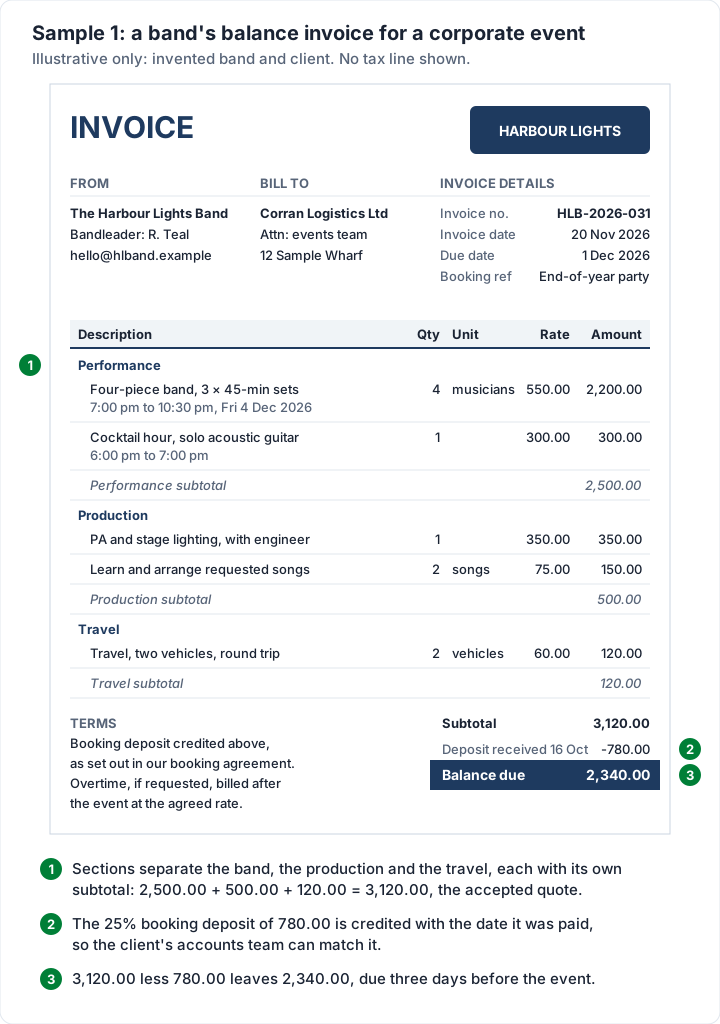
Why this layout works for a corporate client:
- The quoted price appears in full. The subtotal matches the accepted quote, so the events team can approve it at a glance.
- The deposit is dated. Accounts can match it to the payment they already made.
- Sections separate the band from the production. If the client asks what the 3,120.00 covers, the invoice already answers. How the deposit shows on the final invoice explains the deposit mechanics in more detail, and how to invoice a company covers billing a business's accounts team.
Billing as a band: one invoice, then pay the players#
A band usually sends the client one invoice, from the band or the bandleader, for the whole booking. The client has one supplier to pay, as in Sample 1, where the four musicians are a quantity, not four separate invoices.
Paying the other players is a separate step. One way to do it: each player who is not part of the business sends the bandleader their own invoice for their fee, and the leader pays them from the client's payment. A player invoicing a bandleader can use the same session-style invoice as Sample 2 below, with one line for the gig.
Two things to settle before the money moves:
- Whether each player is a contractor or an employee. That is a tax question, not an invoicing one. The IRS has a page on independent contractor or employee status for US businesses; rules elsewhere differ. Ask an accountant.
- Tax forms for the people you pay. Which forms apply, if any, depends on where you are, and rules vary; ask an accountant what applies to your band. For the invoice a US contractor sends, see our 1099 contractor invoice guide.
Musician invoice example 2: session player, per track#
A session bassist (sample) plays on four tracks of an independent artist's EP at a studio session on Tuesday 20 October 2026, adds upright bass on one of them, and records a remote overdub for a fifth track at home. The invoice is dated Friday 23 October 2026 and due on Friday 6 November 2026 (14 days).
Every name and fee below is invented and illustrative.
- Invoice: MQ-0058, dated Friday 23 October 2026, due Friday 6 November 2026
- From: Mara Quill (sample session bassist)
- To: Juno Vale (sample independent artist)
| Description | Qty | Unit | Rate | Amount |
|---|---|---|---|---|
| Electric bass, studio session Tue 20 Oct 2026, EP tracks 1 to 4 (titles listed) | 4 | tracks | 125.00 | 500.00 |
| Second instrument: upright bass on track 3 | 1 | 60.00 | 60.00 | |
| Remote overdub, track 5, recorded at home studio, WAV stems delivered | 1 | track | 150.00 | 150.00 |
| Cartage: upright bass transport to and from the studio | 1 | 40.00 | 40.00 | |
| Total due | 750.00 |
The arithmetic: 4 × 125.00 = 500.00, plus 60.00, 150.00 and 40.00, comes to 750.00.
The notes on this sample read: “Fee covers performance on the tracks listed. Credits and any royalty share are as agreed in writing on 14 Oct 2026.” The invoice records the fee; it does not decide who owns the recording, and it should not try to. Who owns a recording, and any royalty, licence or credit, is set by your written agreement, and the rules vary by country. Ask a music lawyer or an accountant before you sign anything about rights.
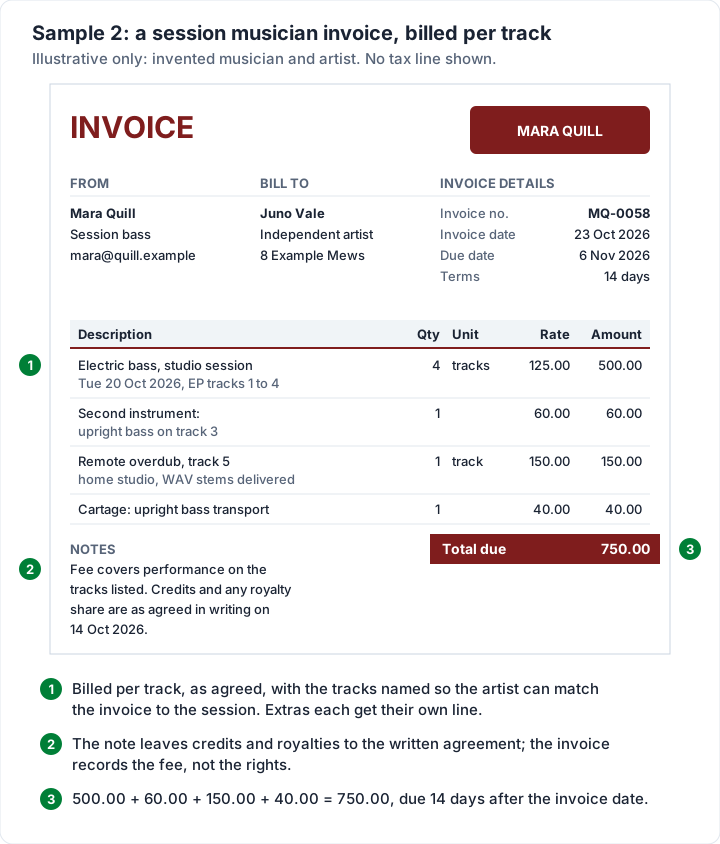
A few habits that make session invoices easy to pay:
- Name the tracks. The artist or producer matches the invoice to the session log.
- Per track or per hour, as agreed. If you quoted per track, bill per track. If you quoted a day rate, use one line with the date.
- Extras on their own lines. A second instrument, a remote overdub or cartage reads as part of the agreement, not a surprise, when each is named.
Union sessions have their own agreements and paperwork. If you are booked for union recording work, the American Federation of Musicians' recording and digital media page is the place to start; follow what the session's paperwork requires, not a template.
Deposits, cancellations and overtime#
These three cause most of the arguments after a gig, and the fix is the same each time: agree it in writing before the event, then repeat it on the invoice.
- Deposits. State the deposit amount and when the balance is due in your booking agreement. On the balance invoice, show the full booking, the deposit with its date and the balance, as in Sample 1. Whether a deposit is refundable is whatever your booking agreement says.
- Cancellations. Write your cancellation terms into the booking agreement (for example, what is owed if the client cancels within a set number of days of the event) and refer to them in the invoice terms. If a booking is cancelled, invoice what the agreement says is owed, with a line that names the clause.
- Overtime. Agree an overtime rate per half hour or hour in advance, and bill any overtime on a short follow-up invoice after the event, with the date and the extra time on the line.
If a balance is late, a late fee only works if it was in the agreement first; late fee wording for your invoice covers how to word it.
Musician invoices in Charming Invoices#
If you play regularly, rebuilding a spreadsheet for every gig gets slow. Here is what Charming Invoices does for musicians, checked in the code:
- Unlimited invoices and clients on the free plan, with no card and no expiry. The free plan covers 1 business.
- Sections, units and subtotals. Each line can carry a unit (“musicians”, “tracks”, “songs”) and a section (“Performance”, “Production”, “Travel”). Turn on “Group lines by section” in the Template Studio and each section prints with its own subtotal, as in Sample 1. The unit column and grouping are off on most templates until you switch them on.
- Deposit credited on the balance invoice. Enter the deposit you already received and the invoice shows the full booking, a “Deposit received” line and the balance. You type the amount; Charming does not collect it.
- Terms on every invoice, up to 5,000 characters, for your balance date, cancellation and overtime wording. The wording is yours.
- Rename “PO number” to “Booking ref” or “Event”, with up to 100 characters per invoice. The label change applies to every invoice that business issues.
- A DJ starter kit with performance, travel and overtime lines at 0.00, which a band can rename. On a new invoice with no lines, choose “Start from a kit”.
- 60 templates on every plan, a PDF to download and a private link your client opens without an account, which you send however you like, a note when they have viewed it, and overdue invoices flagged once the due date passes.
On the paid plans you can also set up recurring invoices for a weekly residency (each one arrives as a draft for you to review and issue, never sent automatically) and run more than 1 business, for example a band and your solo work. Recurring invoices vs subscriptions explains how recurring billing works.
The catches, plainly:
- No card payments through Charming. Your bank details or one payment link of your own print on the invoice, the client pays you directly, and you record the payment (part-payments are allowed) and mark it paid.
- No booking calendar, contracts or e-signature. Use a booking tool or a client-management app for contracts; Charming handles the invoices.
- No email sending or reminders. You send the PDF or link yourself and follow up from your own inbox.
- No splitting payments to band members and no royalty tracking. Players invoice the bandleader separately, as above.
- Free invoices carry a small “Sent with Charming Invoices” line in the footer. Paid plans hide it by default: Individual is $29 once, Team $79 once and Pro $12 a month or $99 a year. The lifetime plans are final sale; the pricing page has the details.
Create a free invoice and rebuild Sample 1 with your next booking, or browse the invoice templates first.
Musician invoice questions#
What should a musician invoice include?#
Your details (or the band's), the client, a unique invoice number, the invoice date, the event or session date and venue, each part of the work on its own line with its fee, any deposit already paid, the balance and its due date, how to pay, and your terms.
Should I invoice before or after the gig?#
Either works. You can invoice a deposit at booking and the balance shortly before the event, as in Sample 1, or invoice the full fee after the gig. Session work can be invoiced after the session or on delivery of the files. Whatever you choose, put it in the booking agreement.
How does a band invoice a client?#
One invoice from the band or bandleader for the whole booking, with the musicians as a quantity. Each player who is paid by the leader then invoices the leader for their own fee.
Do I charge sales tax on a performance?#
It depends where you are and where you perform; rules vary by country and state. Ask an accountant before adding or leaving out a tax line.
What if I teach music lessons?#
Lesson billing works differently: per lesson or per term, often to a parent. See the tutoring invoice, lesson by lesson.
Is there a DJ version?#
Yes. The DJ invoice sample has a DJ booking filled in, and the DJ starter kit in Charming.