The tutoring invoice, lesson by lesson

Nnabuike Okoroafor ·
On this page · 9 sections
Tutoring is billed in small, repeating amounts, and that is exactly why it goes wrong. Four lessons a month, a parent who pays by bank transfer when they remember, a block of ten lessons bought in September that nobody is quite sure how far through you are, and one cancellation at two hours' notice that you are not sure you can charge for. A good tutoring invoice settles all of that on one page.
This guide covers how private tutors, music teachers and other one-to-one teachers should invoice: per lesson or monthly, prepaid blocks and how to show lessons used, cancellation and no-show wording, who the invoice should be addressed to, recurring monthly billing, and tax in general terms. There are two worked examples below, with illustrative numbers.
General information, not legal or tax advice. Where a rule is mentioned, we quote and link the official page; ask an accountant or lawyer about your own situation.

What every tutoring invoice has to show#
The basics are the same as any invoice: the word “Invoice”, your name or business name and contact details, the name of the person paying, a unique invoice number, the issue date, the due date, the lines, the total and how to pay you. The field-by-field invoice checklist has the full list.
Tutoring adds three things that people forget:
- The date of each lesson. “October tutoring” cannot be checked. “Lessons on 6, 13, 20 and 27 October” can, against the parent's own calendar.
- The length and subject. “60 min, GCSE maths” or “30 min piano, grade 3 preparation”. A parent paying for two children, or two subjects, needs to see which line is which.
- The student's name, if it is not the payer. First name is usually enough. The invoice goes to the parent; the line says who was taught.
That first point does the most work. When a parent queries a tutoring invoice, the question is rarely the rate. It is “did that lesson happen?”
Per lesson, monthly or a prepaid block#
Decide the billing rhythm before the wording. Most tutors and teachers use one of four patterns, and each suits a different family.
| Billing rhythm | How it works | Suits | Watch out for |
|---|---|---|---|
| Per lesson | One invoice after each lesson, or payment on the day | Occasional students, exam crams, adult learners | Lots of small invoices; easy to fall behind on sending them |
| Monthly in arrears | One invoice at month end listing every lesson taught | Weekly students with a steady timetable | The total changes with the calendar (four Tuesdays or five) |
| Monthly or termly in advance | A fixed amount before the month or term starts | Music teachers, term-based programmes | Needs a written rule for holidays, illness and missed lessons |
| Prepaid block | The client buys a set number of lessons up front | Families who want a discount or a commitment | You must show lessons used and remaining, every time |
A rough rule: if the number of lessons varies, bill in arrears and list them. If the arrangement is fixed (“weekly piano, autumn term, 12 lessons”), bill the arrangement in advance and keep extras on separate lines.
How you bill also decides how much admin you carry as you grow. One person in a public discussion, a new freelance personal trainer who also bills clients session by session, put it this way:
Previously I used email and a simple invoice, but that got out of hand trying to chase things and keep track as my clients grew.
That is from public online research we read while building this product; the person quoted is not a Charming customer. The fix is usually not more effort each month. It is choosing one rhythm per family and repeating it.
How to show a prepaid block and the lessons used#
A prepaid block is effectively a deposit for future lessons, so the invoice for the block works like any deposit invoice: one line, what it buys, and the conditions.
Wording you can adapt:
- “Block of 10 lessons, 60 min, maths. Valid until 31 March 2027.”
- “10-lesson package at $50.00 per lesson (pay-as-you-go rate $55.00).”
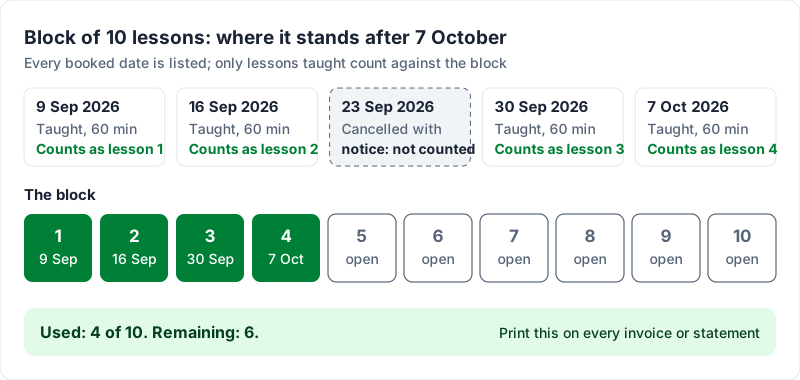
The harder part is afterwards. Each later invoice or statement should show where the block stands, because the parent cannot see your diary. Put a short lesson record on it, with zero-value lines or a table in the notes:
| Lesson | Date | Length | Status |
|---|---|---|---|
| 1 | 9 September 2026 | 60 min | Taught |
| 2 | 16 September 2026 | 60 min | Taught |
| – | 23 September 2026 | 60 min | Cancelled with notice, not counted |
| 3 | 30 September 2026 | 60 min | Taught |
| 4 | 7 October 2026 | 60 min | Taught |
| Used | 4 of 10. Remaining: 6 |
The same record as a tracker: five booked dates, four lessons counted, six left in the block.
Two decisions belong in your terms before the first block is sold, not after:
- Expiry. Whether unused lessons expire, and when. Print the date on the block invoice.
- Refunds. What happens if the student stops halfway. A common approach is to refund unused lessons at the pay-as-you-go rate, so the discount only applies to lessons actually taken. Whatever you choose, write it down. Rules on keeping prepaid money differ by country, so check your local consumer rules before you call a block non-refundable.
Cancellation and no-show policy on the invoice#
This is the delicate part of tutoring invoices: asking to be paid for a lesson that did not happen.
Agree the rule first, then print it. A cancellation fee that appears for the first time on an invoice reads as a penalty, and a parent who never agreed to it has a fair reason to decline. Put the policy in your welcome email or agreement, then repeat it in the invoice notes so it is in front of the payer every month.
Policy wording you can copy and adapt:
- “Lessons cancelled with at least 24 hours' notice are not charged.”
- “Lessons cancelled with less than 24 hours' notice are charged at 50%.”
- “Missed lessons without notice are charged in full.”
- “If the tutor cancels, the lesson is not charged and a make-up lesson is offered.”
A charged cancellation gets its own line with the date and the reason: “Lesson 30 October, cancelled with 3 hours' notice (50%, per lesson policy), $25.00.” A lesson you cancelled gets a line too, at zero: “Lesson 20 October cancelled by tutor, not charged.” The parent was going to notice either way. Showing it first is the honest version. Therapists face the same question; the therapy invoice template shows late cancellation and no-show fees on an invoice.
Invoicing a parent, a student, or a school or agency#
The person in the room is not always the person paying, and a tutoring invoice should be addressed to whoever actually pays.
- A parent or guardian. The most common case. Bill the parent by name, list the student by first name on each line, and send the invoice to the email the parent gave you, not the child's.
- Two parents sharing the cost. If separated parents split lessons, ask how they want it. Two invoices, each for an agreed share, is often clearer than one invoice that two people half-pay.
- An adult student. Bill the student directly. Nothing else changes.
- A school, college or local authority. Expect a purchase order, a supplier form and their payment terms, often Net 30. What a PO number on an invoice does covers why an invoice without one can sit unpaid.
- A tutoring agency. If an agency found the student, read your agreement. Often the agency bills the family and you invoice the agency for hours taught, at the rate it pays you. Do not also invoice the parent.
For terms, families usually pay within a week or two; institutions run on their own cycle. Invoice payment terms, in plain English explains how to choose and count them. If a parent later asks for proof of payment, our free receipt template, in Word or Excel, names the invoice it settles and the balance still due.
Recurring monthly billing without the chaos#
Weekly students make tutoring look like a fixed monthly plan, but each month is slightly different: five Tuesdays instead of four, a half-term week off, one make-up lesson. So the tutoring invoice should repeat, while the lines are checked each time.
- Pick one invoice day. The last school day of the month for arrears, or the 25th of the month before for advance billing. Keep it the same for every family.
- Start from last month's invoice. Same client, same rate, same notes. Change only the dates and any extras.
- List the lessons, not “October”. Dates, length and any cancellations, as above.
- Say whether it is in advance or in arrears. “Billed in advance for November 2026” stops “did I already pay for this?” emails before they start.
- Tell families about rate changes a month ahead. Put the new rate and the date it starts in writing, then note it on the first invoice at the new rate.
If you bill an hourly or retainer-style arrangement for an adult professional, such as language coaching for a company, how to invoice for consulting services is the closer guide.
A sample tutoring invoice with dated lessons#
Here is a tutoring invoice example for one month of weekly maths lessons, billed in arrears to a parent, with one late cancellation and a workbook. The tutor, family and numbers are illustrative examples, not real prices.
- Invoice: INV-0042
- From: Alex Morgan Tutoring
- Billed to: Jordan Ellis (parent of Priya)
- Issued: 30 October 2026. Due: 6 November 2026 (Net 7)
| Description | Qty | Rate | Amount |
|---|---|---|---|
| Maths tuition, 60 min (Priya): 6 October | 1 | $50.00 | $50.00 |
| Maths tuition, 60 min (Priya): 13 October | 1 | $50.00 | $50.00 |
| Maths tuition, 60 min (Priya): 20 October | 1 | $50.00 | $50.00 |
| Maths tuition, 60 min (Priya): 27 October | 1 | $50.00 | $50.00 |
| Extra lesson booked for 30 October, cancelled with 3 hours' notice (50%, per lesson policy) | 1 | $25.00 | $25.00 |
| Practice workbook, as agreed on 6 October | 1 | $14.50 | $14.50 |
| Subtotal | $239.50 | ||
| Total due (USD) | $239.50 |
Notes: Lessons cancelled with at least 24 hours' notice are not charged; less than 24 hours, 50%; no-shows, in full. Please pay by bank transfer to the account below, using INV-0042 as the reference.
Here is the same month on a calendar, which is how the parent will check it:
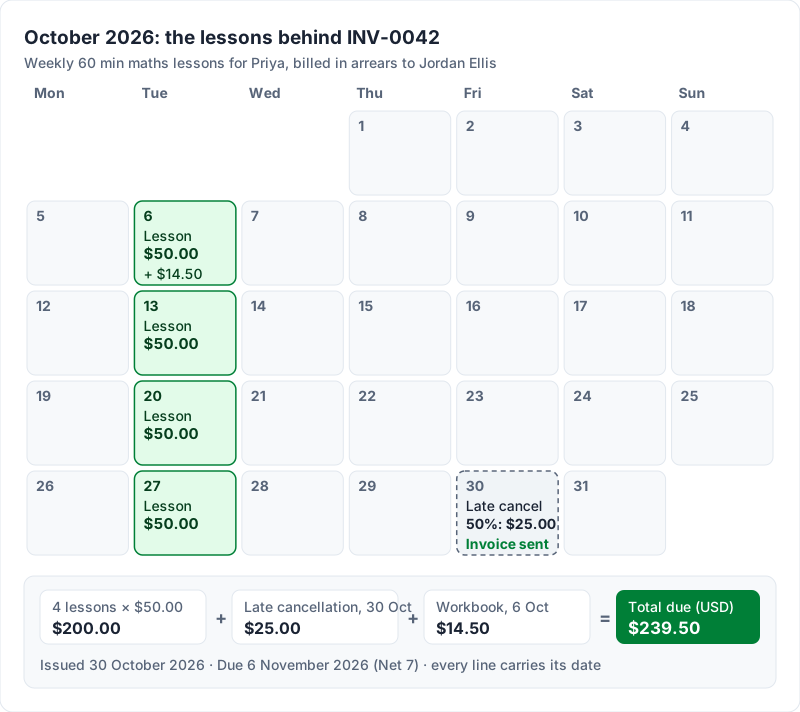
This invoice does three things on purpose. Every lesson has a date. Extras sit on their own lines with a reason. And the cancellation charge names the policy behind it, so it reads as an agreed rule rather than a surprise. For a music lesson invoice the shape is the same: swap the subject for the instrument and length (“Piano, 30 min”) and add exam entry or accompanist fees as separate lines. If you also play gigs or session work, the musician invoice template has filled-in samples for both.
Tax on tutoring income, in general terms#
How tutoring income is taxed depends on where you are and how you work, so ask your tax authority or an accountant. A few official pages to start from, quoted as of 23 October 2026:
- United States. The IRS's Self-Employed Individuals Tax Center lists, among the ways you count as self-employed: “You carry on a trade or business as a sole proprietor or an independent contractor.” Its self-employment tax page says: “The self-employment tax rate is 15.3%.” Read both pages for when the tax applies.
- United Kingdom. GOV.UK's trading allowance page says: “If your annual gross trading income is £1,000 or less, from one or more trades you may not have to tell HMRC, however there are circumstances when you must register for Self Assessment and declare your income on a tax return.” On VAT, HMRC VAT Notice 701/30 says private tuition “supplied by an individual teacher, working in a personal capacity, is exempt from VAT”, subject to the conditions in that notice.
For the tutoring invoice itself, the practice is simple: if you are not registered to charge sales tax, VAT or GST, do not add a tax line. Keep a copy of every invoice; it is your income record at year end.
Where Charming Invoices fits, and where it does not#
If you teach the same families every month, the recurring invoices feature in Charming Invoices raises a draft for each cycle with the client, lines and totals filled in. It is never issued or sent for you: you open the draft, put in this month's lesson dates, a cancellation line or a workbook, issue it, then download the PDF or copy its link and send it to the family yourself. Each line takes a quantity and a unit, and “sessions” is one of the suggested units. The Timesheet template groups lines under headings (one per student or per week) and prints hours per group and a Total hours line.
The catches, plainly. Recurring invoices are on the paid plans (from Individual, $29 once), not the free plan. Schedules are weekly, monthly, quarterly or yearly; there is no per-term option, and generated drafts are due 14 days after the issue date, which you can change on the draft. The hours figures only count lines whose unit is hours, so lessons billed as “sessions” will not add up there. Timesheet is a layout, not a time tracker or a booking calendar. Charming does not count down a prepaid block for you: the lesson record above is something you keep up yourself. Charming does not email invoices or reminders to families. Clients cannot pay by card from the invoice, so payment tracking is manual and you mark it paid. Free invoices carry a small “Sent with Charming Invoices” line in the footer.
If that suits how you teach, see pricing for what each plan includes.
Free downloads
No sign-up and no email address. More on the free templates page.
- Download .docx: Receipt template for Word
Receipt template for Word
Word .docxThe same receipt as a Word document, for people who would rather type than use cells.
- Download .xlsx: Receipt template for Excel
Receipt template for Excel
Excel .xlsxConfirm a payment: paid in full, a part payment against an invoice, or a cash sale with change.