Graphic design invoice template and filled-in samples

Nnabuike Okoroafor ·
On this page · 10 sections
The design is approved, the files are ready, and now you need a graphic design invoice template that covers more than “Logo — 1,800.00”. Design invoices carry things most invoices never do: revision rounds, stock and font licences, a deposit taken at the start, and what the client may do with the work. In the public online discussions we read while researching invoicing (the people quoted are not Charming customers), one new designer put the starting point plainly:
I have just started a graphic design business and I wasn't sure if Invoices are necessary and what to even put on them.
This post answers that: which free file to use, what a graphic design invoice should include, and two filled-in graphic design invoice samples with numbers that add up. The first is a logo and brand identity balance invoice with an extra revision round, stock licences and the deposit credited; the second is a kill-fee invoice for a cancelled project. For the pricing side (why designers undercharge and how presentation changes that), read how designers undercut their own rate. If your work is a painting or a room rather than a logo, the artist invoice template and the interior design invoice template cover those.
General information, not legal advice. Where copyright or trademarks come up, we quote and link the official page; ask a lawyer about your own agreement.
Free graphic design invoice template: which file to use#
Our free templates page has Excel and Word invoice templates, with no sign-up. None is design-specific; the samples below show how each fits a design job.
| File | Calculates? | Best for |
|---|---|---|
| invoice-template.xlsx (Excel) | Yes: line amounts, tax, total, balance due, due date | Itemised projects: concepts, revision rounds, pass-through costs |
| hourly-invoice-template.xlsx (Excel) | Yes, plus a Total hours cell | Hourly design work or production support |
| service-invoice-template.docx (Word) | No, you type every total | A balance invoice: a description-of-work box and a “Less deposit paid” line |
| invoice-template.docx (Word) | No, you type every total | A short fixed-fee job |
The Excel files add up each line, the discount, one tax rate and the balance due for you. The Word files do not calculate; each carries a note with the formulas, which you delete before sending. Our guides to the Excel invoice template with formulas and the free Word invoice template explain both in detail.
A designer's invoice is also a piece of design the client will judge. If you want the invoice itself to look like your studio, Charming's templates (more at the end) do it without a spreadsheet.
What a graphic design invoice should include#
Beyond the basics in the field-by-field invoice checklist (your details, the client's, a number, dates, totals, how to pay), a graphic design invoice is clearer when it names what you sold, in the client's language.
| Line or field | Example wording | Why it is separate |
|---|---|---|
| Project and deliverables | “Logo design: 3 initial concepts, 2 revision rounds included” | Says what the fee covers, including the rounds |
| Extra revision rounds | “Extra revision round (round 3, requested 4 Nov 2026)” | Work beyond the agreed scope, dated |
| Hourly or fixed lines | “Brand discovery workshop (2 hours)” | Fixed and hourly work billed in the units agreed |
| Pass-through costs | “Stock image licences (standard licence, in client's name)” | Money spent for the client, shown at cost |
| Usage licence | “On payment in full, the client may use ...” | Mirrors your agreement on the document that asks for money |
| Deposit already paid | “Less deposit paid 21 Oct 2026” | A credit, not a charge |
| Due date and payment details | “Due 2 Dec 2026”, bank details or payment link | The answer to “how do I pay you?” |
Tax. Whether design services, digital files or printed items are taxable depends on where you and the client are, and the answer can differ between them. The samples below have no tax line so the arithmetic stays visible. Check your tax agency's guidance, or ask an accountant, before you set a rate.
Hourly, fixed fee or per deliverable#
Fixed fee per deliverable suits identity work: a logo, a set of guidelines, a packaging range. The client knows the price up front, and the invoice lists each deliverable at its quoted price. The risk is scope: a fixed fee with unlimited revisions is not a fixed fee. Say how many rounds are included, in the quote and again on the invoice line.
Hourly suits open-ended work: production artwork, changes after sign-off, ongoing support. Bill the hours with a date and a short description, and keep the record; our guide to time tracking and invoicing covers the habits that make hourly invoices easy to check.
A mix is common, and it is what sample 1 shows: fixed lines for the agreed deliverables, an hourly line for the extra round.
Most design jobs start with a quote. When the final invoice comes in higher than the quote, explain the difference line by line; our guide on what to do when the final price exceeds the estimate has the wording. Website projects have their own pattern (milestones, hosting, domains), covered in our web development invoice guide.
Sample 1: logo and brand identity, balance after deposit#
An invented studio, Kite & Compass Design, quoted 2,750.00 for a brand discovery workshop, a logo and brand guidelines; the invented client, Lanternfish Coffee Co., accepted on Friday 16 October 2026 and paid a 50% deposit of 1,375.00 on Wednesday 21 October 2026. During the work the client asked for a third revision round, billed hourly as agreed, and two stock images were licensed in the client's name. The balance invoice is dated Wednesday 18 November 2026 with 14-day terms, so it is due Wednesday 2 December 2026.
| Section | Description | Qty | Rate | Amount |
|---|---|---|---|---|
| Brand identity | Brand discovery workshop (2 hours) | 1 | 300.00 | 300.00 |
| Brand identity | Logo design: 3 initial concepts, 2 revision rounds included | 1 | 1,800.00 | 1,800.00 |
| Brand identity | Extra revision round (round 3, requested 4 Nov 2026), hours | 2 | 75.00 | 150.00 |
| Brand identity | Brand guidelines PDF (12 pages) | 1 | 650.00 | 650.00 |
| Pass-through | Stock image licences (standard licence, in client's name) | 2 | 29.00 | 58.00 |
| Subtotal and total | 2,958.00 | |||
| Less deposit paid 21 Oct 2026 | −1,375.00 | |||
| Balance due | 1,583.00 |
The arithmetic, checked: 2 × 75.00 = 150.00; 2 × 29.00 = 58.00; 300.00 + 1,800.00 + 150.00 + 650.00 + 58.00 = 2,958.00; 2,958.00 − 1,375.00 = 1,583.00. The quote was 300.00 + 1,800.00 + 650.00 = 2,750.00, and the deposit was 50% of that. The invoice is 208.00 above the quote, and the two lines that explain it (150.00 for round 3, 58.00 for stock) are both on the page. All names, prices and the 50% deposit are illustrative, not a rate guide.
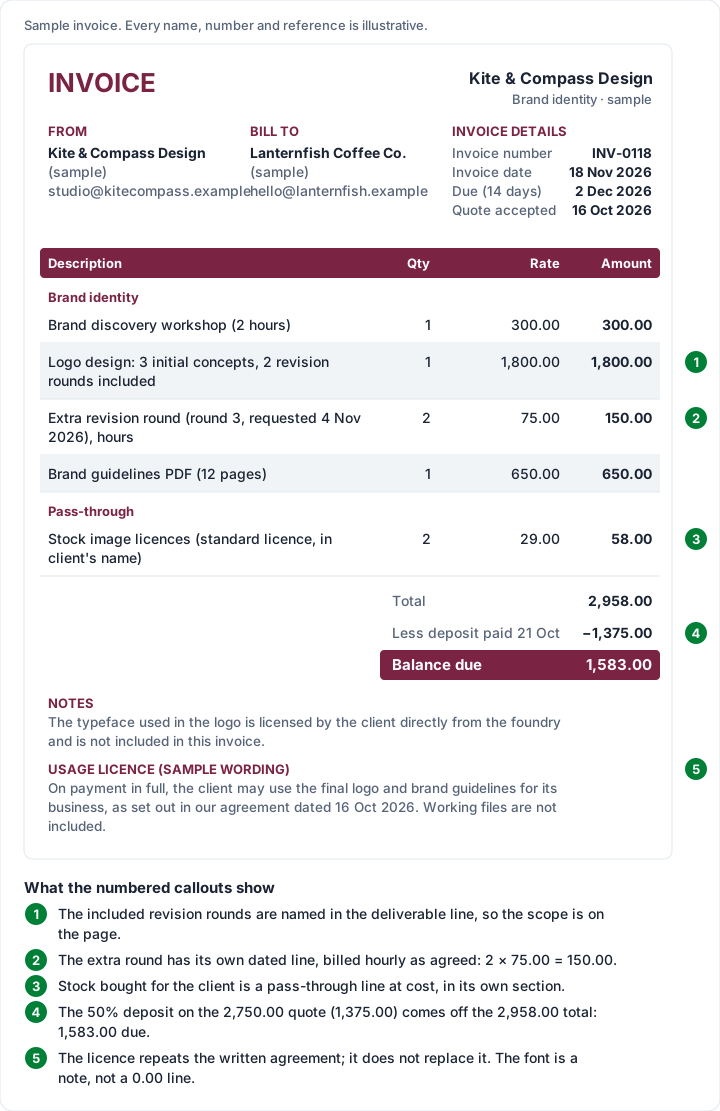
Two short notes sit under the totals. Neither is a line item, because neither is a charge:
- Notes: “The typeface used in the logo is licensed by the client directly from the foundry and is not included in this invoice.”
- Usage licence (sample wording): “On payment in full, the client may use the final logo and brand guidelines for its business, as set out in our agreement dated 16 Oct 2026. Working files are not included.”
That licence wording is an example of a plain business term, not a template to rely on. The licence that counts is the one in your agreement; the invoice should repeat it, not replace it. Our guide to how the deposit shows on the final invoice covers the first invoice, the one that took the 1,375.00.
Revisions, fonts and stock: what goes on the invoice#
Revision rounds. Name the included rounds in the deliverable line (“2 revision rounds included”) and bill any extra round on its own line, with the date it was asked for. The client then sees that the extra charge follows an agreement, not a change of mind on your side.
Stock images. If you license stock for the client, one clean route is a licence in the client's name, billed at cost as a pass-through line, as in sample 1. Some designers add a handling fee; if you do, show it, do not bury it in the line.
Fonts. Fonts are licensed software, and many designers prefer the client to buy the licence directly. In the discussions we read, one designer described their practice:
When you send the files, omit fonts that are not licensed to the client. I include a note explaining that “fonts are not included due to licensing restrictions” and a link to where they can be licensed.
That is one designer's approach, not a rule, and font licences differ between foundries, so read the licence for the font you used. On the invoice, a note works better than a 0.00 line: a line suggests something was sold.
Working files. Whether the client gets your layered or source files is something to agree up front. Another designer in the same thread put their default this way:
Working files are not automatically included in the price.
Again, one designer's view. If you do hand over working files, for a fee or as part of the package, name them on a line so both sides can see they were included.
Usage licence and copyright: what the invoice can and cannot do#
A usage licence line says what the client is paying to do with the work. The invoice can repeat the licence; your agreement is what sets it. Two official pages are worth knowing (US law; other countries differ), as of 28 October 2026.
What Circular 1 says about transfers. The US Copyright Office's Circular 1, Copyright Basics (revised September 2021), under “Transfer of Copyright Ownership”, says:
Any or all of the copyright owner's exclusive rights, or parts of those rights, can be transferred.
The same section explains when a transfer needs to be in writing; our photography invoice template post quotes that passage, along with what Circular 1 says about work made for hire.
A logo is also a brand. The US Patent and Trademark Office's page Trademark, patent, or copyright describes a trademark as:
A word, phrase, design, or a combination that identifies your goods or services, distinguishes them from the goods or services of others, and indicates the source of your goods or services.
It adds, about trademarks: “You might also choose to protect a slogan or logo for those goods or services, if you have one.” Whether and where to register a logo as a trademark is the client's decision, and a question for their lawyer, not something your invoice settles.
In practice: put the licence in writing in your agreement, make the invoice's licence block match it, and ask a lawyer before you sign a rights-transfer or work-for-hire clause. Our guide to what an invoice and a contract each do explains why the invoice is not the place to set terms for the first time.
Sample 2: kill fee for a cancelled project#
A kill fee is a fee you agreed in advance that the client pays if they cancel the project before it is finished. It is a business term in your agreement; the invoice simply bills it. In one public discussion we read, a freelancer argued for agreeing it at the start:
Bingo. State your costs up front, get a contract that also includes a 50% kill fee if they choose to not like any of your work. It helps every freelancer around to stand your ground and demand to be paid.
That 50% is one stranger's practice, not a norm. The right figure is whatever your agreement says. Writers handle the same thing, and our guide to kill fees and rights lines on an invoice shows their version.
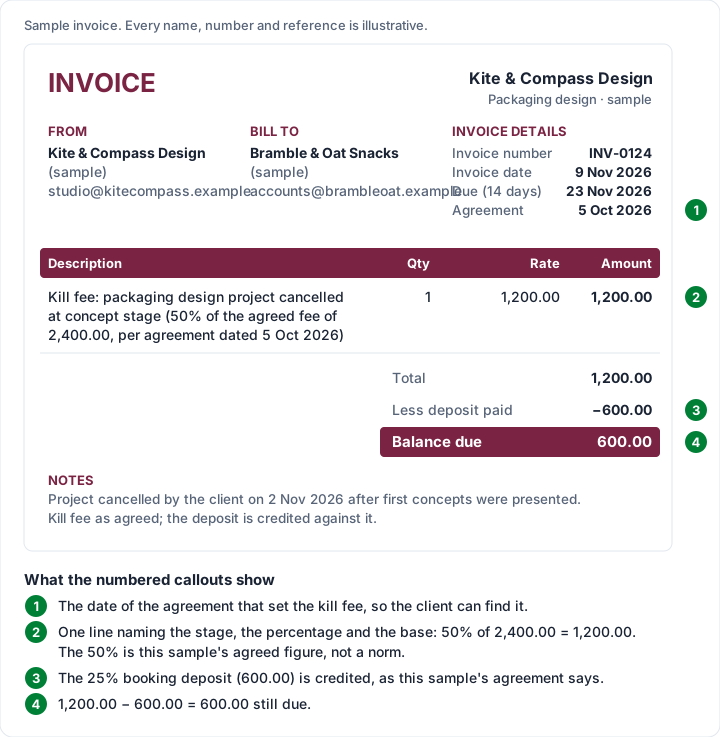
In this invented example, Kite & Compass Design agreed a fee of 2,400.00 for a packaging design project on Monday 5 October 2026, with a 25% booking deposit (600.00) paid and a 50% kill fee if the client cancelled after the concept stage. The client, Bramble & Oat Snacks, cancelled on Monday 2 November 2026, after seeing the first concepts. Invoice dated Monday 9 November 2026 with 14-day terms, due Monday 23 November 2026.
| Description | Qty | Rate | Amount |
|---|---|---|---|
| Kill fee: packaging design project cancelled at concept stage (50% of the agreed fee of 2,400.00, per agreement dated 5 Oct 2026) | 1 | 1,200.00 | 1,200.00 |
| Total | 1,200.00 | ||
| Less deposit paid | −600.00 | ||
| Balance due | 600.00 |
The arithmetic, checked: 50% of 2,400.00 = 1,200.00; the deposit was 25% of 2,400.00 = 600.00; 1,200.00 − 600.00 = 600.00. Names and figures are illustrative.
Three details keep a kill-fee invoice from turning into an argument:
- Quote the agreement. The date of the agreement and the stage at which the project stopped go in the line itself.
- Show the percentage and the base. “50% of 2,400.00” is checkable; “Cancellation, 1,200.00” invites a reply.
- Credit the deposit. If the deposit is part of the kill fee under your agreement, take it off, as here. If the agreement says otherwise, follow it.
Whether a kill fee is enforceable in a dispute is a legal question for a lawyer where you work; the invoice only records what was agreed.
Graphic design invoices in Charming#
We make Charming Invoices, so here is what it adds for designers, with the limits next to each feature.
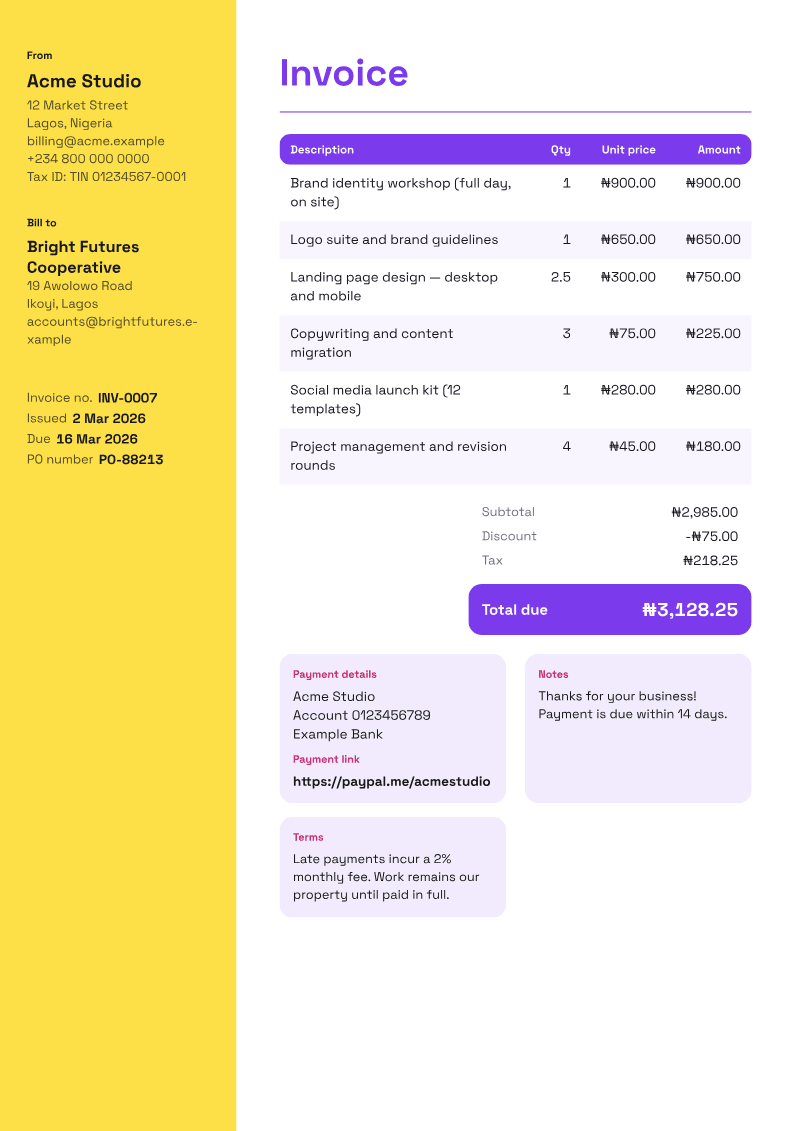
- Templates that look designed. Creative Studio (“Sunny side panel, rounded corners and a confident violet accent.”) and Editorial (“Magazine-style serif display type with a two-column header.”) are 2 of the 60 templates on every plan, including the free one. Your logo, any brand colour and 30 fonts replace the samples; our guide to a logo on an invoice covers file types and size.
- A licence block. Rename the Terms block to “Usage licence”, as Charming's Photographer template does, and write your licence there (up to 5,000 characters). The label applies to the whole business, and the wording is yours: Charming does not draft licences.
- Deposits. Enter the deposit received and the invoice credits it as “Deposit received” and shows the amount due, as in both samples.
- Sections and units. Group lines under “Brand identity” and “Pass-through” with subtotals, and turn on the Unit column for “hrs” or “licence”. Both are off by default.
- A PDF and a private link your client opens without an account, with your bank details and a payment link of your own; you can see when the client has viewed it. Issue the invoice, then download the PDF or copy the link and send it however you like; Charming does not email invoices or send reminders, and overdue invoices are flagged so you know when to follow up.
- On paid plans, AI drafting turns one sentence into line items (it leaves prices it does not know at 0, and never creates a client or sends anything), and a saved line-item library keeps “Extra revision round” ready to reuse.
The limits: Charming does not take card payments; clients pay you directly, and you record payments or mark the invoice paid yourself. It does not deliver files, hold downloads until payment, handle proofing or approvals, write contracts or collect signatures, make quotes or track time; use a contract or proofing tool for those, or a broader freelance platform that bundles them. There is no graphic design starter kit, so you type your own lines. The free plan is $0 forever with no invoice limit, for 1 business, and its invoices carry a small “Sent with Charming Invoices” line; paid plans hide it by default. Individual is $29 once, Team $79 once and Pro $12 a month or $99 a year; the lifetime plans are final sale. Our page on invoicing for designers and other creative freelancers shows the rest, the pricing page compares plans, and you can browse all 60 invoice templates or create a free invoice and rebuild sample 1 with your own prices.
Questions about graphic design invoices#
What should a graphic design invoice include?#
Your details and the client's, an invoice number, the invoice and due dates, each deliverable by name with the revision rounds it includes, any extra rounds or hourly work, pass-through costs such as stock licences, any deposit already paid, the balance due, how to pay you and a usage licence that matches your agreement.
How do I bill extra revision rounds?#
On their own line, dated, at the rate you agreed for extra work (hourly or per round). Name the included rounds in the deliverable line, so the extra line is clearly outside them.
Should I charge a deposit for design work?#
Many designers take one before starting, often a share of the quoted fee, and credit it on the final invoice, as in sample 1. The amount and when it is due are business terms to agree in your quote or agreement.
What is a kill fee?#
A fee agreed in advance that the client pays if they cancel the project before it is finished, often a percentage of the full fee that depends on the stage reached. Invoice it on one line that names the agreement and the stage, and credit any deposit as your agreement says.
Do I have to hand over working files?#
Your agreement decides. Many designers do not include working files by default and price them separately if the client wants them. If they are included, name them on the invoice.
Is there a free graphic design invoice template?#
Yes. The invoice templates on our downloads page are free to download, change and use, with no sign-up: the Excel invoice files calculate and the Word ones do not. The samples above show how to fill them for a design job.
The short version#
Use the Excel file if you want the totals worked out, or the Word service template for a balance invoice. Name every deliverable with its included rounds, put extra rounds and pass-through costs on their own dated lines, keep fonts and working files in notes and your agreement, and take the deposit off the total. For copyright and trademarks, quote the official page and ask a lawyer; the invoice repeats your agreement, it does not replace it.