Service invoice vs sales invoice, with a free template

Nnabuike Okoroafor ·
On this page · 11 sections
You did some work, or sold some things, and now you need to bill for it. Somewhere along the way you met two phrases, “service invoice” and “sales invoice”, and started wondering whether you need a special kind of document. One person in a public small-business discussion put the question the way most people feel it:
I am about to invoice my first client (for a service, not product) - only thing is, I've never invoiced a client (!)
The short answer: a service invoice bills for work you performed, a sales invoice bills for goods you sold, and both are ordinary invoices. The differences are in the line items, the dates, and sometimes the tax. This post shows each one with a worked example, gives you wording for “services rendered” that does not invite a query, and settles what to do when a job is half parts and half labour.
This is general information, not legal or tax advice. Rules differ by country and by state, and they change.
A service invoice and a sales invoice, in one paragraph each#
A service invoice asks to be paid for work: hours of consulting, a finished logo, a cleaned house, a repaired boiler. What you are selling is your time, skill or a result, so the lines describe what you did, when, and how it was priced (by the hour, the day, or a fixed fee).
A sales invoice asks to be paid for goods: a batch of mugs, a printed run of posters, a used camera body. What changes hands is a physical thing, so the lines describe items, quantities and unit prices, and the invoice often carries delivery details.
In everyday use, both are ordinary invoices with the same core fields: your details, the client’s details, a unique invoice number, the issue date, a due date, the lines, the total and how to pay. If you want that list field by field, what actually belongs on an invoice is the checklist.
The other meaning of “sales invoice”#
This trips people up, so it is worth a short section. In bookkeeping, “sales invoice” often means any invoice you send out, goods or services, as opposed to a “purchase invoice”, which is one you receive from a supplier. HMRC’s VAT record-keeping guidance, for example, lists “purchase invoices and copy sales invoices” among business records (VAT Notice 700/21, read 28 October 2026).
So if your accountant asks for “your sales invoices”, they almost certainly mean every invoice you issued, including your service invoices. That is the sense accounting software uses too. In the rest of this post, “sales invoice” means the narrower thing: an invoice for goods. For the other kinds of invoice, from proforma to credit note, see the types of invoices.
The real differences, side by side#
Most of the fields are identical. The table shows the ones that are not.
| Service invoice | Sales invoice (goods) | |
|---|---|---|
| What a line describes | The work or result: “Kitchen deep clean — 4 hours” | The item: “Stoneware mug, 350 ml, sage glaze” |
| How a line is priced | Hours or days × rate, or a fixed fee (quantity 1) | Units × unit price |
| The date that matters | When the work was done, or the period it covers | When the goods were delivered or collected |
| Extra details | Scope, milestone, revision rounds, expenses at cost | SKU or item code, delivery address, shipping charge |
| What proves it happened | Your records, the deliverable, the client’s sign-off | A delivery note or courier tracking |
| Common disputes | “What did these hours cover?” | “Two arrived broken” or “we ordered 40, not 48” |
| Tax | Depends on the service and the place | Depends on the goods and the place |
The pattern underneath: a sales invoice is easy to check, because the client can count the boxes. A service invoice is checked against memory, which is why its wording matters more.
How tax can differ for goods and services#
This is the part most guides skip, and it is the part that can change your total. We will stay general, because the detail depends entirely on where you and your client are, and it changes.
Tax rules can treat goods and services differently in three ways worth asking about: what is taxed (some places tax one and not the other), when tax is due (the date that matters can differ for goods and for services), and cross-border sales (selling goods and selling services abroad can follow different rules). Official pages to start from:
- US: your state’s tax authority. For example, California’s CDTFA Publication 108 covers charges for labour.
- UK: HMRC’s VAT manual on the time of supply.
- EU: for goods and services sold to other EU countries, Your Europe’s cross-border VAT page.
Whether you add a tax line at all depends on whether you are registered to charge sales tax, VAT or GST; ask your accountant if you are unsure. If you are registered, what a tax invoice is covers what the invoice shows.
Wording for “services rendered” that avoids queries#
“For services rendered” is a perfectly good phrase. On its own, as the only line on an invoice, it is not enough. The client’s accounts team cannot approve a payment against it, and the person who hired you may not remember which week it covers.
It is a common struggle. From another public discussion about writing first invoices (the people quoted in this post are strangers in public forums, not Charming customers):
On top of that, I struggled with writing clear and professional service descriptions.
A line that does not get queried answers four questions: what you did, for which project, when, and how the price was worked out. Some before-and-after pairs:
| Vague | Clear |
|---|---|
| Services rendered | Bookkeeping, September 2026 — reconciliation of 2 bank accounts, VAT return prepared |
| Design work | Brand identity — primary logo, 2 alternative lockups, colour palette (as agreed 2 September) |
| Consulting | Strategy workshop, 14 October — half day, on site, including summary notes |
| Repairs | Boiler service and repair, 12 Elm Road, 9 October — replaced diverter valve |
| Labour | Labour — 3.5 hours at $60.00 |
If you want a heading above the lines, these all read naturally:
- “Invoice for professional services rendered, 1–30 September 2026”
- “Services provided under the agreement dated 2 September 2026”
- “Work completed for the Hartley Café website project”
The period or agreement date in the heading does a surprising amount of work. It tells the client’s accounts team exactly which piece of work this is, before they read a single line. For more on describing deliverables and hours, how to invoice for consulting services goes deeper.
Example 1: a service invoice#
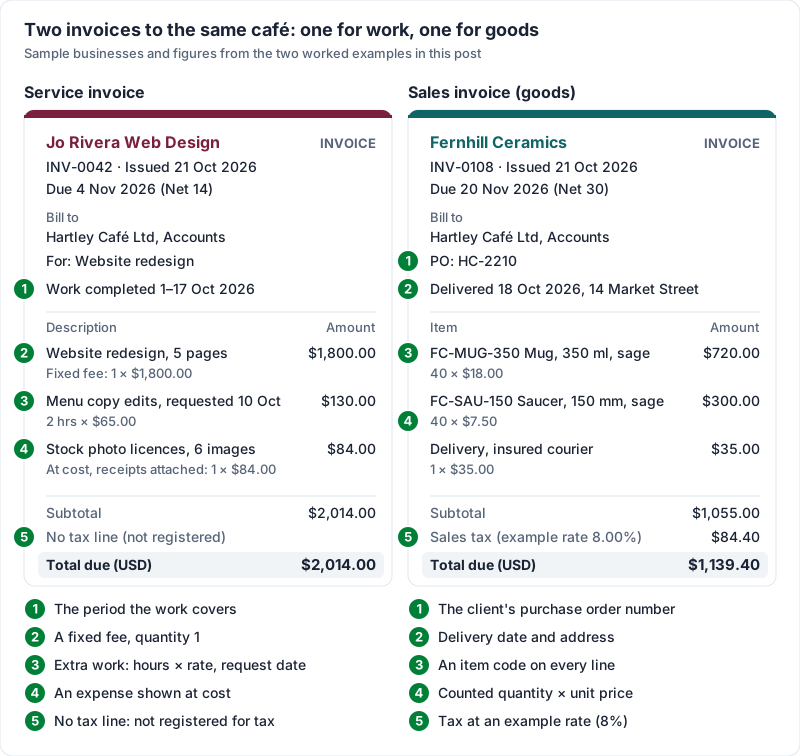
An illustrative service invoice example from a freelance web designer to a small café. The names and numbers are made up for this example.
Invoice INV-0042 · Issued 21 October 2026 · Due 4 November 2026 (Net 14) From: Jo Rivera Web Design · To: Hartley Café Ltd, Accounts For: Website redesign, work completed 1–17 October 2026
| Description | Qty | Rate | Amount |
|---|---|---|---|
| Website redesign — 5 pages, mobile layout, as per proposal of 25 September | 1 | $1,800.00 | $1,800.00 |
| Menu page copy edits — additional, requested 10 October | 2 hrs | $65.00 | $130.00 |
| Stock photography licences, 6 images (at cost, receipts attached) | 1 | $84.00 | $84.00 |
| Subtotal | $2,014.00 | ||
| Total due (USD) | $2,014.00 |
Payment: bank transfer to the account below, quoting INV-0042.
What makes it a service invoice: the main line is a fixed fee with quantity 1, the extra work is hours times a rate, the request date for the extra work is on the line, and the expense is shown at cost rather than folded into the fee. There is no tax line because, in this example, the designer is not registered for sales tax. How to bill expenses to a client covers lines like that one in full, and itemised invoices covers how much detail to show.
Example 2: a sales invoice#
An illustrative invoice from a small ceramics studio selling mugs to the same café.
Invoice INV-0108 · Issued 21 October 2026 · Due 20 November 2026 (Net 30) From: Fernhill Ceramics · To: Hartley Café Ltd, Accounts · PO: HC-2210 Delivered to: 14 Market Street, delivered 18 October 2026
| Item | Qty | Unit price | Amount |
|---|---|---|---|
| FC-MUG-350 Stoneware mug, 350 ml, sage glaze | 40 | $18.00 | $720.00 |
| FC-SAU-150 Saucer, 150 mm, sage glaze | 40 | $7.50 | $300.00 |
| Delivery, insured courier | 1 | $35.00 | $35.00 |
| Subtotal | $1,055.00 | ||
| Sales tax (example rate 8.00%) | $84.40 | ||
| Total due (USD) | $1,139.40 |
What makes it a sales invoice: item codes, counted quantities, a unit price per item, the delivery address and delivery date, and the client’s purchase order number so their accounts team can match it. The 8% rate is an example only. Whether delivery charges are taxable varies by place, so check before copying this layout.
Put next to each other, the two examples show the differences from the table above in practice:
Service invoice template (free Word file)#
If you would rather start from a file than a blank page, there is a free service-invoice-template.docx on our free templates page. We checked its contents by script; it has not been opened in Word or Google Docs. From top to bottom it has:
- A title row with “INVOICE” and a space for your logo.
- Three columns of details. From: your business name, address, email and phone, and a tax or business number if you are registered. Bill to: the client’s name, company, address and email. Invoice details: the invoice number (starting at INV-0001), invoice date, due date, payment terms (set to 30 days) and a reference or PO.
- A “Description of work” box with four prompts: job or project, site address, date(s) of work, and work performed.
- A “Labour and materials” table with Item, Qty / hours, Rate and Amount columns and 6 blank lines.
- Payment details and notes on the left, and on the right Subtotal, Discount, Tax, Total, Less deposit paid and Balance due.
The description-of-work box is where the “services rendered” wording from earlier goes. Here it is filled in for an illustrative job, Brackenridge Home Repairs billing Tremayne Lettings Ltd:
- Job / project: Bathroom extractor fan replacement
- Site address: Flat 3, 18 Selwyn Road
- Date(s) of work: Wednesday 4 and Thursday 5 November 2026
- Work performed: Removed the failed fan, fitted a new humidity-sensing fan, replaced the ducting to the outside vent, then tested it and left it running.
And the labour and materials table, with the totals below it:
| Item | Qty / hours | Rate | Amount |
|---|---|---|---|
| Labour, 4 and 5 November | 3 hrs | $45.00 | $135.00 |
| Extractor fan, humidity-sensing | 1 | $62.50 | $62.50 |
| Ducting and fixings | 1 | $14.75 | $14.75 |
| Subtotal | $212.25 | ||
| Total | $212.25 | ||
| Less deposit paid | $50.00 | ||
| Balance due | $162.25 |
There is no discount or tax line, because Brackenridge is not registered for sales tax or VAT in this example. The deposit comes off the total, so the client pays the balance; how deposit invoices work covers when to ask for one.
Word tables do not add up by themselves, so you fill in each amount and the totals by hand. If you would rather have the arithmetic done for you, the general invoice-template.xlsx calculates each line, the subtotal, a fixed discount, one tax rate, the total, an amount paid and the balance due (formulas checked by script). It has no description-of-work box, so put the job, site and dates in the line descriptions or the notes. For the general Word file and how to edit it, see the Word invoice template guide; for a version to print and fill in by hand, see the blank invoice template.
A mixed job: goods plus labour#
Plenty of work is both. A plumber fits a part, a technician installs a screen they supplied, a sign maker designs and then prints. The question people ask is which kind of invoice to send.
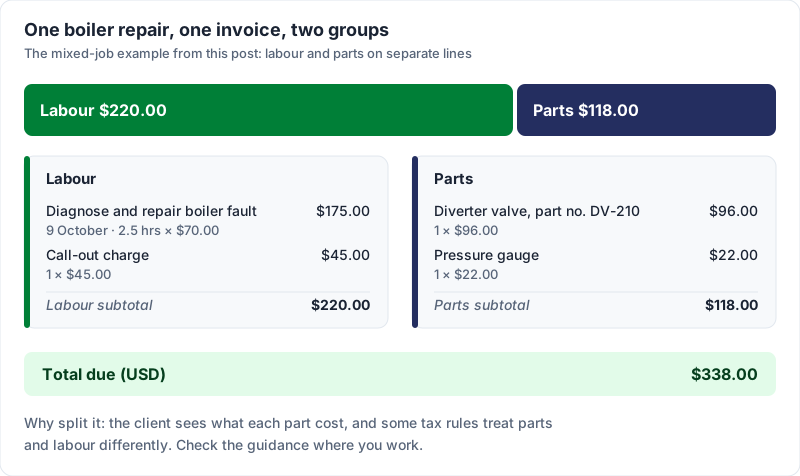
Send one invoice, and put the goods and the labour on separate lines. You do not need two documents, and you do not need to call it either kind. What helps is a split the client, and anyone checking the tax, can read.
Separating them is often more than tidiness. The client can see what each part cost, and in some places tax rules treat parts and labour differently, so a clear split lets the right treatment be applied. How a mixed job is taxed where you work is a question for your state or national tax authority’s guidance, or your accountant.
An illustrative mixed invoice, grouped the way a client reads it:
| Description | Qty | Rate | Amount |
|---|---|---|---|
| Labour | |||
| Diagnose and repair boiler fault, 9 October | 2.5 hrs | $70.00 | $175.00 |
| Call-out charge | 1 | $45.00 | $45.00 |
| Labour subtotal | $220.00 | ||
| Parts | |||
| Diverter valve, part no. DV-210 | 1 | $96.00 | $96.00 |
| Pressure gauge | 1 | $22.00 | $22.00 |
| Parts subtotal | $118.00 | ||
| Total due (USD) | $338.00 |
If your contract is a fixed price for the whole job and you did not agree to itemise, that is a different conversation, covered in what a contractor invoice should show. For a filled-in labour and materials sample, see the job invoice template. A body shop invoice is the same split with paint, materials and sublet work added.
Billing services, goods or both in Charming Invoices#
Charming Invoices has one kind of invoice, and it handles all three examples above. Each line has a description, a quantity, a rate and an optional unit such as “hrs” or “days”. Give lines a section label such as “Labour” or “Parts” and, with grouping switched on in the template, consecutive lines with the same label print under one heading with a subtotal. The Contractor template has the unit column and grouping on already. You can rename labels such as “Rate” to “Unit price”. If the client paid a deposit up front, add a “Deposit received” line and it comes off the total, the same job the template’s “Less deposit paid” line does. All of this is on the free plan.
The catches, plainly. There is one tax rate per invoice, so Charming cannot tax parts and leave labour untaxed on the same invoice. If your rules need that, Charming is the wrong tool for that job, or for that invoice. There is no separate field for item codes, a delivery date or a shipping address (put them in the line description or the invoice notes), and there is no stock or inventory tracking. Charming does not take card payments, payment tracking is manual, and free-plan invoices carry a small “Sent with Charming Invoices” line in the footer.
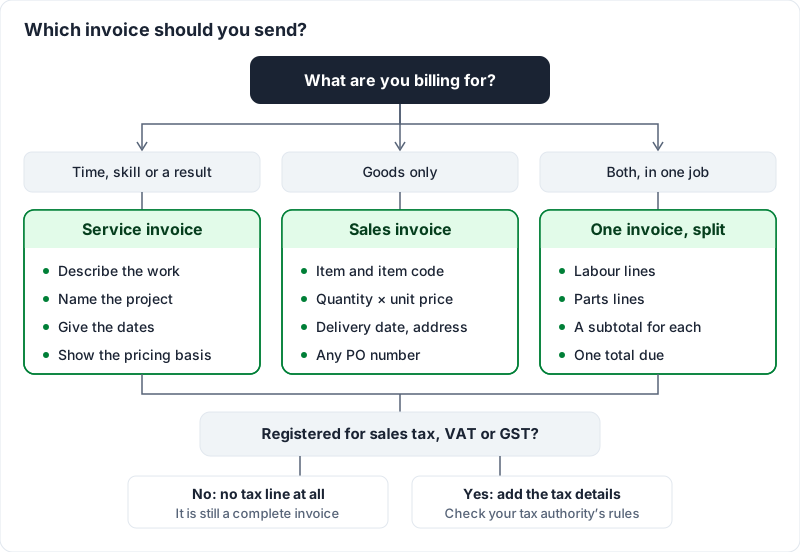
Which one should you send?#
- Billing for time, skill or a result? A service invoice. Describe the work, the project, the dates and the pricing basis.
- Billing for goods only? A sales invoice. Item, quantity, unit price, delivery details, any PO number.
- Both in one job? One invoice, with goods and labour on separate lines, grouped if you can.
- Want a file to start from? The free service invoice template above, in Word, or the Excel invoice template if you want the totals calculated.
- Unsure about tax? Check your tax authority’s guidance for both goods and services where you work, or ask an accountant once. Whether a paid invoice can serve as a receipt is a separate question with its own answer.
Whichever it is, the document is still an invoice. A clear one, sent today, does more than a perfect one still being formatted. If you want somewhere to build it, you can create a free invoice.
Free downloads
No sign-up and no email address. More on the free templates page.
- Download .docx: Service invoice template for Word
Service invoice template for Word
Word .docxFor a job: what you did, where and when, then labour and materials.
- Download .xlsx: Invoice template for Excel
Invoice template for Excel
Excel .xlsxThe general-purpose invoice: products, services or a mix, priced by quantity and rate.