A towing invoice that itemizes the hook, the miles and the lot

A towing invoice is often handed over at the worst moment of someone's week: at the roadside, at the storage lot gate, or to an insurer who will read it line by line before reimbursing the driver. It has to say which vehicle was moved, from where to where, who asked for the tow, and exactly what each charge was for. This tow invoice template is built as a receipt you can hand over or email on release. It names the vehicle and plate, records whether the tow was requested by the owner, ordered by police or done from private property without consent, and itemizes hook-up, loaded miles, recovery time and each day of storage. The notes cover Texas, where the regulator caps several non-consent fees and sets what the tow ticket must show.

Updated

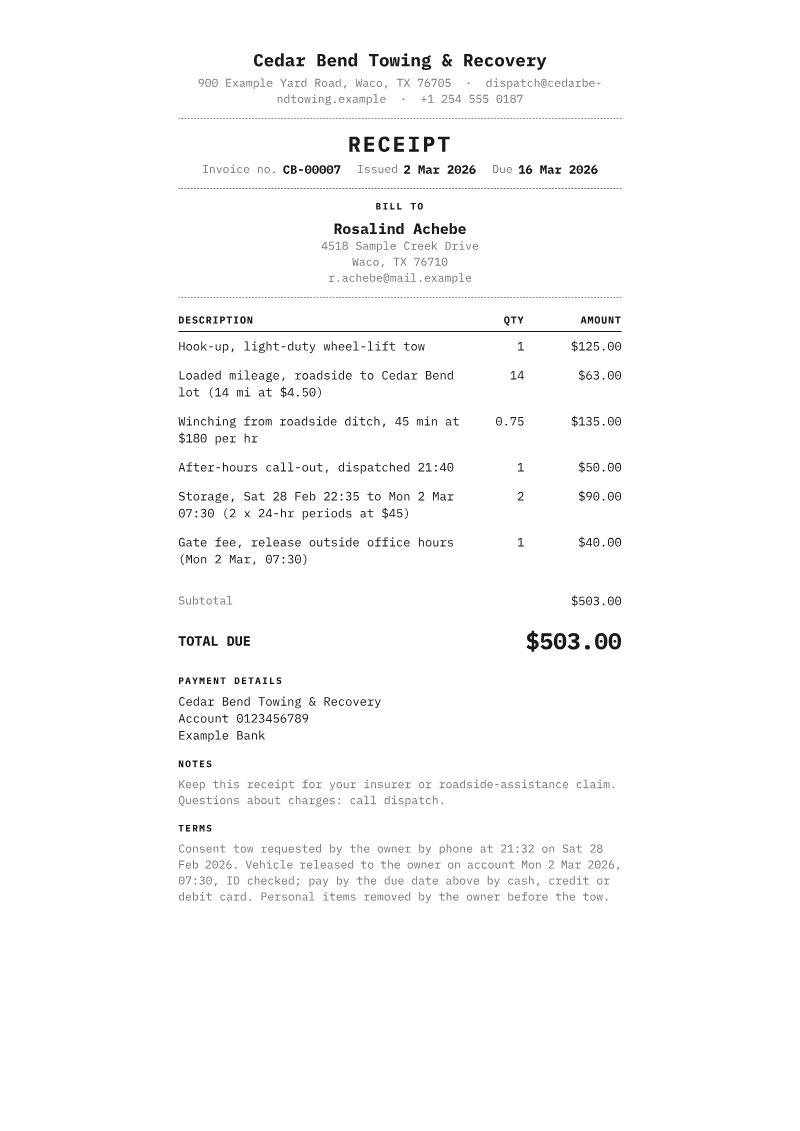
Sample towing invoice on the Receipt template, with invented business, client and prices

Job details

Vehicle
2017 compact SUV, silver, plate SMP-4471 (invented)
Pickup
Westbound shoulder, Example County Road, mile marker 12
Drop-off
Cedar Bend storage lot, 900 Example Yard Road
Tow type
Consent tow (owner request)
Storage start
Sat 28 Feb 2026, 22:35
Shown on the Receipt template. Rendered by the same engine that builds the PDFs Charming sends. Business, client and prices are invented for illustration.

Line items for towing invoices

Starter line items for towing invoices, prices left blank
DescriptionQtyUnitPrice
Tow
Hook-up or base tow fee (light, medium or heavy duty)1eachLeft blank
Loaded mileage, pickup to drop-off1miLeft blank
Dolly or flatbed equipment charge1eachLeft blank
Recovery
Winching or recovery time1hrLeft blank
After-hours, weekend or holiday call-out fee1eachLeft blank
Storage and release
Vehicle storage, per day or part day1dayLeft blank
Gate or release fee outside office hours1eachLeft blank
Drop fee (vehicle released before it left the scene)1eachLeft blank

Prices are left blank on purpose. Use your own rates.

What towing invoices should include

Vehicle description, plate and VIN
The receipt is proof of which car you moved and released. Insurers and motor clubs match it to their claim by plate or VIN, and a lot that stores dozens of vehicles needs an unambiguous record of which one left with whom.
Example: 2017 compact SUV, silver, plate SMP-4471, VIN last 6: 104422
Tow type and who authorized it
A consent tow requested by the owner, a police-ordered tow and a non-consent tow from private property are priced and regulated differently. Write the type, the person or agency that authorized it, and the time, so anyone reading the receipt knows which fee rules applied.
Example: Consent tow, owner request by phone, 21:32
Pickup and drop-off locations
Loaded mileage is only checkable if both ends are written down. For a roadside call, use a road name and mile marker or a cross street; for a private lot, the property address and the space or area the vehicle was in.
Example: Example County Road mile marker 12 to 900 Example Yard Road
Storage start date and time
Storage is charged per day or part day, so the clock-in time decides the count. Printing it lets the owner see why a car collected on the third morning was billed for two or three days.
Example: Storage from Sat 28 Feb 2026, 22:35
Your licence and registration numbers
In states that license tow companies and operators, the receipt is where an owner looks for the numbers to check you or file a complaint. In Texas the tow ticket for a non-consent tow must carry them.
Example: Company registration and operator licence numbers

How towing work is usually billed

Consent tows priced by your own rate sheet

When the owner or driver calls you, the price is usually what you quote: a hook-up fee, a rate per loaded mile after any included miles, and extras such as dolly use, winching or an after-hours fee. Quote before you hook up and repeat the same structure on the receipt, line for line, so the quoted figure and the billed figure can be compared without a call.

Non-consent and police-ordered tows under set maximums

Tows from private property without the owner's consent, and many tows ordered by police, are often capped by state or local rules, with the fee names fixed by a schedule you file. Bill those using exactly the fee names and amounts on the schedule, never your consent-tow rate sheet, and keep each charge on its own line so a regulator or owner can check it against the caps.

Daily storage and release charges

Storage runs per day or part day from when the vehicle enters the lot, and a release outside office hours may carry a gate fee where local rules allow one. Itemize storage by date range and day count rather than one storage total. Stop the count the day the owner is told the vehicle can be collected, if your rules or agreement require it.

Motor-club and insurer accounts

Roadside-assistance programmes and insurers often send work at contracted rates and pay you directly, with the driver paying only what the plan does not cover. Put the club's job or dispatch number on the invoice, bill the club's rates on its lines, and show any amount the driver owes, such as miles beyond the covered distance, as separate lines on the driver's receipt.

Rules and good practice

Texas (TDLR): what a non-consent tow ticket must show, and the fee caps
Rule

The Texas Department of Licensing and Regulation says a towing company must issue a tow ticket for each non-consent tow and give the owner a copy when the owner or operator is present. The ticket may only authorize charges directly related to the tow, must itemize each charge using the identical fee structure on the company's filed schedule, and must show the company's licensed name, a publicly listed phone number, its certificate of registration number and the operator's TDLR license number. TDLR also lists statewide maximums for private property tows, by vehicle weight, and drop fees, and says local rules may set lower rates. On the day this page was checked, the listed maximum for a private property tow of a vehicle up to 10,000 lbs was $272 and the drop fee was $135. Check TDLR's current figures and your city's ordinance before billing.
Texas (TDLR): payment methods for a drop charge
Rule

On a private property tow, if the owner arrives after the vehicle is fully hooked up but before it leaves the lot and you release it for a drop fee, TDLR's consumer guidance says the tow truck driver must accept cash, credit cards and debit cards for the drop charge. Carry a way to take card payment on the truck, and give a receipt for the drop fee like any other charge.

Photograph the vehicle before you hook up

Damage disputes are settled by evidence from before the tow. Take timestamped photos of all four sides, the odometer if you can reach it, and the scene, and note the photo set on the receipt. It costs a minute and answers the claim that a scratch appeared on your truck.

General information, not tax or legal advice. Rules vary by place and change; check the current official guidance.

Making towing invoices in Charming

The Receipt template used here prints a narrow, till-style column. Each line can also carry a unit (each, mi, hr, day) and a section; switch on section grouping in the Template Studio and Tow, Recovery and Storage and release print as separate groups with subtotals (the sample keeps the template as it comes, without them). When the owner pays at the gate, record the payment by method (cash, card or bank transfer) and the receipt shows as Paid. You issue the invoice, then hand over the PDF or share a private link that opens on a phone, without an account, however suits the customer. The line items above are also a starter kit in the app: on a new invoice with no lines yet, choose Start from a kit, then "Tow and storage" under Trades. Prices start at 0.00 for your own rates.

Charming does not run a card reader or take card payments, so the payment is taken on your own terminal and recorded by hand. There is no dispatch board, photo storage or impound log, the Receipt template hides the unit-price column (put the rate in the description, as here), you get one tax rate per invoice, and the Free plan adds a small "Sent with Charming Invoices" footer line.

Questions

What should a towing receipt include?
The tow company's name, phone and any licence numbers; the vehicle's description, plate and ideally VIN; pickup and drop-off locations; the tow type and who authorized it; each charge itemized, such as hook-up, mileage, recovery, storage days and gate fees; the total paid; and the date, time and person the vehicle was released to.
How is storage charged on a tow invoice?
Usually per day or part of a day from the time the vehicle enters the storage lot, so a vehicle stored late one evening and collected two mornings later can count as two or three days depending on the rule. Print the storage start time and the day count, and follow any state or local cap for non-consent tows.
Who pays the towing invoice after an accident?
Normally the vehicle owner pays at release and claims it back from their insurer, unless an insurer or motor club has arranged the tow and pays you directly. Either way the insurer will want an itemized receipt with the vehicle, the locations and each charge, so a single lump-sum figure often delays the owner's reimbursement.
Can a tow company charge whatever it wants for a private property tow?
Not everywhere. Many states and cities cap fees for non-consent tows from private property. Texas, for example, publishes statewide maximums by vehicle weight and lets local rules set lower ones. For tows the owner requests, prices are generally set by the company, so quote before hooking up and itemize the same way.

Template designs

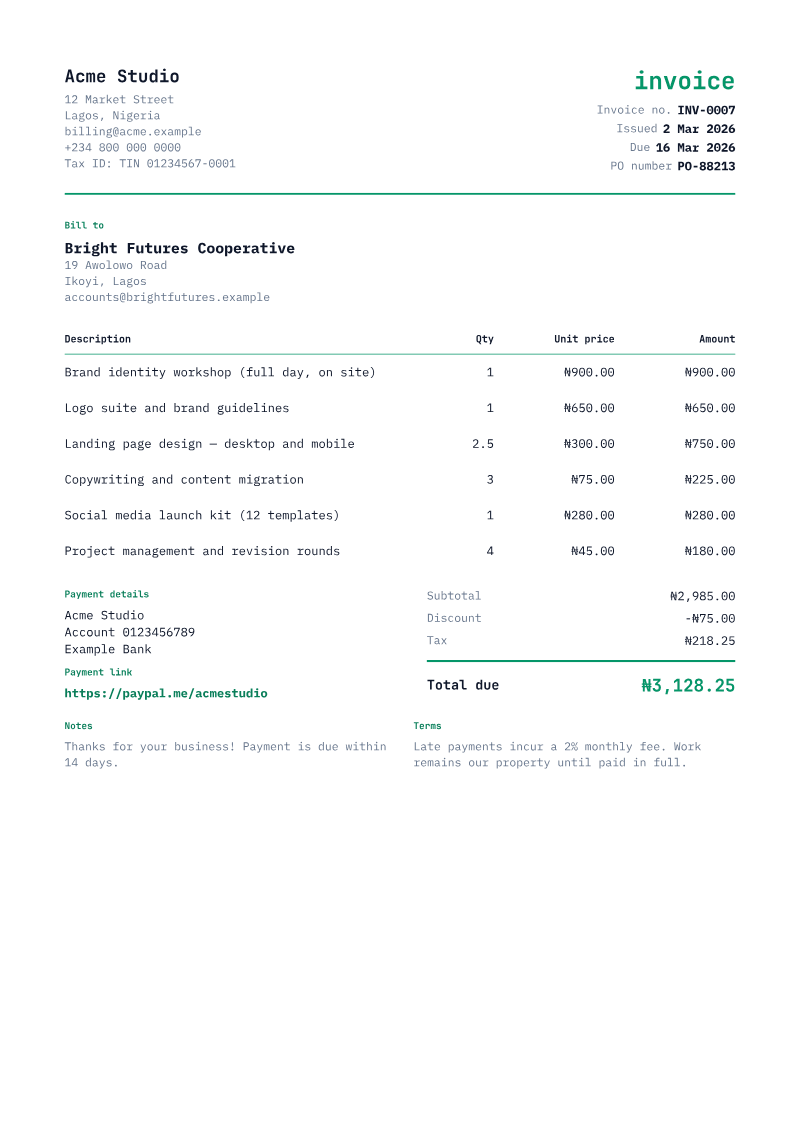
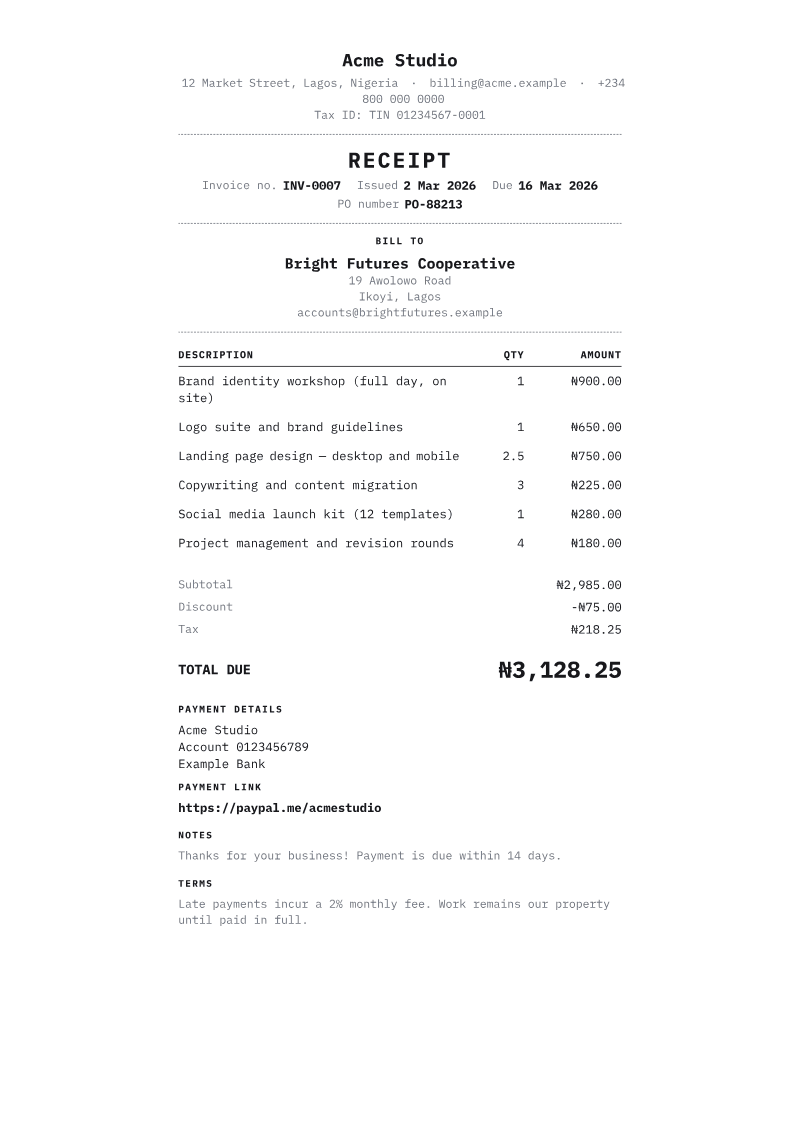
The Receipt invoice template, shown on a sample invoice

Receipt

Narrow till-receipt column, ideal for quick retail sales.

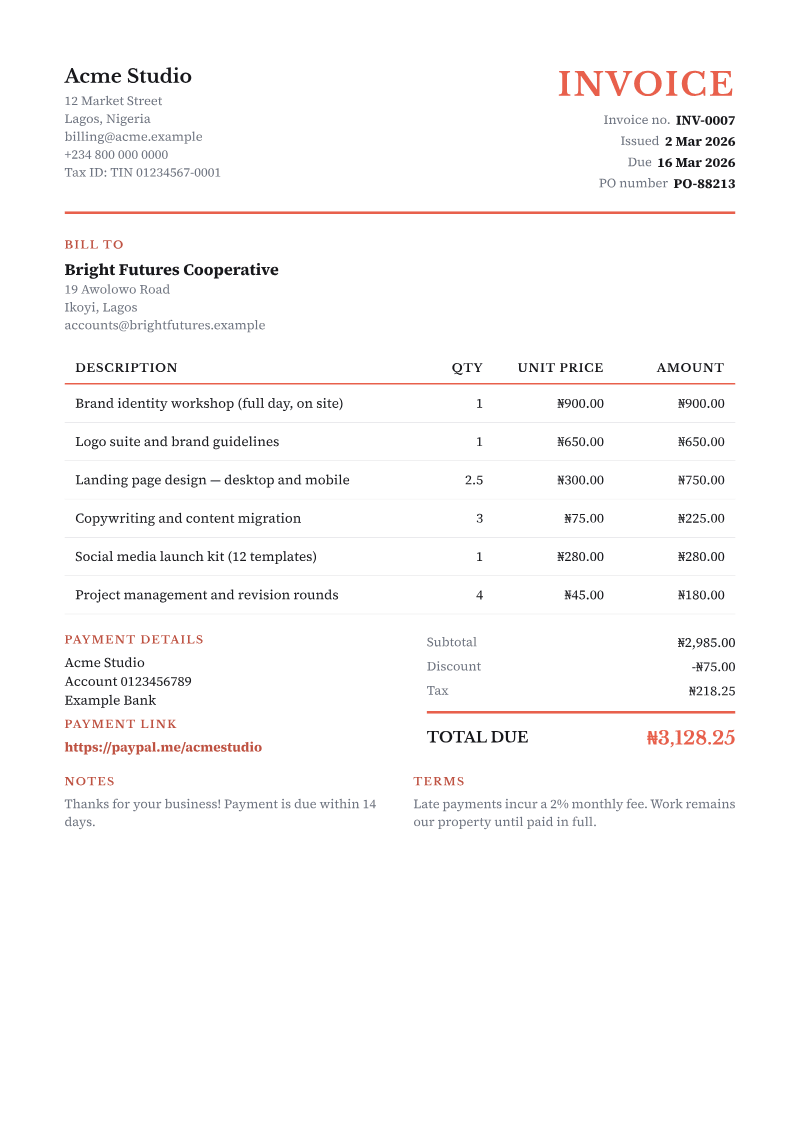
The Classic invoice template, shown on a sample invoice

Classic

Serif letterhead with a coloured rule — timeless and formal.

The Mono / Tech invoice template, shown on a sample invoice

Mono / Tech

Monospaced, terminal-inspired and precise. Made for developers.

Make this invoice with your own details

Add your business, your client and your own rates, then send it to your client as a PDF.