Invoice factoring for staffing agencies: how it works

Nnabuike Okoroafor ·
On this page · 12 sections
Your temps worked last week. If you pay them weekly, payroll goes out on Friday. The client that used them pays on Net 45, so the money for those hours arrives about six weeks after you have already paid the people who worked them. Win a bigger client, place ten more workers, and the gap grows with you. That gap is the problem invoice factoring for staffing agencies is sold to solve.
This guide works through one invented week in dollars: the invoice, the payroll date, the client’s due date, and what a factor would advance and charge. It also defines “payroll funding”, shows what factoring changes on your invoices, and lists the staffing-specific questions to ask before you sign. For the general mechanics in any industry, invoice factoring explained is the companion guide; this post does not repeat it.
Two things up front. General information, not legal or tax advice, and not financial advice either: nothing here recommends using or avoiding any factor, and no provider is named or ranked. And we make Charming Invoices, an invoicing app. Charming does not factor, finance or buy invoices, advance money, collect debts, send notices of assignment or connect to any factor. It appears only where the invoice itself is discussed.
In short#
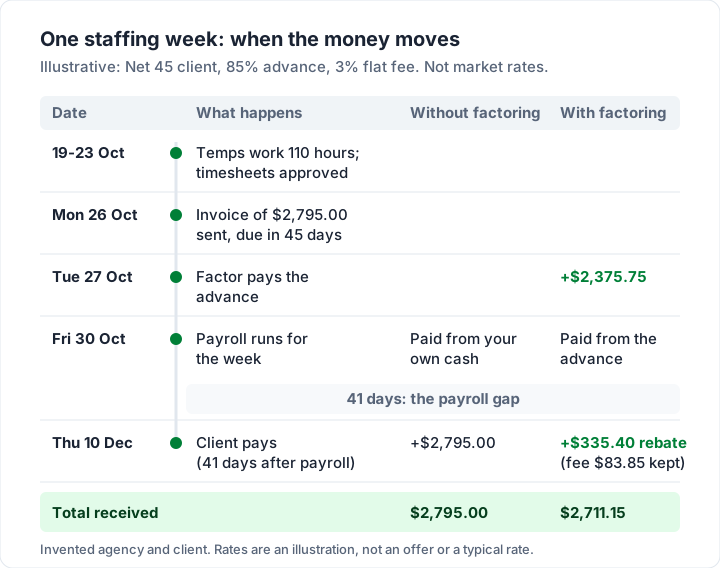
- The gap sits between your payroll and the client’s due date. In our illustrative week, the temps are paid on Friday 30 October 2026 and the client’s Net 45 invoice is due on Thursday 10 December 2026, 41 days later.
- Factoring sells that invoice to a factor for an advance now and the rest, less a fee, when the client pays the factor.
- On our illustrative $2,795.00 invoice, an 85% advance and a 3% flat fee put $2,375.75 in your account the next day and $335.40 more when the client pays: $2,711.15 in total, a cost of $83.85.
- “Payroll funding” is a name for what the funding is used for. Your contract decides what you actually signed.
- Factoring changes your invoices: remit-to details, often assignment wording, and a client accounts team that now pays someone else.
- If a funder also runs your payroll, read the IRS line quoted below before you hand over your payroll taxes.
Why staffing agencies run short of cash before clients pay#
A staffing agency’s biggest cost, the wages of the people on assignment, falls due before the invoice does. If you pay weekly and your clients pay on Net 30, Net 45 or Net 60, every new placement adds weeks of payroll that you fund yourself until the client pays.
Many large clients pay on a fixed payment run, on the terms in their contract. If you agree to Net 45, plan your payroll around Net 45, or negotiate the terms before you sign. Our guide to what Net 30 actually means explains when the clock starts and how terms are written on an invoice.
How invoice factoring for staffing agencies works#
The steps are the same as in any factoring arrangement, with staffing’s paperwork added:
- The week ends and the client approves the timesheets. A factor will usually want evidence that the client accepts the hours before it buys the invoice.
- You invoice the client for the hours at your bill rates, and send the invoice and the approved timesheets to the factor.
- The factor checks the client’s credit and the paperwork, then pays you an advance: a percentage of the invoice.
- The client pays the factor on its normal terms, because it has been told to pay the factor instead of you.
- The factor releases the reserve (the part it held back) less its fee.
The factor is buying your client’s promise to pay, so the client’s payment record matters as much as yours. That is why factors set limits per client, and may decline some. The trucking guide shows how factoring works on one load if you want the same flow in another industry.
One week, worked through#
Here is one invented week. Every rate in this section is an illustration chosen to show the arithmetic. It is not a market rate, a typical rate or an offer from any provider. Real advance rates and fees are set by each factor’s contract.
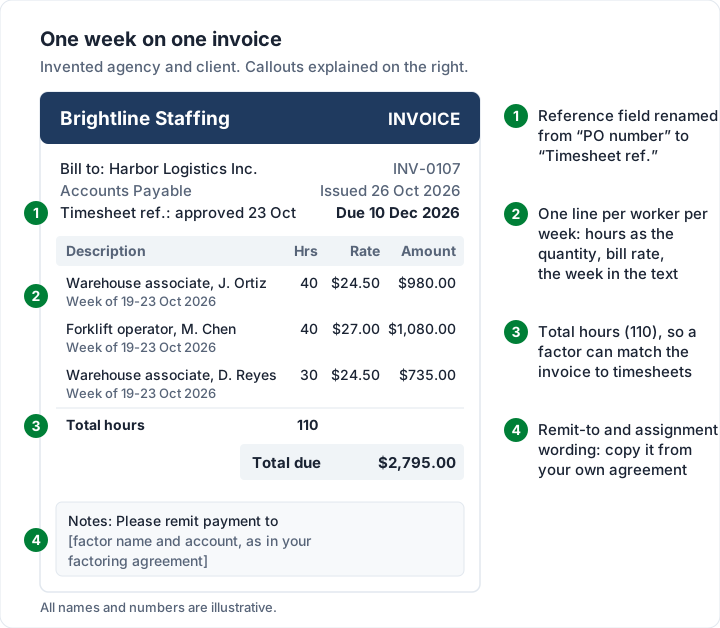
Brightline Staffing (invented) supplies three temps to Harbor Logistics Inc. (invented) on Net 45 terms. The work week runs from Monday 19 to Friday 23 October 2026. Harbor approves the timesheets on Friday 23 October, and Brightline sends its invoice on Monday 26 October.
| Line item | Qty | Rate | Amount |
|---|---|---|---|
| Warehouse associate — J. Ortiz, week of 19-23 Oct 2026 | 40 hrs | $24.50 | $980.00 |
| Forklift operator — M. Chen, week of 19-23 Oct 2026 | 40 hrs | $27.00 | $1,080.00 |
| Warehouse associate — D. Reyes, week of 19-23 Oct 2026 | 30 hrs | $24.50 | $735.00 |
| Total hours | 110 | ||
| Total due by Thursday 10 December 2026 | $2,795.00 |
The rates are bill rates: what Brightline charges Harbor, not what it pays the workers. Brightline’s payroll for that week runs on Friday 30 October 2026. Without factoring, it pays its temps 41 days before Harbor’s money is due. The sample shows no sales tax line; whether staffing services are taxed where you work is a question for your state tax agency.
Now the illustrative factoring deal: an 85% advance, a flat fee of 3% of the invoice, and the reserve released when the client pays.
| Item | When | Amount |
|---|---|---|
| Invoice total | Mon 26 Oct 2026 | $2,795.00 |
| Advance at 85% (illustrative) | Tue 27 Oct 2026 | $2,375.75 |
| Reserve held back (15%) | Until Harbor pays | $419.25 |
| Fee at 3% of the invoice (illustrative, flat) | Taken from the reserve | $83.85 |
| Rebate when Harbor pays (reserve less fee) | Thu 10 Dec 2026 | $335.40 |
| Total Brightline receives | $2,711.15 |
So Brightline pays $83.85 to have $2,375.75 on 27 October instead of 10 December, 44 days early. Turned into a simple yearly rate, the same way the guide to what invoice factoring really costs does it:
Fee ÷ cash advanced     83.85 ÷ 2,375.75   = 3.53% for 44 days
Simple yearly rate      3.53% × 365 ÷ 44   = about 29.3% a year
That is a simple annualised figure for comparison; a provider’s own estimated APR may be worked out differently. Whether it is worth paying depends on what the cash does. If it lets you staff a client you could not otherwise carry, the fee may well be worth it. If it only smooths a payroll you could have covered anyway, it is $83.85 for nothing.
Multiply by your weeks. Payroll is weekly, so the invoices you factor will be too. Over 52 weeks like this one, the fees alone would come to $4,360.20 (52 × $83.85), before any other charges. And real contracts may differ from this flat example: a fee that rises for every extra period the client takes, a fee charged on the advance rather than the invoice, or per-invoice charges on top. Ask for every one of them in writing and work them into your own week.
Payroll funding vs factoring vs invoice financing#
These words are used loosely, and sometimes interchangeably. As plain business terms:
| Term | What it usually describes | What to check in the contract |
|---|---|---|
| Invoice factoring | You sell the invoice to a factor, which collects from your client | Who collects, and what happens if the client never pays |
| Payroll funding | A name for funding aimed at making payroll: often factoring underneath, sometimes bundled with the funder running your payroll | Whether it is a sale of invoices, a loan or a credit line, and whether the funder handles payroll |
| Invoice financing | The umbrella term for raising money against unpaid invoices; factoring is one form, borrowing against invoices while you keep collecting is another | Who collects, whether your clients are told, and what secures the money |
The product name is only a starting point. Your contract decides what you actually signed: a sale of invoices, borrowing secured on them, or a service that also runs payroll. Factors describe factoring as a sale of the invoice, not a loan; how it is treated in your accounts is a question for your accountant.
Recourse is the term to read first. With recourse factoring, if your client does not pay, you typically buy the invoice back. Non-recourse moves some of that risk to the factor, but only for the losses the contract lists. The companion guide covers both with a worked case.
Reading this from the UK? Searches for invoice finance for recruitment agencies describe the same advance, reserve and fee. This post does not cover UK law or regulation, so ask an accountant or solicitor before you sign anything.
What changes on your invoices and with your client#
Once a factor owns your invoices, a few things change on paper and with your client:
- A notice of assignment. In plain business terms, a letter telling your client to pay the factor instead of you. It usually goes to each client once, before the first factored invoice. What a notice binds your client to is a legal question; ask a lawyer.
- Remit-to details. Your invoices point payment to the factor’s account or address instead of yours. Remittance on an invoice explains remit-to details in general.
- Assignment wording. Many factoring agreements give you a sentence to print on each invoice. Use the factor’s wording, word for word, not a sample from the internet.
- Your client’s vendor record. A new bank account may mean a form or a confirmation call on their side before the change takes effect, and until it does, payments may keep arriving with you. Your agreement will say what you must do with them.
- Who chases late payment. Once the factor owns an invoice, chasing it may be the factor’s job, not yours. Check before you send your own reminders.
- Leaving a factor. Clients will keep paying the factor until they are told otherwise. Ask for a written release when your account is settled, and send it to each client before you invoice them directly again.
When the funder also runs your payroll#
Some funders that work with staffing agencies also offer to run payroll, file payroll taxes or act as your back office. Before you hand over the job, ask who is responsible if the payroll taxes are not deposited.
The IRS answers the general case on its page about outsourcing payroll, under the heading “Payroll service provider not making federal tax deposits?”:
In the event of default by a third party, the employer remains responsible for the deposit of the federal tax liabilities and timely filing of returns.
Source: IRS, Outsourcing payroll and third-party payers, marked “Last Reviewed or Updated: 10-Oct-2026”, read on 28 October 2026.
What that means for your own arrangement, and which kind of third-party payer your funder is, are questions for an accountant or payroll tax adviser. Before you sign, ask the funder in writing what it files, in whose name, and how you can check that each deposit was made.
Costs and contract terms to check#
Most of the risk sits in the contract, not the advance rate. These are the staffing-specific questions, worth sending to every factor you speak to and getting answered in writing:
| Term | What to ask |
|---|---|
| Fee basis | Is the fee flat, or does it rise for every extra period the client takes? Is it charged on the invoice or on the advance? What else is charged per invoice or per month? |
| Timesheet approval | What proof of approved hours do you need with each invoice, and in what form? |
| Per-client limits | How much will you fund for each of my clients, and what happens when one reaches its limit in the middle of an assignment? |
| Funding cut-off | By what time must an invoice reach you to be funded before my payroll run? |
| Minimum volume | Is there a monthly minimum, and what do I pay if I fall short? |
| All clients or some | Must I factor every client’s invoices, or can I choose? |
| Recourse window | After how many days unpaid must I buy an invoice back, and what does that cost? |
| Term and exit | How long is the term, does it renew automatically, what notice ends it, is there a termination fee, and how fast will you send release letters? |
| Payroll services | If you run my payroll, what do you file, in whose name, and how do I check it? |
For the general list, including the UCC-1 filing and cost disclosures, see our questions to ask a factoring company. Wherever you are, you can ask any provider for the total dollar cost on one of your own invoices and an estimated APR, in writing.
Alternatives to try before you factor#
These cost less or nothing, and some work alongside factoring:
- Invoice on approval day. Send the invoice the day the client approves the timesheets, not at the end of the month. Every day you wait is added to the gap.
- Shorter terms on new contracts. Net 15 or Net 30 is a fair ask before you sign, harder to win afterwards.
- Deposits or stage payments on permanent placements. A retained search can be invoiced in parts rather than in one fee at the end; see deposit invoices: how they actually work.
- A monthly statement. A statement of open invoices shows a client’s accounts team everything outstanding on one page.
- A bank line of credit. It leaves your clients out of it. Compare its cost in dollars on the same week.
- A firm process for late payers. The escalation ladder for unpaid invoices runs from a polite reminder to a final notice.
Staffing invoices in Charming, and what it does not do#
A factor checks every invoice against the timesheets, so the invoice should make that easy: one line per worker per week, the hours as the quantity, the bill rate, the week in the description and a reference to the approved timesheets. Address it to the client’s accounts team; who to address an invoice to covers what a company’s payables team expects. If your hours start in a tracker, turning tracked hours into an invoice covers that step.
If you would rather start with a file, the invoice template for hours worked has a filled sample, and the hourly Excel file is free on the Excel and Word invoice templates page with no sign-up.
Here is what Charming Invoices does for the week above, checked in our code on 28 October 2026:
- Hours as the unit. Each line takes a quantity to 3 decimals and a unit such as “hrs”. Unit prices print at 2 decimals, so use whole-cent bill rates like the sample’s.
- A total hours line, on by default in the Timesheet and Contractor templates (2 of the 60) and a “Total hours” switch in any template’s table settings. It adds up every line billed in hours: 110 in the sample.
- A reference you can rename. Relabel “PO number” as “Timesheet ref.” or “Week ending” in your template’s labels, and type up to 100 characters on each invoice. Where to put the PO number on an invoice covers reference fields in general.
- Notes and terms on each invoice, where you paste the assignment wording your factor supplies. Charming does not write it for you.
- Client statements as a PDF with ageing columns (current, 1-30, 31-60, 61-90 and 90+ days), which you download and send yourself.
- A PDF and a private link. Issue the invoice, then download the PDF or copy its private link and send it to the client or your factor however you like. Overdue invoices are flagged. Charming does not send reminders; with a factor, chasing may be its job, so check your agreement before you follow up yourself.
- Weekly recurring invoices on the paid plans (from Individual, $29 once). Each arrives as a draft for you to review and issue, not sent automatically. Hours change every week, so a recurring draft saves you the client and the lines, not the numbers.
- CSV export of your invoices, for your bookkeeper.
The catches, plainly:
- Payment details are per business. Bank details and one payment link are set for the business and copied onto each invoice when you save it, not edited per invoice. If you factor some clients and not others, change the business’s payment details before you save a factored invoice, or put the factor’s remit-to wording in that invoice’s notes.
- Payment tracking is manual. You record payments and mark invoices paid. A factor’s advance is not a payment from your client, so track advances, reserves and fees in your bookkeeping, outside Charming.
- No card payments and no integrations. Charming does not take card payments, connect to a factor’s portal or a payroll system, or attach timesheets; send those to your factor yourself.
- The free plan has unlimited invoices and clients for 1 business, and its invoices carry a small “Sent with Charming Invoices” line in the footer. Paid plans hide that line by default and can switch it back on. The lifetime plans (Individual $29 once, Team $79 once) are final sale; Pro is $12 a month or $99 a year.
- A web app only, with no mobile app.
If that fits how you bill, create a free invoice and set up one week with the Timesheet template.
Invoice factoring for staffing agencies: questions#
Is invoice factoring a loan?#
Factors describe it as a sale of the invoice, not a loan. How your contract is treated in your accounts is a question for your accountant.
What is payroll funding for staffing agencies?#
A name for funding aimed at making payroll before clients pay: often invoice factoring underneath, sometimes bundled with running your payroll. Ask what the contract actually does.
Will my clients know I factor?#
Usually, yes. With notification factoring, each client receives a notice of assignment and pays the factor, and your invoices show the factor’s remit-to details. Some arrangements work without telling clients; ask the factor which kind it offers.
Can I factor permanent placement fees?#
Some factors do and some do not; ask. A perm fee is a one-off invoice rather than a weekly one, and if your placement terms include a replacement guarantee, ask how the factor treats the fee during that period.
What do factors ask staffing agencies for?#
Expect to be asked for approved timesheets with each invoice, the invoice itself, details of the clients you want to factor so the factor can check their credit, and your own company details. Each factor sets its own list, so ask for it in writing before you apply.
The short version#
Invoice factoring for staffing agencies trades a fee for moving client money in front of payroll: on our illustrative week, $2,375.75 the next day and $2,711.15 in total, for $83.85, about 29.3% a year as a simple rate. Read what the contract really is, ask the staffing questions in writing, check who files your payroll taxes, and try the cheaper fixes first.