Demand letter for an unpaid invoice

Nnabuike Okoroafor ·
On this page · 11 sections
You have sent the invoice, the reminders and a final notice. The client has gone quiet, or keeps promising a payment that never arrives. The usual next step is a demand letter for the unpaid invoice: a formal, written request that states what is owed, sets a last date to pay, and says plainly what you will do if that date passes.
General information, not legal advice. Court rules, limits, fees and deadlines differ between countries and between US states, and they change. This post links the official pages rather than summarising them; check your own court's current guidance, and ask a lawyer before you rely on any of it.
When a demand letter is the right next step#
A demand letter is the last thing you send before you act. Send one when all of these are true:
- The invoice is undisputed. If the client says the work was wrong or incomplete, deal with that first: what to do when a client disputes an invoice covers it. A demand that ignores a live complaint tends to harden it.
- You have already chased. At least two reminders and a final notice, in writing, with dates. If you have not got that far, start with the overdue invoice email, step by step.
- You know who owes you. The legal name of the person or company, and an address. "Sam from the agency" is not enough for any formal step.
- You will follow through. A letter that threatens court, followed by nothing, teaches the client to wait you out.
- The amount justifies the effort. Fees, your time and the chance of not collecting all count. A few hundred dollars may be better written off; a few thousand usually is not.
If you are not sure you have reached this point, what to do when a client is not paying your invoice walks through the earlier options, including a payment plan.
Final notice, demand letter and letter of claim#
People use these words loosely. They are different documents, sent at different moments.
| Document | When | Tone | What it asks |
|---|---|---|---|
| Reminder | Around the due date | Friendly, factual | Please pay invoice 2026-014 |
| Final notice | Several weeks late | Calm, formal | Pay by a date, or a named next step follows |
| Demand letter | Final notice ignored | Formal, written as evidence | Pay the stated sum by a date, or you start a claim or hand the debt on |
| Letter of claim | Where a formal pre-action rule applies | Formal, in the form that rule sets | Whatever the official rule says |
Write a demand letter so that a stranger could read it later and understand the whole story from that page alone. That is the test for every sentence in it.
What a demand letter for an unpaid invoice should contain#
Keep it to one page if you can.
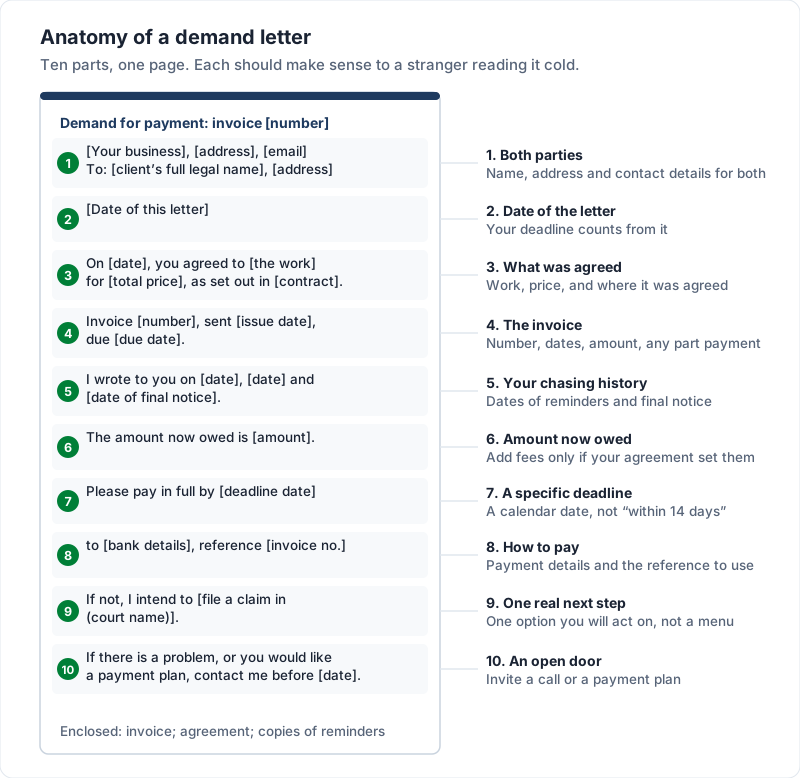
- Both parties. Your name or business name, address and contact details; the client's full legal name and address.
- The date of the letter. Your deadline counts from it.
- What was agreed. The work, the price, and where it was agreed: a signed contract, an accepted proposal, or the emails where the client approved the work.
- The invoice. Number, issue date, due date, amount, and any part payment received.
- Your chasing history. The dates of your reminders and final notice. This shows you were reasonable.
- The amount now owed. Add a late fee or interest only if your agreement set one out; the free late fee calculator does the arithmetic for an agreed fee. If you think a law gives you a right to interest, check the official guidance or ask a lawyer before you add it.
- A specific deadline. A calendar date, not "within 14 days".
- How to pay, with the reference to use.
- One real next step, stated without heat: a small claims filing or a collection agency.
- An open door. An invitation to call or propose a payment plan. It costs nothing and reads well later.
Leave out insults, threats to post about the client online, threats of criminal action, and anything you would not want read aloud to a stranger.
Sample demand letter for unpaid invoices#
This is a plain template to adapt, not a legal form. Copy it, replace everything in square brackets, and delete any line that does not apply. Plain language is deliberate. If the sum is large, the client is abroad, or your local rules set out what a pre-claim letter must contain, get advice before you send it.
[Your name or business name], [your address], [email], [phone]
[Date of this letter]
To: [client's full legal name], [client's address]
Demand for payment: invoice [number]
Dear [Name],
On [date], you agreed to [short description of the work] for [total price], as set out in [our contract dated ... / your email of ...]. I completed the work on [date] and sent invoice [number] on [issue date], due on [due date].
The invoice remains unpaid. I wrote to you about it on [date], [date] and [date of final notice] and have not received payment [or: I received a part payment of (amount) on (date)].
The amount now owed is [amount]: invoice [number] for [amount] [plus (late fee or interest) of (amount), as set out in (clause of our agreement)].
Please pay [amount] in full by [deadline date] to [bank details or payment link], using the reference [invoice number].
If I have not received payment, or a written proposal to pay, by that date, I intend to [file a claim in (court name) / pass this debt to a collection agency].
If there is a problem I should know about, or you would like to agree a payment plan, please contact me before [deadline date] at [phone or email].
Yours sincerely, [Your name]
Enclosed: invoice [number]; [contract or approval email]; [copies of reminders]
Make the bracket after "I intend to" one option you are prepared to take, not a menu. Attach the invoice and the agreement, so the letter stands on its own. Some places have formal rules for the letter you send before a court claim, especially when the client is an individual: see the official pages below before you use this template for that purpose.
How to send it and keep proof#
Part of the point of a demand letter is the record it creates.
- Save it as a PDF with the date in the file name.
- Email it to the client, and to their accounts address if they have one, with a subject such as "Demand for payment: invoice 2026-014".
- Post a copy by a tracked or signed-for service (in the US, certified mail with a return receipt is the usual choice). Keep the receipt.
- Keep one file: the letter, delivery proof, invoice, agreement and every reminder. Any later step runs on this record.
- Put the deadline in your calendar, and decide now what you will do the day after it.
Some courts expect you to have asked first. California's self-help guide, for example, says: "The court wants you to ask the other side for the money you think they owe you before you start a small claims case." It adds: "You can ask in person, by writing a letter, or emailing the other side." (California Courts Self-Help Guide, "Ask for the money", as of 23 October 2026). A dated letter is an easy way to keep a record that you asked.
How long to give the client#
No single deadline suits every case, and a formal rule where you are may set one. In practice, many businesses give a business client 10 to 14 days from the date of the letter; whatever you pick, write it as a specific date.
One example of a formal rule is England and Wales's Pre-Action Protocol for Debt Claims. Its paragraph 1.1 says: "This Protocol applies to any business (including sole traders and public bodies) claiming payment of a debt from an individual (including a sole trader)." Paragraph 3.4 says: "If the debtor does not reply to the Letter of Claim within 30 days of the date at the top of the letter, the creditor may start court proceedings, subject to any remaining obligations the creditor may have to the debtor (for example, under the Financial Conduct Authority’s Handbook)." (Pre-Action Protocol for Debt Claims, justice.gov.uk, as of 23 October 2026). The protocol also sets out what the letter of claim contains and what goes with it. If it may apply to you, read the protocol and the Practice Direction on Pre-Action Conduct themselves, or get advice; do not rely on this summary.
For business-to-business invoices in the UK, GOV.UK says: "The interest you can charge if another business is late paying for goods or a service is ‘statutory interest’ - this is 8% plus the Bank of England base rate for business to business transactions. You cannot claim statutory interest if there’s a different rate of interest in a contract." (GOV.UK, "Late commercial payments: charging interest and debt recovery", as of 23 October 2026). The same page describes a fixed debt recovery charge. If you think either applies, read the page in full and show any figure you add in the letter.
Small claims court for unpaid invoices#
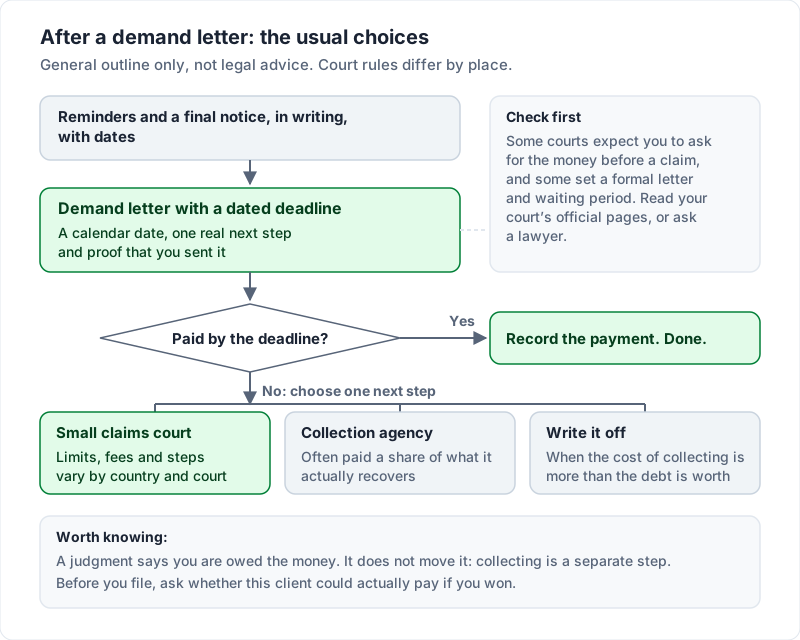
If the deadline passes with nothing, a small claim is a common next step for a modest unpaid invoice. The process varies by country, state and court, so this post does not walk you through it. Start with the official pages for the place where the claim would be heard:
- California: the California Courts small claims guide. As of 23 October 2026 it says: "Generally, you can only sue for up to $12,500 in small claims court (or up to $6,250 if you’re a business). You can ask a lawyer for advice before you go to court, but you can't have one with you in court."
- Other US states: your state court's website, or the National Center for State Courts' small claims overview.
- England and Wales: GOV.UK, "Make a court claim for money", which lists the current fees and options, including mediation.
Check the limit, the fee and which court can hear the claim on those pages before you file, especially if the client is in another state or country.
Winning is not the same as being paid#
Winning and collecting are separate. California's small claims guide says it directly: "You have to collect the money if you win your case. The court does not do it for you." (California Courts, "Small claims in California", as of 23 October 2026). In public online discussions we read while researching this post (the people quoted are not Charming customers), a graphic designer was encouraging about the first part:
If they don’t pay you within the allotted time, small claims court is very easy to navigate.
Both can be true: the process can be approachable, and collecting from someone determined not to pay can still be slow and costly. The enforcement options, and their fees, are on your court's official pages. In practice, a trading business with a bank account is far easier to collect from than a client who has vanished.
When a collection agency for unpaid invoices makes sense#
A collection agency takes over the chasing. It tends to make sense when the client is a business that is still trading but ignoring you, the amount is too large to write off but not worth a lawyer, you do not have the time for court, or the client is somewhere you cannot easily sue.
What it costs, in general terms. Most agencies are paid a contingency fee: a percentage of what they actually recover, often with nothing to pay if they recover nothing. The percentage varies by agency and usually rises with the age and difficulty of the debt, so get it in writing, along with who pays any court costs and whether you may still accept a payment directly. An agency can improve your odds; it does not guarantee them.
Waiting too long has a cost of its own. A commenter in a videography thread from the same research wrote:
Client owed me thousands. I gave up. I should have just kept going and sent them to a collections agency.
Who the client is matters. Debt-collection rules can differ when the client is a person rather than a business. In the US, the Consumer Financial Protection Bureau says: "The FDCPA covers the collection of debts that are primarily for personal, family, or household purposes." It also says: "Most states have laws about debt collection practices, many of which are similar to the FDCPA." (CFPB, "What laws limit what debt collectors can say or do?", as of 23 October 2026). If you bill individuals, read that page and your state's rules, or ask a lawyer, before you or an agency chase a personal client hard.
When to talk to a lawyer#
A short consultation is worth paying for when the amount is above your small claims limit, the client disputes the work and threatens a counterclaim, the client is abroad or insolvent, your contract has an arbitration or jurisdiction clause you do not understand, or the time limit for bringing a claim may be close. A letter on a lawyer's letterhead can also prompt payment where yours did not; some lawyers offer this for a fixed fee, so ask the price first.
Questions people ask#
I never signed a contract. Can I still claim? That is a question for a lawyer where you are. Either way, gather whatever shows the agreement: the proposal the client accepted, emails approving the work and the price, messages confirming delivery.
Can I add a late fee to the demand? Add one only if your agreement included it. If you think a law gives you a right to interest, such as the UK statutory interest quoted above, read the official page or ask a lawyer first. A fee that appears for the first time in a demand letter looks invented after the fact. For future work, invoice payment terms, in plain English shows how to agree terms up front.
The client paid part of it. Now what? Acknowledge the payment in writing and demand the balance, using the same structure as the sample.
The short version#
Send a demand letter only for an undisputed invoice you have already chased. Keep to the facts, give a dated deadline and one real next step, and keep proof of delivery. If the date passes, choose between small claims, a collection agency or a write-off, counting the cost of collecting as well as the cost of filing.
For the next client, the cheapest demand letter is the one you never write: a deposit, written terms and a real due date on every invoice.