Videographer invoice: day rates, kit, edits and licensing

Nnabuike Okoroafor ·
On this page · 15 sections
A videographer invoice has more moving parts than most. One job can hold a pre-production call, a shoot day, a second shooter, your own camera kit, a rented gimbal, an edit with revision rounds, a music licence, mileage and a usage licence, and the client still expects one clear total. Many videographers learn this the first time a corporate client says “just invoice us”.
This guide answers that request for videography of every kind: corporate, events, weddings, music videos and social content. It covers day rate versus half day versus project pricing, how to split pre-production, production and post-production, crew and gear, travel, editing rounds, usage and buyouts, raw footage and rush fees, deposits and kill fees, and milestone billing. Then it puts all of it on one worked invoice with real arithmetic, and ends with how to get paid before the final files leave your drive. If you only edit, how to write a video editor invoice covers per-minute pricing, revision rounds and rush fees.
General information, not legal or tax advice. Where a rule is mentioned, we quote and link the official page; ask an accountant or lawyer about your own situation.
In short:
- Bill in the unit you agreed: days, half days, hours or a project fee, with the length of a day written on the invoice.
- Split the job into phases: pre-production, production and post-production, each with its own lines.
- Keep labour, your own kit and rented kit apart. Your kit is a day fee; a rental is a cost you pass through with the receipt.
- Price usage as its own line, with the same terms as your written agreement.
- Take a deposit to hold the date, and send the final files when the balance is paid.
What a videographer invoice needs on top of the basics#
Every invoice needs the standard fields: your business name and contact details, the client’s, a unique invoice number, the issue date and due date, line items, the total and how to pay you. If you want the full field-by-field list, what actually belongs on an invoice has it, and how to invoice as a freelancer covers the wider routine of terms and records.
A videography invoice adds a few things a generic one leaves out:
- The shoot date and location, so the client’s accounts team can match the invoice to the job.
- What a “day” means. “Shoot day (10 hours)” stops an argument about hour eleven before it starts.
- The deliverables, by name and length. “90-second brand film plus 3 × 15-second vertical cutdowns” beats “video editing”.
- How many revision rounds the fee includes, and the price of another.
- The usage you are licensing: where, for how long and whether it is exclusive.
- Costs you are passing through, such as rentals, music and mileage, marked as at cost.
- Any deposit already paid, credited against the total with its invoice number.
Day rate, half day or project fee#
Most videography is sold one of three ways. The invoice should use the same unit the quote used, in the same words, so the client can tick it off rather than question it.
| Billing model | How it reads on the invoice | Best for | Put in writing first |
|---|---|---|---|
| Day rate | 1 day × $850.00, shoot day (10 hours) | Corporate shoots, events, crew work | Day length and the overtime rate |
| Half day | 1 half day × $500.00 (5 hours) | Interviews, short promos, headshot video | Whether travel counts inside the 5 hours |
| Project fee | 1 × brand film package, scope listed | Clients who want one number | Exactly what the package includes |
The figures above are examples, not a rate guide. Two pricing points matter more than the numbers.
A half day is rarely worth exactly half a day. The other half of the day is hard to sell, so price a half day above 50% of your day rate if you offer one at all. In the example, $500.00 is a little under 60% of the $850.00 day.
State overtime before you need it. A common way to write it is a multiple of your hourly equivalent. With an $850.00 ten-hour day, time and a half is $127.50 an hour, and the invoice line reads “Overtime, 1.5 hours at $127.50”. If the client asked for the extra hour on set, that line is simple to defend.
A project fee can still be itemised. Many clients want a single price on the quote, but the invoice is where an itemised breakdown earns its keep: it shows what the money paid for. Our post on why your invoice argues against your rate was written for designers, and the same point applies to video: one vague line invites a discount, and itemised lines explain the price.
Split the job into pre-production, production and post-production#
Video work happens in three phases, and grouping your lines the same way makes a long invoice easy to read. It also makes milestone billing simple later, because each phase is already its own block.
- Pre-production: discovery or brief call, script or shot list, storyboard, location scout, casting, permits.
- Production: each shoot day, each crew member, your kit, rentals, location fees.
- Post-production: edit, colour grade, audio mix, motion graphics, captions, cutdowns, music licensing.
A section heading with a subtotal under each phase tells the client at a glance that the edit cost more than the shoot, and why.
Crew and gear: kit fee or rental#
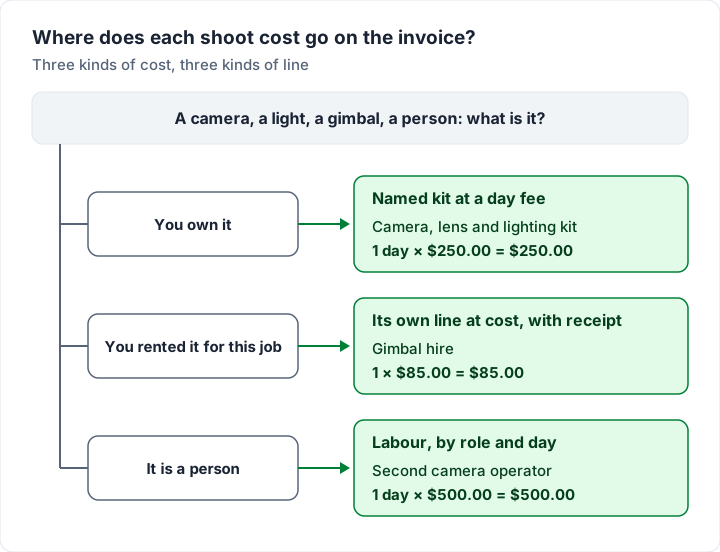
Gear is where videography invoices get confusing, because there are two different kinds of gear charge and they belong on separate lines.
Your own kit is a fee. Camera bodies, lenses, lights, audio, drones and gimbals you own cost money to buy, insure and replace, so they earn a day fee. Bundle them into named kits: “Camera, lens and lighting kit, 1 day, $250.00”.
A rental is a cost you pass through. If you hired a gimbal or a second lens for this job, invoice it as its own line at cost (or at cost plus a handling fee you agreed in advance), and attach or offer the receipt. Our rental invoice guide covers the other side of that transaction if you also rent your own kit out to other crews.
Crew is labour, not kit. A second shooter, a sound recordist or a gaffer each gets a line with their name or role, the day count and the day rate. If a crew member invoices you directly, you pass their fee through or mark it up as agreed; either way the client sees the role, not a mystery lump.
This decision tree sorts any piece of gear onto the right line:
Travel, mileage and per diem#
Travel is a real cost of a shoot, and it is easier to bill when the rules are in the quote. Agree three things up front: how travel time is charged, how distance is charged and what happens on overnight jobs.
| Travel item | Example invoice line | Note |
|---|---|---|
| Travel day | Travel day, Denver to Moab, 1 half day × $500.00 | Common when a shoot needs a full day on the road |
| Mileage | Mileage, 120 miles × $0.70 = $84.00 | Use the rate in your quote; this one is an example |
| Accommodation | Hotel, 1 night, at cost (receipt attached) | Pass through at cost unless agreed otherwise |
| Per diem | Per diem, meals, 2 days × $60.00 | A flat daily allowance on overnight jobs, agreed in the quote |
| Parking, tolls, permits | Location parking, at cost | Keep receipts; group small items on one line if the client agrees |
Rates above are examples. Some clients have their own travel policy, so ask before you quote if the client is a larger company.
Editing rounds and what happens after them#
The edit is usually the largest single line on a videography invoice, and revision rounds are where it quietly grows. Write the number of included rounds into the edit line itself: “Edit: 90-second brand film, 2 revision rounds included”. Then price an extra round the same way you price anything else, as its own line, such as “Additional revision round, 1 × $200.00”.
Drafts are also where your leverage sits. A burned-in timecode or a “draft” watermark lets the client judge the edit while keeping the finished file yours until the invoice is paid. Say on the invoice which version is final: “Final delivery: clean master and cutdowns, released on payment in full.”
Usage, licensing and buyouts#
Videographers often leave the licence off the invoice entirely, which means they give it away inside the shoot fee. Pricing usage as its own line does two jobs: it shows the client what they are paying for, and it gives you a clear answer when they want broader use later.
A usage line names the media, the term and the exclusivity: “Usage licence: web and social, 2 years, non-exclusive”. Broader use, such as paid ads, broadcast or a longer term, is a bigger number on the same line. A buyout is the top of that scale: the client gets all rights, often for good, and the price reflects that you can never license the footage again.
Who owns the footage, and what a licence or buyout really transfers, is a legal question: rules differ by country, and how they apply to your agreement is one for a lawyer. For US readers, the Copyright Office's own circulars are the place to start. Quoted as of 23 October 2026:
- Circular 1, Copyright Basics (revised September 2021): “The copyright in a work initially belongs to the author(s) who created that work.”
- Circular 30, Works Made for Hire (revised August 2024): among the kinds of “specially ordered or commissioned” work it lists is one “as a part of a motion picture or other audiovisual work”, and it sets out four criteria, including “The agreement must be signed by all parties.”
The practical habits do not need a lawyer: put the rights in writing before the shoot, read any work-for-hire or buyout clause before you sign it, price a buyout as a buyout, and make the licence line on the invoice match the agreement rather than replace it. A note such as “The licence above takes effect on payment of this invoice in full” is common, but check with a lawyer that it fits what you signed. If rights are a large part of the fee, an intellectual property lawyer in your country is worth an hour.
Raw footage, delivery formats and rush fees#
Clients ask for three extras often enough that it pays to have the lines ready. Each should be agreed in the quote and invoiced as its own line, never absorbed into the edit.
| Extra | Example invoice line | Why it is separate |
|---|---|---|
| Raw footage | Raw footage delivery: file prep and 2 TB drive, $150.00 | Time to organise files, plus the drive if you supply it |
| Raw footage rights | Licence to use raw footage: internal use only | Raw files without a licence line can blur what the client may do with them |
| Extra formats | Additional deliverable: 4:5 version of the brand film, $150.00 | Each new aspect ratio or length is more edit time |
| Rush delivery | Rush delivery, final within 48 hours of approval: 25% of the edit fee, $300.00 | Moves other work and often means evenings |
| Extra revision round | Additional revision round, $200.00 | Keeps the included rounds meaningful |
The rush example is 25% of the $1,200.00 edit. The percentage is yours to set; the point is to state it before the client asks for the rush.
Deposits, kill fees and milestone billing#
A deposit holds the date. For a single shoot plus edit, a common structure is a deposit at booking and the balance at delivery. In the worked example below, the deposit is 50% of the fees, with at-cost items billed afterwards. How deposit invoices work covers the deposit invoice itself, its wording and how to credit it on the final invoice.
A kill fee covers a job that stops. It only works if it is in the agreement the client accepted before the shoot. Introducing a new charge on the invoice alone is a weak position, and whether an invoice is a contract explains why. Here is an example set of cancellation terms, applied to the worked example’s $2,175.00 deposit:
| When the client cancels | Example term | On the worked example |
|---|---|---|
| More than 14 days before the shoot | Deposit kept, nothing more owed | $2,175.00 kept, no further invoice |
| 14 days or fewer before the shoot | Deposit kept, plus any rental already booked | $2,175.00 kept, $85.00 gimbal hire invoiced |
| After the shoot, during the edit | Work done to date, deposit credited | $2,585.00 of work, less $2,175.00, so $410.00 invoiced |
The last row adds pre-production ($300.00), the shoot crew ($1,350.00), the kit ($250.00), the gimbal hire ($85.00) and half the edit ($600.00). These terms are an illustration, not a recommendation for your contract.
Milestone billing suits larger productions. Bigger projects can be billed in stages: pre-production, production and post-production. On an example $15,000.00 production, that could be three invoices:
| Invoice | When it is sent | Share | Amount |
|---|---|---|---|
| 1. Pre-production | On signing | 30% | $4,500.00 |
| 2. Production | After the last shoot day | 40% | $6,000.00 |
| 3. Post-production | On final delivery | 30% | $4,500.00 |
Each is its own invoice with its own number and due date. If the milestones are percentages of a fixed contract value, progress invoicing shows how to show the amount billed to date and the balance left on each one. For ongoing monthly work, such as a social content package, a retainer invoice fits better.
A worked videography invoice: one-day shoot plus edit#
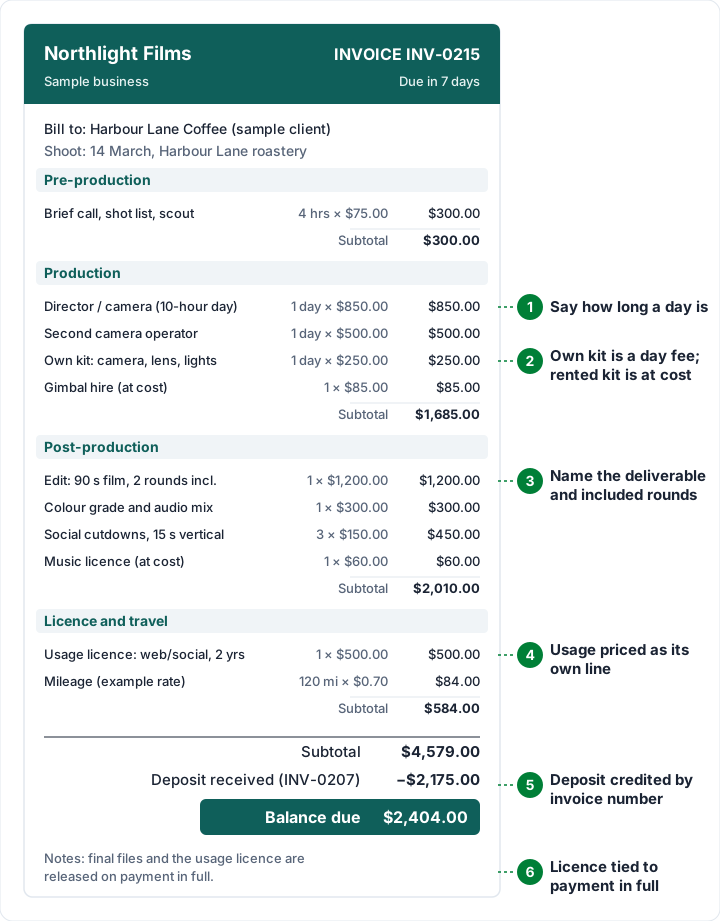
Here is a complete example. Northlight Films, an invented one-person video business, shoots a one-day brand film for an invented client, Harbour Lane Coffee. The quote listed $4,350.00 of fees, with rentals, music and mileage at cost. The client paid a $2,175.00 deposit (50% of the fees) on invoice INV-0207 when they booked. This is the final invoice, INV-0215. All figures are illustrative.
| Line | Qty | Rate | Amount |
|---|---|---|---|
| Pre-production | |||
| Brief call, shot list, location scout | 4 hrs | $75.00 | $300.00 |
| Production: 14 March, Harbour Lane roastery | |||
| Director and camera operator, shoot day (10 hours) | 1 day | $850.00 | $850.00 |
| Second camera operator, shoot day | 1 day | $500.00 | $500.00 |
| Camera, lens and lighting kit (own kit) | 1 day | $250.00 | $250.00 |
| Gimbal hire, rented for this job (receipt attached) | 1 | $85.00 | $85.00 |
| Post-production | |||
| Edit: 90-second brand film, 2 revision rounds included | 1 | $1,200.00 | $1,200.00 |
| Colour grade and audio mix | 1 | $300.00 | $300.00 |
| Social cutdowns, 15 seconds, vertical | 3 | $150.00 | $450.00 |
| Licensed music track (at cost) | 1 | $60.00 | $60.00 |
| Licence and travel | |||
| Usage licence: web and social, 2 years, non-exclusive | 1 | $500.00 | $500.00 |
| Mileage (example rate) | 120 miles | $0.70 | $84.00 |
| Subtotal | $4,579.00 | ||
| Deposit received (INV-0207) | −$2,175.00 | ||
| Balance due | $2,404.00 |
Notes on the invoice: “Payment due within 7 days. Final files and the usage licence are released on payment in full. Revision rounds beyond the 2 included are billed at $200.00 each.” No sales tax is shown in this example. Whether a sales tax applies is a question for your tax authority or an accountant.
The annotated version shows where each of the earlier sections lands on the page:
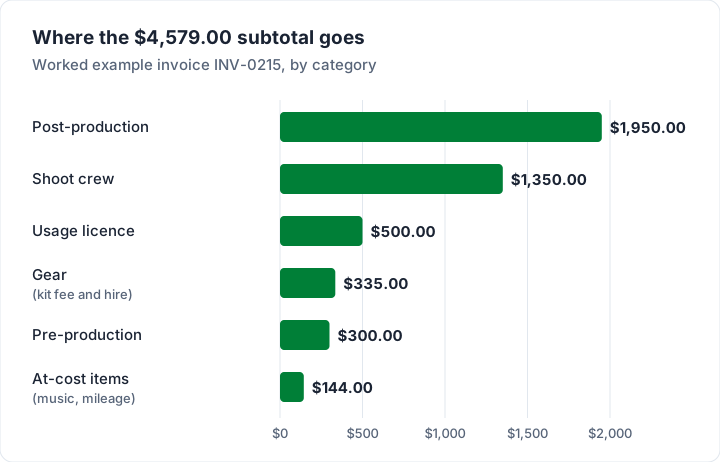
Seen as a breakdown, the edit and the crew are most of the bill, and the at-cost items are a small share:
Getting paid on delivery#
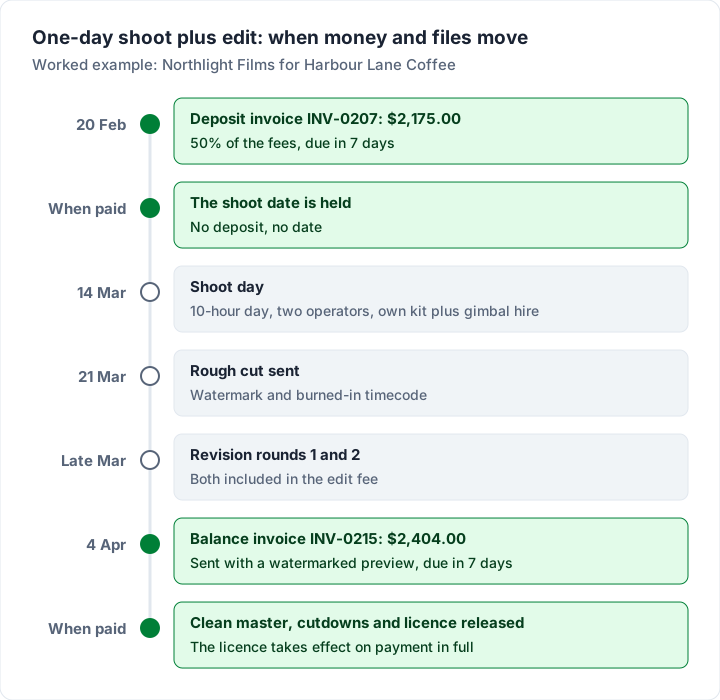
The usual order is money first, then final files. A preview with a burned-in timecode or watermark goes out with the balance invoice, and the clean master follows the payment. Here is the whole job as a timeline, using the worked example:
A few habits help the balance arrive:
- Short terms for small jobs. Seven days, or due on receipt, suits a one-off shoot. Payment terms like Net 30 explains the options, and the invoice due date calculator works out the exact date.
- Say how to pay. Put bank transfer details or your own payment link on the invoice. Card payments cost you a fee; invoice payment fees for Square, PayPal and Stripe compares them.
- Follow up on a schedule. A polite reminder on the due date and another a week later is normal, not pushy. Overdue invoice follow-up emails has wording you can copy.
Wedding videographer invoices: what changes#
Wedding work follows the same structure with three differences. The deposit (often called a retainer) holds a date you cannot sell twice, so the agreement and the deposit invoice should both say what happens to it if the couple cancels. Whether a “non-refundable” term holds up is a question for a lawyer where you work. You may also want the balance due before the wedding day rather than after delivery, since chasing a couple after their honeymoon is harder than chasing a company. And the packages are named: “Wedding film package: 8 hours coverage, two shooters, 5-minute highlight film, full ceremony edit.” List extras such as a drone, an extra hour or a next-day teaser as separate lines so the couple can see what they added.
Making a videographer invoice in Charming#
Charming Invoices does not have a template made only for video, but the parts above map onto features that exist today, on every plan unless noted:
| What you need | What Charming does | The catch |
|---|---|---|
| A starting set of lines | “Start from a kit” offers a Photography shoot kit: shoot day on location, editing and retouching, travel and expenses | Prices are left at $0.00 on purpose, the kit is only offered on an invoice with no lines yet, and you rename or add the video lines yourself |
| A creative layout | 60 templates, including Photographer, with a dark gallery band and a terms block labelled “Usage licence” | Built for photography; you may want to rename labels |
| Phases with subtotals | Group lines by section, with a subtotal under each, and an optional unit column for days and hours | Turned on in the Template Studio for the business |
| Deposit credited | “Add a deposit received” prints a Deposit received line and bills the balance | You type the amount; it is not linked to the deposit invoice |
| Staged billing | Progress billing tracks a contract value, billed to date and balance | Designed around percentages of a fixed contract |
| Sending | Issue the invoice, then download the PDF, print it or copy a private link | No email sending or reminders; you send it and follow up yourself |
| Payment | Your bank details or payment link printed on the invoice | No card payments through Charming; you mark it paid by hand |
Some limits are worth knowing before you start. Charming does not host or deliver your footage, so keep using your usual delivery service for previews and final files. It has no estimates or quotes, so the quote lives in your own document or proposal tool. It has no time tracker. Free invoices carry a “Sent with Charming Invoices” line in the footer. Saved line items, so your kit and crew lines are one click away, start with the Individual plan at $29 once (lifetime plans are final sale), and our page for photographers, videographers and designers shows the creative templates. You can browse all 60 templates without an account, or create a free invoice and send the first one today.
Videographer invoice FAQ#
Should I charge sales tax or VAT on videography?#
Ask your tax authority or an accountant: the answer depends on where you work and what you deliver, and the rules change. If you do charge tax, show it as its own line. What a tax invoice is covers the extra details some countries require.
Should I hand over raw footage?#
Only if it is in the quote, and as its own priced line with a clear licence for what the client may do with it. Raw files take time to organise and often a drive to deliver.
Can I invoice before the shoot?#
Yes. A deposit invoice at booking is normal, and some videographers bill the full fee before the shoot day. The invoice just needs to say what it is for and what it secures.
Is a videographer invoice template enough?#
A template gives you the layout. What gets you paid is what goes in it: the unit you agreed, phases, kit and rentals apart, rounds, licence, deposit credited and clear terms. Our invoice templates page has ready layouts if you want one. If you shoot stills as well, photography invoice templates for Excel and Word have three filled-in samples, including a wedding balance after a deposit.
How do I number videography invoices?#
One unique number per invoice, in sequence, including deposit invoices. How to number invoices covers formats, and the invoice number generator gives you one if you are starting from scratch.
The short version#
Bill in the unit you quoted and say how long a day is. Group the job into pre-production, production and post-production. Keep your kit, rented kit and crew on separate lines. Name the deliverables and the revision rounds. Price the licence and tie it to payment. Take a deposit, credit it by number, and release the clean files when the balance lands.