Video editor invoice: what to bill and a sample

Nnabuike Okoroafor ·
On this page · 12 sections
You did not shoot the footage. You received six hours of it on a drive, cut it into three minutes, took two rounds of notes, then a third, graded it, mixed it and exported four versions. Now the producer wants an invoice, and a single line saying “Video editing” will not survive their accounts team, or the conversation about the third round.
This guide covers the video editor invoice only: post-production work billed by a freelance editor or a small edit studio. It explains how editors charge (hourly, day rate, per finished minute, per project), how to turn edit stages into line items, how to price revision rounds, rush jobs and kill fees, how to handle music licences and project files, and what “work made for hire” means for an edit. A full sample invoice with checked arithmetic is in the middle. If you also shoot, the videographer invoice guide covers shoot days, crew, kit and travel; this post stays in the edit suite.
General information, not legal or tax advice. Where a rule is mentioned, we quote and link the official page; ask an accountant or lawyer about your own situation.
In short#
- Bill in the unit you quoted: hours, days, finished minutes or a project fee, and say which on the invoice.
- Name the deliverable: length, aspect ratio and version count, not “editing”.
- Write the included revision rounds into the edit line, and bill any further round as its own dated line.
- Pass licensed music and stock through at cost, licensed to whoever the licence names, with the receipt.
- Price project-file handover separately if you agree to it, and point to the signed agreement for rights.
What a video editing invoice needs#
Every invoice needs the usual fields: your business details, the client's, a unique invoice number, issue and due dates, line items, the total and how to pay you. What actually belongs on an invoice has the full list. An editor's invoice adds a few things that let a producer approve it without asking you a question:
- The project, and the end client if there is one. Production companies run several jobs at once; “Harbourside brand film” finds the budget line faster than your name does.
- The client's reference: a purchase order number and the producer who commissioned you. Where a PO number goes on an invoice explains why some clients cannot pay without one.
- The footage you received, if prep time is billed: hours of material, number of cameras, whether audio needed syncing.
- Each deliverable by length and format: “3-minute film, 16:9” and “3 × 30-second cutdowns, 9:16”.
- Revision rounds included, and the date of picture lock if you reached it.
- Pass-through costs: music, stock footage, fonts or plug-ins bought for this job, marked at cost.
- A reference to the agreement for rights and file delivery.
How video editors charge#
Freelance editors usually price one of five ways. Use the same unit on the invoice as on the quote, in the same words.
| Model | How it reads on the invoice | Suits | Watch for |
|---|---|---|---|
| Hourly | 28 hrs × $65.00 | Open-ended edits, notes that keep coming | Clients asking for a cap; agree one up front if so |
| Day rate | 3 days × $450.00 (8-hour day) | Agency bookings, edits in the client's suite | Say how long a day is and what overtime costs |
| Per finished minute | 3 finished minutes × $600.00 | Repeatable formats with predictable footage | Ignores how much footage you must watch |
| Per project | 1 × brand film package, scope listed | Clients who want one number | Scope creep: list rounds and deliverables |
| Retainer | Monthly: up to 8 short-form edits | Ongoing social or YouTube work | What happens to unused edits |
The figures are illustrative, not a rate guide. Two notes on choosing:
Per finished minute is the riskiest unit. Three minutes cut from 40 minutes of interview is a different job from three minutes cut from six hours of multi-camera event footage. If you price this way, set a footage limit in the quote and bill ingest and prep separately, as the sample below does.
Employee pay is a floor, not a freelance rate. The US Bureau of Labor Statistics puts the median annual wage for film and video editors at $75,420 in May 2025, and notes that its pay figures do not include self-employed workers (BLS Occupational Outlook Handbook). Divided by a 2,080-hour working year, that is about $36.26 an hour (our arithmetic, not a BLS figure). A freelance rate also has to cover unbilled hours, software, storage, hardware and your own benefits. The same page lists self-employed workers as 35% of film and video editors, so you are far from alone in doing this sum.
If you do bill hourly, the hourly invoice template shows dated task lines, weekly subtotals and a rounding increment, and a retainer invoice covers the monthly model. Prefer a spreadsheet? The hourly file in our Excel invoice template guide adds up the hours and the total for you.
Turn edit stages into line items#
An edit moves through stages: ingest and sync, assembly, rough cut, fine cut, picture lock, then finishing (colour, sound, graphics, captions) and deliverables. Your invoice does not need a line per stage, but it does need lines that match how the work was quoted.
The common pattern is one edit line that runs to picture lock with the included rounds inside it, and separate lines for everything a client could reasonably have chosen not to buy:
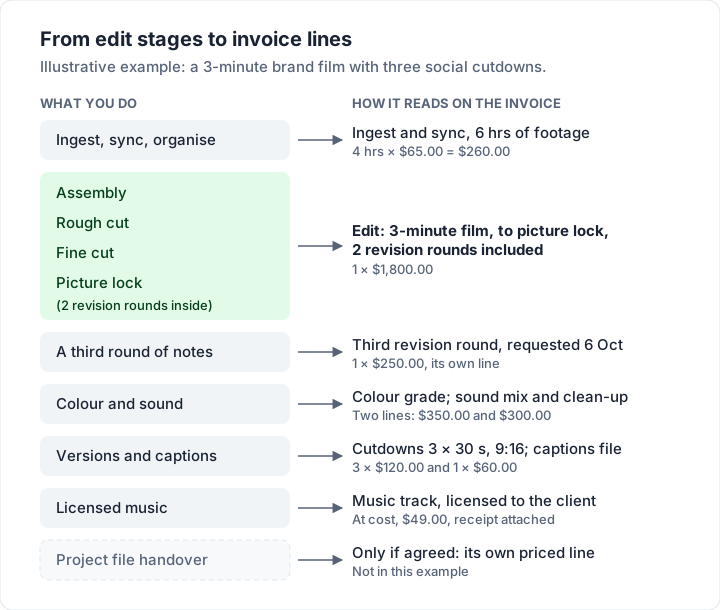
Colour and sound earn their own lines even when you do them yourself. They are often specialist jobs, so a client comparing your quote with another editor's can see like for like, and a client who drops the grade can see what that saves.
A sample video editor invoice#
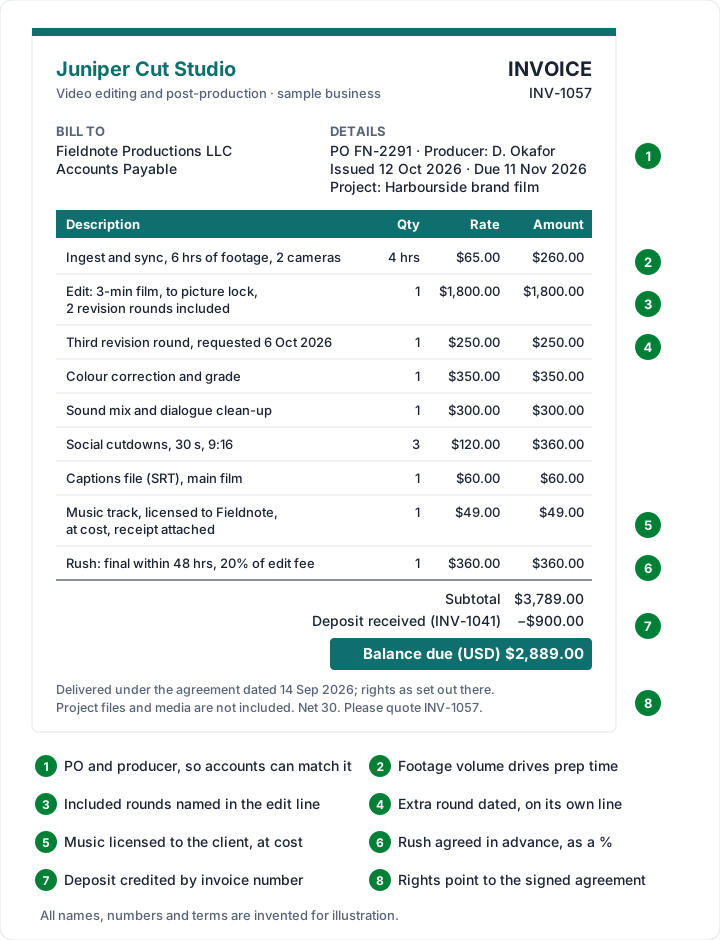
Here is a complete example. Juniper Cut Studio, an invented edit studio, cut a brand film for an invented production company, Fieldnote Productions LLC, which is making it for its own client. The agreement, dated Monday 14 September 2026, set a $1,800.00 edit fee with 2 revision rounds, a 50% deposit on the edit fee and Net 30 terms. Fieldnote paid the $900.00 deposit on invoice INV-1041. This is the final invoice. All names and figures are illustrative.
Invoice INV-1057. Issued Monday 12 October 2026, due Wednesday 11 November 2026 (Net 30). PO FN-2291. Producer: D. Okafor. Project: Harbourside brand film.
| Description | Qty | Rate | Amount |
|---|---|---|---|
| Ingest and sync, 6 hrs of footage, 2 cameras plus external audio | 4 hrs | $65.00 | $260.00 |
| Edit: 3-minute film, 16:9, to picture lock, 2 revision rounds included | 1 | $1,800.00 | $1,800.00 |
| Third revision round, requested 6 Oct 2026 | 1 | $250.00 | $250.00 |
| Colour correction and grade | 1 | $350.00 | $350.00 |
| Sound mix and dialogue clean-up | 1 | $300.00 | $300.00 |
| Social cutdowns, 30 seconds, 9:16 | 3 | $120.00 | $360.00 |
| Captions file (SRT), main film | 1 | $60.00 | $60.00 |
| Music track, licensed to Fieldnote Productions, at cost, receipt attached | 1 | $49.00 | $49.00 |
| Rush: final within 48 hours of lock, 20% of edit fee | 1 | $360.00 | $360.00 |
| Subtotal | $3,789.00 | ||
| Deposit received (INV-1041) | −$900.00 | ||
| Balance due (USD) | $2,889.00 |
Notes on the invoice: “Delivered under the agreement dated 14 Sep 2026; rights as set out there. Project files and media are not included. Please quote INV-1057.” There is no tax line, because whether editing services are taxable depends on where you and the client are; check with your tax authority or an accountant.
Revisions, rush fees and kill fees#
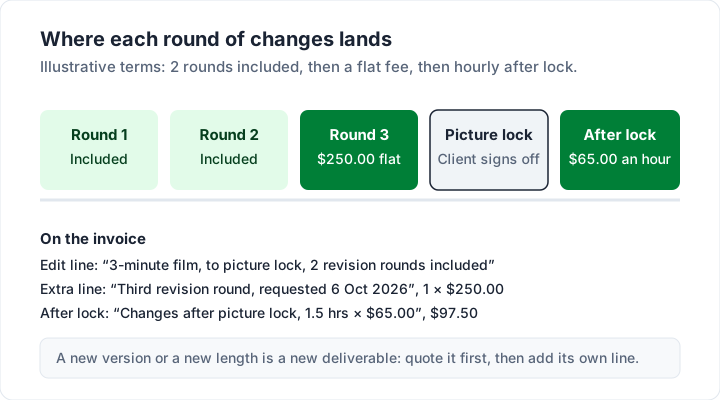
Revision rounds. Name the included rounds in the edit line, define a round in the agreement (one consolidated set of notes, not a stream of emails), and price the next one before it is asked for. After picture lock, changes are a different kind of work: re-conforming, re-grading, re-exporting every version. Many editors switch to hourly at that point.
Drafts are where many editors protect themselves before the invoice is paid. A burned-in timecode on review copies, with the clean master released on payment, is a common way to keep leverage without holding up feedback. Say on the invoice which file is the final delivery.
Rush fees. A rush moves other clients' work and often means evenings. Agree it as a percentage of the edit fee or a flat amount before you accept the deadline, then bill it as its own line, as the sample does at 20% of $1,800.00 = $360.00.
Kill fees. If a project is cancelled part-way, you bill what the agreement says. Write the stages into the agreement so the invoice is arithmetic. Using the sample's $1,800.00 edit fee, $260.00 of ingest and the $900.00 deposit, illustrative terms could be:
| Cancelled | Example term | On the sample |
|---|---|---|
| Before the edit starts | Deposit kept, nothing more owed | $900.00 kept |
| After the rough cut | 60% of the edit fee plus ingest, deposit credited | $1,080.00 + $260.00 − $900.00 = $440.00 invoiced |
| After picture lock | Full edit fee plus completed extras, deposit credited | Billed as finished work |
These are illustrations, not recommended terms. A charge that appears for the first time on an invoice is easy to dispute: whether an invoice is a contract explains why the agreement has to come first, and the freelance writer invoice shows how to word a kill-fee invoice.
Music, stock and project files#
Licensed music and stock footage. Check who the licence is issued to before you buy. Some licences can be bought in the client's name; others cover only the licensee who bought them, which may be you. Whatever the licence says, bill the cost on its own line, say whose name it is in, attach the receipt, and add a handling fee only if the agreement allows one.
Fonts, plug-ins and templates. If you bought a font or a motion-graphics template for this job, it is a pass-through cost like music. If it is part of your normal toolkit, it belongs in your rate.
Project files and media. Clients sometimes ask for the editing project file, media and proxies, so another editor can make changes later. That is a real handover: organising, consolidating, relinking and often supplying a drive. If you agree to it, give it its own priced line, for example “Project file and media handover: consolidated project, media and proxies on a client-supplied drive”, and say in the agreement whether the client may have the file edited by someone else. If you have not agreed to hand it over, say so in the notes, as the sample does.
Who owns the edit: work made for hire, carefully#
Rights decide what a project-file request really means, so it helps to read what the US Copyright Office says about “work made for hire”. Other countries differ, and the rights in an edit depend on your written agreement and on how the law applies to it, which is a question for a lawyer.
The Copyright Office's Circular 30, Works Made for Hire (revised August 2024, quoted as of 23 October 2026) says:
- The categories: among the kinds of “specially ordered or commissioned” work it lists, one is “as a part of a motion picture or other audiovisual work”.
- The four criteria: “A specially ordered or commissioned work is considered a work made for hire if it satisfies all of the following four criteria”, the last two being “In the written agreement, the parties must expressly agree that the work is to be considered a work made for hire” and “The agreement must be signed by all parties.”
- Authorship: “If a work is a work made for hire, the employer or the party that specially ordered or commissioned that work is the author of that work."
What that means for your invoice:
- Rights are set by your written agreement, not by the invoice. Point to the signed agreement in the notes, as the sample does, rather than adding rights wording that might not match it.
- Check that the invoice and the agreement say the same thing. A note such as “licence on payment” may not fit a signed work-for-hire agreement. If you are unsure how the two fit, ask a lawyer before you send it.
- Footage you did not shoot. Who owns the client's camera files, and your edit of them, is a question for the agreement. Put it in writing.
If a contract asks you to sign a work-for-hire or assignment clause on a large project, an intellectual property lawyer can explain what it means for you before you sign.
Invoicing an agency or production company#
Much editing work is subcontracted: you cut for a production company or agency that bills its own client. That changes three things.
- You bill the company that hired you, not the end client, unless your agreement says otherwise. Put the end client's project name in the description so the producer can match it.
- Expect a purchase order and set terms, often Net 30 or longer, and payment runs on fixed days. Ask before you start who invoices go to, what reference to quote and whether there is a vendor portal. How to invoice a company covers the accounts payable side, and payment terms like Net 30 explains when the clock starts.
- Take a deposit on longer edits. A production company waiting on its own client may pay you late. A deposit at booking, credited by invoice number on the final invoice, limits the gap. How deposit invoices work covers the wording.
In the US, a company paying a freelancer will usually ask for a Form W-9 before the first payment, so have yours ready.
Making a video editor invoice in Charming#
Charming Invoices has no template made only for editors, but the pieces above exist today:
- Templates: 60 designs, including Timesheet (time entries grouped by week or project, with hours per group and a total hours line) and Creative Studio. You can rename labels and show a Unit column, so “hrs” or “min” prints beside the quantity.
- Exact arithmetic: quantities take up to 3 decimal places (1.5 hrs) and rates up to 4, and only line totals are rounded to the cent.
- A PO number field and deposits: a balance invoice can show a deposit already received. You type the amount; it is not linked to the deposit invoice.
- Starting lines: “Start from a kit” offers general kits such as Hourly consulting and Photography shoot. There is no editing kit, and kit prices are left at 0.00 on purpose. On paid plans, AI drafting turns one sentence such as “3-minute edit, 2 rounds, grade, mix and 3 cutdowns” into line items; it leaves unknown prices at 0 and never creates a client or sends anything. See how AI drafting works.
The limits, plainly: Charming has no time tracker, so log hours in your editing or time-tracking tool and type the totals. It does not host or deliver footage, and it does not email invoices: you download the PDF or copy its private link and send it yourself. It does not take card payments: clients pay by the bank details or payment link printed on the invoice, and you record the payment or mark it paid. Free invoices carry a small “Sent with Charming Invoices” line. The page for photographers, videographers and designers shows the creative templates, or you can create a free invoice, rebuild the sample above with your own numbers, download the PDF and send it your way.
Video editor invoice FAQ#
Should I bill a video edit hourly or per project?#
Per project when the scope is clear and the footage is known; hourly when notes are open-ended or the footage is unknown. Many editors quote a project fee with a set number of rounds and bill hourly after that. The figures are yours to set; why your invoice can argue against your rate explains why itemised lines defend a price better than one total.
Do I charge for exports and extra versions?#
Each new aspect ratio, length or language version is more work, so quote it as its own deliverable. A re-export with no edit changes is usually small; a 9:16 version that needs reframing every shot is not.
Is a video editing invoice template enough?#
A template gives you the layout. What gets the invoice approved is what goes in it: the unit you quoted, named deliverables, included rounds, dated extras, at-cost items and the client's PO.
Should I hand over the project file?#
Only if it is in the agreement, as its own priced line, with the rights position clear. If it is not agreed, the notes on the invoice can say “Project files and media are not included”.
The short version#
Bill in the unit you quoted. Name each deliverable by length and format. Put the included rounds in the edit line and give every extra round, rush and change after lock its own line. Pass music and stock through at cost with the receipt, price a project-file handover separately, and let the signed agreement, not the invoice, decide who owns the edit.
Sources, checked 23 October 2026: US Copyright Office, Circular 30: Works Made for Hire (revised August 2024); US Bureau of Labor Statistics, Occupational Outlook Handbook: Film and Video Editors and Camera Operators.