Rental invoice: dates, rates, deposits

Nnabuike Okoroafor ·
On this page · 13 sections
Something of yours left with a client on Friday morning: a mini excavator, a marquee and forty chairs, a camera kit, a van, a spare room for the week. Now it has to be billed, and a rental invoice has to answer questions an ordinary invoice never faces. When did the rental start and end, to the hour? Is a day 24 hours or a calendar date? Was the deposit a payment, or money you are holding? What happens if it comes back late, or scratched?
This guide shows how to invoice a rental if you are a small operator renting out tools, plant, party gear, vehicles or short-term rooms. It covers the rental period, rate basis, deposits and damage deposits, extras, late returns, waivers, tax in general terms and recurring rent, with a worked example using invented figures.
General information, not legal or tax advice. Where a rule is mentioned, we quote and link the official page; ask an accountant or lawyer about your own situation.

What a rental invoice has to show that other invoices do not#
Start with everything any invoice needs: the word “Invoice”, a unique number, the issue date, your details, the client’s details, line items, the total and a due date. The field-by-field invoice checklist has the full list. Rental invoicing then adds five things.
| Rental-specific field | Example wording | Why it matters |
|---|---|---|
| Rental period, start and end | “Out: Fri 6 March, 08:00. Due back: Mon 9 March, 08:00” | Every charge is calculated from it; vague dates cause late-return disputes |
| What was rented, identifiably | “Mini excavator 1.5t, fleet no. MX-04, hour meter 1,212 on dispatch” | Proves which item left, in what state |
| Rate basis | “3 days at $220.00 a day” | Lets the client check the arithmetic |
| Deposit status | “Security deposit $500.00 held, refundable on inspection” | Separates money you are holding from money you have earned |
| Return terms | “Late returns charged at the day rate per day or part day” | The client sees the rule before it is applied |
If you get only one of these right, make it the rental period. Write the date and the time, for both ends, every time.
Choose the rate basis and say it on every line#
Rentals are priced by time, so the quantity is usually hours, days, weeks or months, and the rate is the price per unit. Put the unit in the line.
- Hourly: “Floor sander, 4.5 hours at $18.00 an hour.”
- Daily: “Pressure washer, 2 days at $65.00 a day.” Say what a day is: 24 hours from collection, or a calendar day ending at closing time.
- Weekend or package rate: “Weekend rate, Fri 16:00 to Mon 09:00, $140.00.” A fixed price for a fixed window is a quantity of 1, with the window in the description.
- Weekly or monthly: “Scaffold tower, 2 weeks at $210.00 a week.” If a week costs less than seven days, a client who keeps the item for nine days should see how you counted: “1 week at $210.00, plus 2 days at $45.00.”
- Minimum hire: if you have one, state it in the line or the notes (“Minimum hire 4 hours”) so a short rental is not queried.
Kits and packages can be one line or several: a named kit at a day rate, with what it includes listed in the description, is easier to check than a dozen small lines. If the kit goes out with an operator, keep the two apart. One bundled price hides what the equipment costs and what the labour costs; two lines let the client see that each one is reasonable on its own. Put the operator’s time and the equipment on separate lines. If you rent out your own camera kit as part of a shoot, the videographer invoice guide shows owned kit, hired kit and crew as three different lines.
Deposits: booking deposit or security deposit#
Rentals use two different kinds of deposit, and they belong in different places on the paperwork.
- A booking deposit is part of the rental price paid in advance to hold the date. Once the rental goes ahead, it comes off the final invoice as “Deposit received”. How deposit invoices work covers wording, refund terms and how to show it on the balance invoice.
- A security or damage deposit is money you hold against loss or damage, and you expect to give it back. It is not the price of the rental, so do not add it into the rental total or take it off as if it were a discount.
Here is how the two travel, using the figures from the worked example later in this guide.
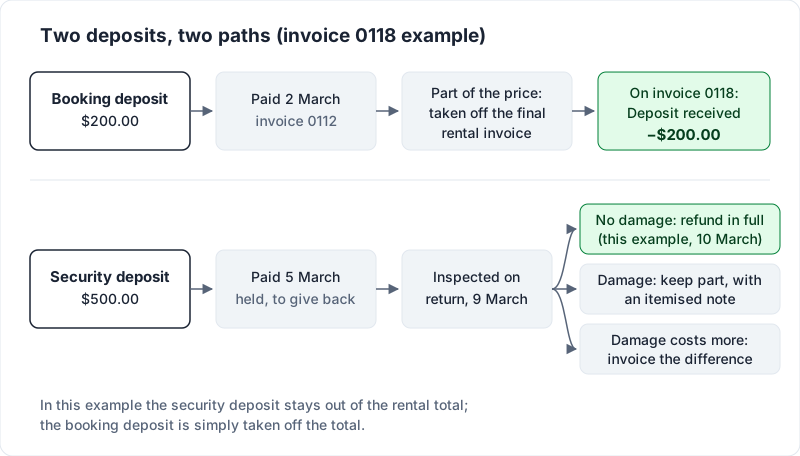
Keep a security deposit apart from the rental charges: bill it on a short invoice of its own, or add a labelled note to the rental invoice (“Security deposit of $500.00 paid 5 March and held. Refundable within 7 days of return, less any damage charges itemised separately.”). When the item comes back, refund it in full, keep part of it with an itemised note of the damage and its cost, or invoice the difference if the damage costs more than the deposit. Put the refund window and conditions in your rental agreement before the item leaves. For rooms and residential property, check the deposit rules where the property is. In England, for example, GOV.UK’s guidance on tenancy deposit protection says, as of 28 October 2026: “Your landlord must put your deposit in a government-approved tenancy deposit scheme (TDP) if you rent your home on an assured periodic tenancy (APT).” Other parts of the UK, other countries and US states have their own rules, and they change, so check the official guidance where the property is, or ask a lawyer.
Delivery, collection, fuel and other extras#
Extras are where rental invoices get queried, because the client did not see them coming. Put each on its own line, and agree them in writing at booking. If you move a client’s belongings rather than rent out equipment, the moving company invoice guide covers crew hours, travel time and packing materials.
- Delivery and collection: “Delivery and collection, 12 miles each way, $90.00.” If you charge them separately, use two lines.
- Fuel or charge: “Fuel used, refilled on return: 12 litres at $1.80.” Say in the agreement whether items go out full and must come back full.
- Cleaning: “Cleaning, returned with mud in tracks, $40.00.” Tie it to a condition you set out in advance.
- Mileage (vehicles): “Mileage over 300-mile allowance: 84 miles at $0.25.” Record the odometer reading out and in.
- Consumables: sanding discs, blades, gas bottles. Bill them by quantity used, not as “sundries”.
- Tolls and fines (vehicles): if your agreement passes these on, bill them later with the reference number.
Late returns: how to bill them without an argument#
A late return is extra rental time, so bill it at the rate you already agreed, under the rule you wrote down at booking. A penalty on top is a different thing, and whether you may charge one depends on the agreement and where you are. Show the agreed time, the actual time and the arithmetic:
| Description | Qty | Rate | Amount |
|---|---|---|---|
| Late return, pressure washer PW-07. Due back Sat 14 March 17:00, returned Sun 15 March 10:30. Charged per day or part day, as agreed | 1 day | $65.00 | $65.00 |
If the rental invoice has already gone out, bill the late return on a new invoice rather than changing the one the client has. A fee for paying late is a different matter; late fees on invoices covers it.
Insurance and damage waivers#
The invoice should say which of three set-ups applies:
- The client’s own insurance covers the item. Note the policy or certificate reference.
- You sell a damage waiver. A charge that limits what the client pays if the item is damaged, under terms in your agreement. Bill it as its own line, and do not call it insurance unless it is an insurance product.
- Neither. The client is responsible for loss and damage under your agreement; point to that clause.
A waiver or insurance line can be taxed differently from the rental itself.
Tax on rentals: it varies a lot#
Tax on rentals depends on what you rent, for how long, to whom, and where, so ask your tax authority or an accountant. One official example, quoted as of 28 October 2026, shows how detailed the answer can be:
- US sales and use tax on equipment rentals (California). The California Department of Tax and Fee Administration’s guide to leases in general says: “In California, leases of tangible personal property are generally subject to use tax, unless you pay sales tax reimbursement or use tax at the time of purchase of the property or you timely elect to pay use tax based on the purchase price”. On optional extras, it says: “if a car rental company does not require a customer to purchase collision damage insurance, but the customer does choose to purchase the optional insurance, the charges for the insurance, are not subject to tax.” The same guide covers delivery charges.
Rooms and property have their own rules, such as occupancy taxes on short stays in some US states (Texas’s is in Tax Code chapter 156) and HMRC’s VAT Notice 742 in the UK. Rules also change. Get the answer for your own rentals once, then build it into your invoices: which lines are taxed, at what rate, and your tax registration number if you have one. What a tax invoice is explains what a tax-registered business usually has to show.
A worked rental invoice example#
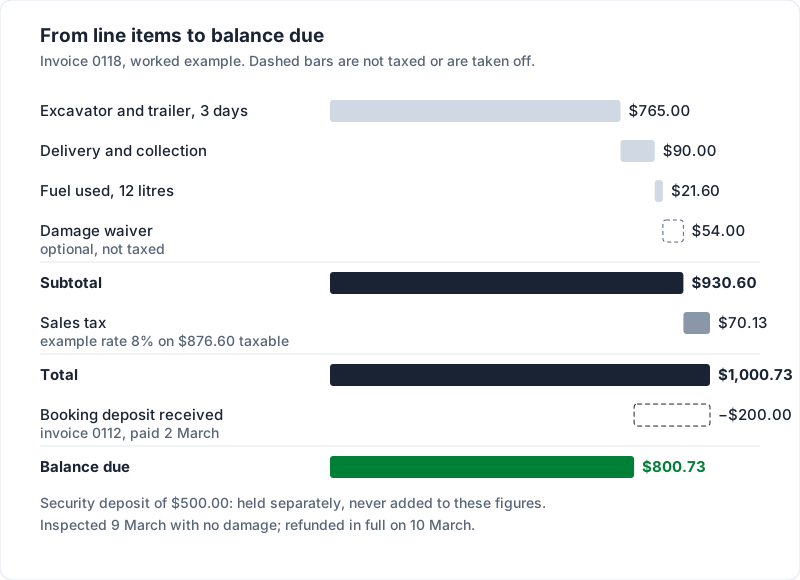
An invented weekend equipment hire, for illustration only. The tax rate and treatment are illustrative: tax is shown on every line except the optional damage waiver, because an optional charge of this kind can be taxed differently from the rental itself (see the California quote above on optional insurance). In your area other lines may be treated differently too.
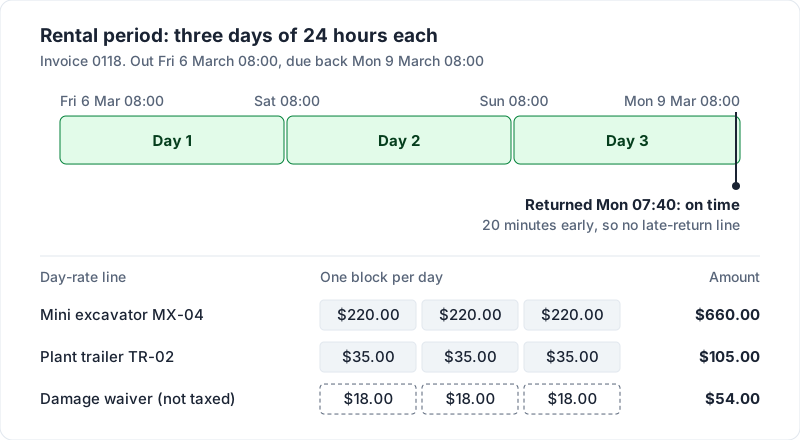
Invoice 0118. Issued 9 March. Due 23 March. Rental period: out Fri 6 March 08:00, due back Mon 9 March 08:00, returned Mon 9 March 07:40.
| Description | Qty | Rate | Amount |
|---|---|---|---|
| Mini excavator 1.5t, fleet no. MX-04 (hour meter 1,212 out, 1,231 in) | 3 days | $220.00 | $660.00 |
| Plant trailer, fleet no. TR-02 | 3 days | $35.00 | $105.00 |
| Delivery and collection, 12 miles each way | 1 | $90.00 | $90.00 |
| Damage waiver (optional, accepted at booking; not taxed) | 3 days | $18.00 | $54.00 |
| Fuel used, refilled on return | 12 litres | $1.80 | $21.60 |
| Subtotal | $930.60 | ||
| Sales tax, example rate 8% on taxable lines ($876.60) | $70.13 | ||
| Total | $1,000.73 | ||
| Booking deposit received (invoice 0112, paid 2 March) | −$200.00 | ||
| Balance due | $800.73 |
Notes on the invoice: “Security deposit of $500.00 held. Returned on time and inspected 9 March, no damage found; refunded in full by bank transfer on 10 March.”
The rental period is exact, so nobody can argue about lateness. The booking deposit comes off the total, while the security deposit stays out of the arithmetic. And every extra is a line the client agreed to before the gear left.
The rental period sets the quantity on every day-rate line:
And this is how those lines build to the balance:
Recurring rent: the same invoice every month#
Storage units, a long equipment hire, a desk or studio space, a room let by the month: each is the same rent invoice on a schedule. Each one should still name its own period (“Studio rent, 1 to 31 March”), so a client paying several months can match each payment to a month. Variable amounts, such as a utilities share, go on their own lines.
If you bill the same rent on a schedule, the recurring invoices feature in Charming Invoices raises a draft for each cycle, weekly, monthly, quarterly or yearly, with your lines and the client’s details filled in. It never sends itself: you review the draft, change the period or add a late-return line, issue it, and send the PDF or link however you like. Recurring invoices are not subscriptions explains the mechanism. The catches: recurring invoices are on the paid plans (from Individual, $29 once), not Free; there is no fortnightly schedule; and generated drafts are due 14 days after the issue date unless you change it.
Rent invoice for a tenant#
If you let a flat, a house or a room, the monthly rent invoice is the same document with a tenant as the client. Some landlords call it a rent statement, especially when it carries a running balance. Either way, it records what the lease already says; it should never be the first place a charge appears.
This section covers the billing format only, not tenancy law. It does not cover what a landlord may charge, deposits, late fees, notices or rent receipts. Rules vary by state and country; ask a lawyer or your local housing authority. Official starting points include GOV.UK’s private renting guide and USAGov’s tenant rights page, which points to state tenant rights agencies.
A monthly invoice for rent usually shows:
- The tenant and the property. The tenant’s name, and the address of the property or unit the rent is for.
- The rent period. “Rent, 1 to 31 December 2026”, so each payment matches one month.
- The rent line, at the amount in the lease.
- Any other charges, as agreed in the lease, each on its own line: a parking space, or a utilities share with the bill it comes from.
- The due date the lease sets.
- How to pay: bank details, and the payment reference the tenant should use.
- The running balance: what was owed before, what has been paid since, and what is owed now.
A rent invoice example#
An invented monthly rent invoice. The landlord, tenant, property and amounts are illustrative examples.
- From: Pellworth Lettings. Invoice: R-0012. Issued: Tuesday 24 November 2026. Due: Tuesday 1 December 2026, the due date in the lease
- Tenant: Tomas Brierly, Flat 2, 14 Brackenfold Road
- Period: 1 to 31 December 2026
| Description | Amount |
|---|---|
| Rent, Flat 2, 1 to 31 December 2026 | $1,450.00 |
| Parking space, December 2026 | $75.00 |
| Water and sewer share, as set out in the lease (October to November bill) | $38.62 |
| Total for December | $1,563.62 |
Under it, the account so far. November’s water share was $38.40, so that month came to $1,563.40.
| Date | Item | Charged | Paid | Balance |
|---|---|---|---|---|
| Mon 26 October 2026 | Invoice R-0011, November rent and charges | $1,563.40 | $1,563.40 | |
| Mon 2 November 2026 | Payment received, bank transfer | $1,563.40 | $0.00 | |
| Tue 24 November 2026 | Invoice R-0012, December rent and charges | $1,563.62 | $1,563.62 | |
| Balance due by 1 December | $1,563.62 |
Only the utilities line moves from month to month, and the running balance shows the tenant that last month is settled. When you email it, invoice email examples has wording you can adapt.
Rent invoices in Charming#
In Charming, the tenant is a client, and the monthly rent invoice is a recurring invoice (paid plans, from $29 once; see the section above). Each month you get a draft to check: update the utilities line, set the due date the lease gives (drafts default to 14 days after the issue date), and issue it. Each client also has a Statement button, on every plan including Free, which makes a PDF of that client’s open invoices with what is still owed on each and how overdue it is; the invoice statement guide shows what it prints.
The catches: the statement lists open invoices only, not a full history of charges and payments like the table above. It is only as current as the payments you record, because Charming takes no payments itself. And Charming keeps no tenancy records (leases, deposits, rent rolls or property lists): it is invoicing only.
Rental invoice template: copy the layout or download one#
For a rental invoice template, start from the tables in this guide: the five rental fields near the top, the worked example’s lines for equipment, or the rent invoice above for a tenancy. Copy the layout into whatever you invoice with.
If you want a file, the free invoice templates page has blank invoice files, with no sign-up, among them an invoice template and an hourly invoice template for Excel, and an invoice template and a service invoice template for Word. None of them is rental-specific.
- For equipment and party hire, use the Excel invoice template. Put the days in the quantity column and the day rate in the rate column, and write the rental period and fleet number in the description. It works out each amount, the subtotal, one tax rate, the total and, from the amount paid, the balance due. It applies one rate to the whole subtotal, so an untaxed line like the optional damage waiver in the worked example does not fit; the same is true of Charming.
- For a monthly rent invoice, the Word invoice template is enough: one rent line and one line per charge, with the period in each description. Word does not add up the totals for you.
The Excel invoice template guide walks through the formulas. In Charming itself, the layout comes from your choice of 60 invoice templates, all available on Free.
Where this guide, and Charming, stop#
This is not a landlord and tenant guide, and it does not cover tenancy law. Rules differ by country, state and city; ask a lawyer or your local housing authority.
Charming Invoices is invoicing only. It does not take card payments, place a hold on a client’s card for a security deposit, or track which item is out on which date. Clients pay you directly, by the bank details or payment link you print on the invoice, and you mark the invoice paid yourself. It does not email invoices or send rent reminders: you send the PDF or link yourself. On every plan, including Free, the invoice form has a “Deposit received” line for a booking deposit, but you type that amount in yourself; it is not linked to the earlier deposit invoice. Free invoices carry a small “Sent with Charming Invoices” line in the footer.
Before you send a rental invoice#
- Write the rental period with dates and times, out and due back.
- Identify each item: name, size or model, and a fleet or serial number.
- Show the rate basis on every line: hours, days, weeks or months, at a stated rate.
- Put delivery, collection, fuel, cleaning and waivers on their own lines.
- Take off any booking deposit as “Deposit received”, with its invoice number.
- Keep any security deposit out of the total, and say what happens to it.
- Apply tax the way your tax authority or accountant advises, line by line if needed.
- Bill a late return or damage on a new invoice, with the times or the evidence.
If you want a layout to start from, there are ready designs on the invoice templates page. When you are ready to send the first one, you can create a free invoice with Charming.