A painter's invoice for an interior repaint in a 1971 house

Months after the job, a painting invoice gets pulled out for one reason: someone needs to know exactly which colour went on which wall. Clients keep it for touch-ups, landlords keep it for the next tenant turnover, and buyers ask for it when the house sells. So a good one records more than a price. This painting invoice sample covers an interior repaint of a living room and hallway in a house built in 1971. It separates preparation from painting, prices walls by the square foot and doors by the each, lists paint by the gallon with the colour code and sheen, credits the materials deposit, and shows the lead-safe setup that a pre-1978 home can require. The notes explain what the EPA's renovation rule asks painters to keep on file.

Updated

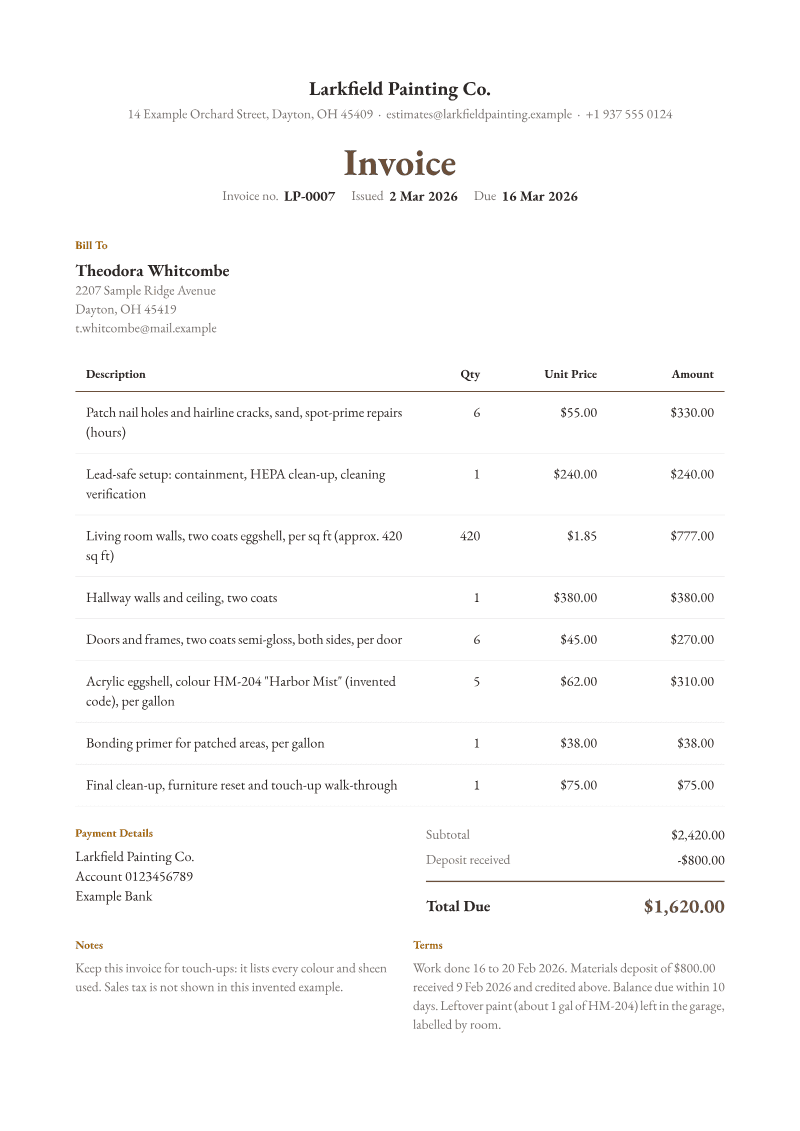
Sample painting invoice on the Elegant template, with invented business, client and prices

Job details

Job address
2207 Sample Ridge Avenue, Dayton, OH (built 1971)
Rooms / areas
Living room walls, hallway walls and ceiling, 6 doors
Paint and colour codes
Walls HM-204 eggshell; trim and doors white semi-gloss (invented codes)
Coats
Two finish coats over spot-primed repairs
Shown on the Elegant template. Rendered by the same engine that builds the PDFs Charming sends. Business, client and prices are invented for illustration.

Line items for painting invoices

Starter line items for painting invoices, prices left blank
DescriptionQtyUnitPrice
Preparation
Surface prep: sanding, patching, caulking and masking1hrsLeft blank
Lead-safe work setup and cleaning verification (pre-1978 homes)1jobLeft blank
Interior painting
Walls, two coats (state room and sheen)1sq ftLeft blank
Ceiling, per room1roomLeft blank
Doors and frames, per door1doorLeft blank
Exterior painting
Siding, pressure wash, scrape and two coats1sq ftLeft blank
Materials
Finish paint (brand, colour code and sheen)1galLeft blank
Primer or stain blocker1galLeft blank
Clean-up
Clean-up and touch-up walk-through1jobLeft blank

Prices are left blank on purpose. Use your own rates.

What painting invoices should include

Colour, brand, code and sheen for each surface
This is the line clients come back for. A colour name alone is not enough, because brands reuse names and tint formulas change between product lines. Record the brand, product, colour code and sheen per room or surface, and note where any leftover paint was left.
Example: Walls: HM-204 Harbor Mist, acrylic eggshell; trim: white semi-gloss
Rooms and surfaces, with a measure
"Interior painting" tells the client nothing they can check. Name each room and surface (walls, ceiling, trim, doors, cabinets) and give the measure you priced it on, whether square feet, the room or the door count, so the figure can be compared with the quote.
Example: Living room walls, approx. 420 sq ft; 6 doors
Number of coats and primer
Coverage disputes usually come down to coats. Saying two finish coats over spot-primed repairs, or a stain blocker over water marks, documents the work the client paid for and explains why a dark-to-light colour change cost more than the last repaint.
Example: Two coats eggshell over bonding primer on patches
Year the house was built, for older homes
For a home built before 1978, whether lead-safe practices applied changes both the price and what you must keep on file. Putting the build year on the invoice links it to your renovation records and explains a lead-safe setup line if there is one.
Example: Built 1971; lead-safe setup used

How painting work is usually billed

Per room, per square foot or by the hour

Painters price in three common ways. Per room is simple for clients and works when rooms are similar; per square foot of wall or siding scales cleanly to odd shapes and exteriors; hourly suits repair-heavy work where prep time cannot be predicted. Many invoices mix them: walls by the square foot, doors by the each, and patching by the hour. Whatever you quoted, keep the same unit on the invoice so the comparison is direct.

A deposit for materials

Paint for a whole house can cost hundreds of dollars before a brush touches a wall, so many painters take a deposit at booking to buy it. Record the date and amount, and credit it on the final invoice so the balance is plain. For how the credit should appear, see how deposit invoices work.

Change orders for extra coats or surfaces

A client who chooses a deep red over grey, or adds the stairwell on day two, has changed the job. Agree the extra in writing before you do it, then bill it as its own line named for the change, such as "Third coat, living room accent wall", rather than quietly increasing a quantity. Clients accept a visible extra they approved far more readily than a total that grew.

Rules and good practice

United States (EPA): the Renovation, Repair and Painting rule for pre-1978 homes
Rule

The EPA's RRP rule covers renovation, repair and painting done for compensation that disturbs painted surfaces in housing built before 1978 and in child-occupied facilities such as child care facilities and kindergartens, with some exceptions, for example where the components have been tested and found free of lead-based paint, and for minor repair that disturbs no more than 6 square feet of painted surface per room inside or 20 square feet outside, without window replacement, demolition of painted surfaces or the prohibited work practices. Covered firms must be EPA- or state-certified and use certified renovators. Before work in a home, the firm must give the owner the EPA lead pamphlet no more than 60 days before starting and get a written acknowledgment, or a certificate of mailing at least 7 days before the work begins.

United States (EPA): RRP records are kept for three years
Rule

Firms doing covered renovations must keep, for three years after the job is complete, the records showing they complied: test results or reports showing lead-based paint was not present, the signed pamphlet acknowledgments or certificates of mailing, and documentation that a certified renovator was assigned and did the cleaning verification. The invoice is not one of the listed records, but it is the document that dates the job, so file it with them under the same job address.

Leave the leftover paint and say where it is

Labelled leftover paint is worth more to the client than a discount. Decant or label each can with the room and the colour code, leave it where the client asked, and say so on the invoice. It turns the invoice into the touch-up guide they will look for next year.

General information, not tax or legal advice. Rules vary by place and change; check the current official guidance.

Making painting invoices in Charming

In Charming you can add the deposit you already received and the invoice prints it as a "Deposit received" credit with the balance due, as in this sample on the Elegant template. Lines can also carry a unit (sq ft, room, door, gal, hrs) and a section label: turn on the Unit column and Group lines by section in the Template Studio, and Preparation, Interior painting, Materials and Clean-up print under their own headings with subtotals. Elegant leaves both off, so this sample writes the units into the descriptions. Put the colour codes and coats in the line descriptions and the leftover-paint note in the terms, and you can send the client the PDF or a private link they can keep. The line items above are also a starter kit in the app: on a new invoice with no lines yet, choose Start from a kit, then "Painting job" under Trades. Prices start at 0.00 for your own rates.

Charming has no estimates or quotes, so the quote and any change order live elsewhere, and it keeps no RRP records, photos or signed pamphlet acknowledgments. Clients cannot pay by card from the invoice, there is one tax rate per invoice, and Free-plan invoices include a small "Sent with Charming Invoices" footer line.

Questions

What should a painting invoice include?
Your business details, the client and job address, the dates worked, each room or surface with the measure you priced on, preparation separately from painting, the number of coats, materials with the paint brand, colour code and sheen, any deposit already paid, the balance due and payment terms. For homes built before 1978, note whether lead-safe practices were used.
Should a painter charge by the room or by the square foot?
Per room is easier for clients to understand and works for typical bedrooms and living spaces. Per square foot is fairer for large, irregular or exterior surfaces. Many painters quote rooms for standard interiors and square feet for exteriors and feature walls, then price trim and doors per piece. Use the same unit on the invoice as on the quote.
Do painters have to list the paint colours on the invoice?
It is not normally a legal requirement, but it is one of the most useful things a painting invoice can carry. Clients need the brand, colour code and sheen for touch-ups and future rooms, and property managers use it to match units. Recording it per surface also settles any later question about which colour was agreed.
How do I bill a painting deposit on the final invoice?
Show the full job on the final invoice, then credit the deposit you already received, with its date, so the balance due is the job total minus the deposit. Do not reduce line prices to absorb the deposit. That way the client sees what the whole job cost and that their earlier payment was counted.

Template designs

The Elegant invoice template, shown on a sample invoice

Elegant

Centred Garamond letterhead with fine rules and warm tones.

The Contractor invoice template, shown on a sample invoice

Contractor

Labour and materials in sections with subtotals, units and total hours, plus a sign-off line.

The Classic invoice template, shown on a sample invoice

Classic

Serif letterhead with a coloured rule — timeless and formal.

Make this invoice with your own details

Add your business, your client and your own rates, then send it to your client as a PDF.