A handyman invoice for a five-job visit

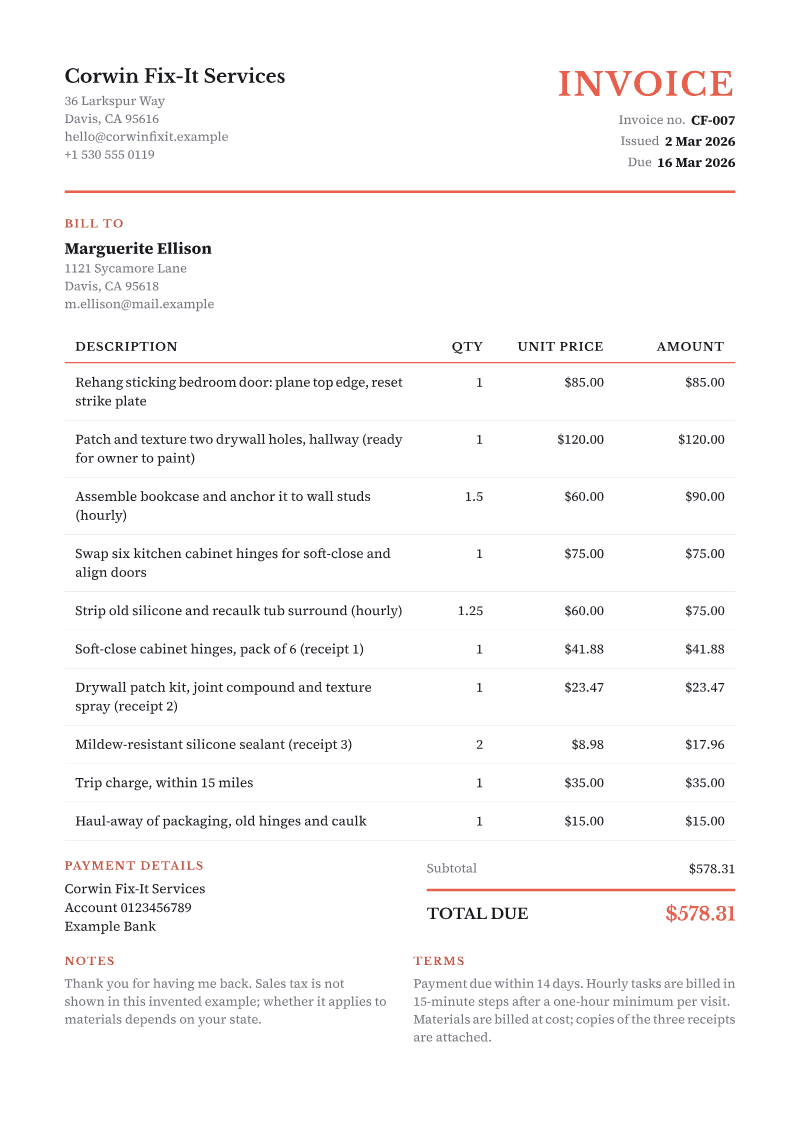
A handyman visit rarely means one job. It is a list on the fridge: the door that sticks, two holes in the hallway wall, a bookcase to anchor, the tub caulk that has gone black. The client remembers the list, not the hours, so the invoice that gets paid without a phone call follows the list. This handyman invoice example puts every task on its own line, prices some by the job and some by the hour, lists the materials you bought at what you paid with the receipts attached, and adds the trip charge and haul-away as their own lines. The notes below also cover the dollar limits some states put on work done without a contractor's licence.

Updated

Sample handyman invoice on the Classic template, with invented business, client and prices

Job details

Job address
1121 Sycamore Lane, Davis, CA
Visit date
26 Feb 2026, 9:00 to 14:30
Tasks completed
5 of 5 on the client's list
Materials receipts
3 attached
Shown on the Classic template. Rendered by the same engine that builds the PDFs Charming sends. Business, client and prices are invented for illustration.

Line items for handyman invoices

Starter line items for handyman invoices, prices left blank
DescriptionQtyUnitPrice
Tasks
Small repair task, flat price (describe the job)1jobLeft blank
Hourly task (describe the job)1hrsLeft blank
Furniture or shelving assembly and wall anchoring1hrsLeft blank
Materials
Materials bought for this visit, at cost (receipt attached)1lotLeft blank
Materials handling or pickup time1lotLeft blank
Visit
Trip charge1visitLeft blank
Minimum visit charge (when the jobs total less)1visitLeft blank
Haul-away of debris and packaging1lotLeft blank

Prices are left blank on purpose. Use your own rates.

What handyman invoices should include

One line per task
The client checks the invoice against their own list. When each job has a line, they can tick them off; a single "Handyman services, 5.5 hrs" makes them reconstruct the day and wonder which job took longest.
Example: Rehang sticking bedroom door: plane top edge, reset strike plate
Visit date and time on site
If any task is hourly, the arrival and departure times anchor the hours. They also settle the question of which visit an invoice belongs to when you go back to the same house three times in a month.
Example: 26 Feb 2026, 9:00 to 14:30
Materials with receipts
Small purchases are where trust goes first. Number each materials line to its receipt, attach the copies, and say whether the price is at cost or includes a markup, so the client never finds a cheaper shelf price and wonders.
Example: Soft-close hinges, pack of 6 (receipt 1), at cost
Your minimum and how you round
A minimum charge or a one-hour floor is fair, but only if it is written down. Printing it in the terms means a 20-minute job billed as an hour reads as policy, not padding.
Example: One-hour minimum per visit, then 15-minute steps
Scope limits that apply to you
In states with a handyman threshold, the job's total and the absence of a permit are what keep the work legal without a licence. A short scope line also stops a client assuming you did the electrical or plumbing they mentioned in passing.
Example: Minor repairs only; no permit work on this visit

How handyman work is usually billed

Hourly with a minimum

The simplest model: an hourly rate, a minimum per visit (often one or two hours), and a stated rounding step. It suits lists where you cannot know how long a job will take until you open it up. On the invoice, give each task its own hours rather than one total, so the minimum only shows up when the visit was genuinely short.

Flat price per task

Many handymen price common jobs by the job: rehang a door, mount a TV, swap a faucet cartridge, patch a hole up to a stated size. Clients like knowing the price before you start, and you carry the risk when a job runs long. Mix both models on one invoice if that is how you quoted it, but label each line so the client can see which tasks were fixed and which were timed.

Materials at cost, or cost plus a handling charge

Picking up parts takes time and ties up your money, so charging for it is reasonable. The two honest ways to show it are materials at receipt price plus a separate handling line, or a stated percentage markup in your terms. What clients object to is a materials line labelled "at cost" that does not match the receipt. If you do not want to hand over receipts, do not call the price cost.

Trip charge and haul-away

A trip charge covers driving to the job and is usually a fixed amount within a radius, sometimes waived when the visit runs past a set total. Haul-away covers taking packaging, old parts and debris to the dump or recycler. Put both on their own lines; folded into task prices, they make every flat price look higher than the one you quoted.

Rules and good practice

California: the $1,000 minor work exemption
Rule

California's Contractors State License Law does not apply to minor work on one project where the combined price of labour, materials and everything else is under $1,000 and no building permit is needed. The exemption does not cover anyone who employs helpers on the job or presents themselves as a contractor, and it is lost if a larger job is split into smaller contracts to stay under the limit. The Contractors State License Board says the threshold rose from $500 to $1,000 on 1 January 2025. A separate section lets an unlicensed person advertise for work under $1,000 only if the advert says they are not licensed. Keep the invoice total honest: a visit list that adds up to more than the limit is one project.
Arizona: under $1,000, no permit, and "not a licensed contractor" in adverts
Rule

Arizona's handyman exemption also sits below $1,000 per project, counting labour and materials, and must be casual or minor work. It does not apply where the work needs a local building permit, where a bigger job is divided to evade the law, or where the person advertises without the words "not a licensed contractor". The statute also excludes work connecting to natural gas or propane and fire safety work from this exemption.

United States (IRS): keep the receipts behind your materials lines
Rule

The IRS lists sales slips, paid bills, invoices and receipts as the supporting documents that back up the entries in your books and on your tax return, and says those documents should show the payee, the amount, proof of payment, the date and a description. The hardware-store receipts you attach for a client are also your own expense records, so keep a copy before you hand one over.

General information, not tax or legal advice. Rules vary by place and change; check the current official guidance.

Making handyman invoices in Charming

Each line in Charming can carry its own unit (job, hrs, visit, lot) and a section label. Turn on the Unit column and section grouping in the Template Studio, or start from the Contractor template, which has both on, and Tasks, Materials at cost and Visit print as separate blocks with their own subtotals. The sample uses the Classic template as it comes, with both off, so its hourly lines say "hourly" in the description. Your hourly minimum and rounding rule can live in the business's default terms, and after the first visit you can duplicate the last invoice for a repeat client and change the tasks. The line items above are also a starter kit in the app: on a new invoice with no lines yet, choose Start from a kit, then "Handyman visit" under Trades. Prices start at 0.00 for your own rates.

Receipts cannot be attached to the invoice in Charming, so send them separately or by email. Payments are marked paid by hand (clients cannot pay by card through the invoice), there is one tax rate per invoice, there are no estimates, and Free-plan invoices include a small "Sent with Charming Invoices" line.

Questions

Should a handyman charge by the hour or by the job?
Both work, and many handymen use both on one invoice. Price by the job when you know the task well and can predict the time, such as hanging a door or mounting a TV. Charge by the hour for open-ended work like tracing a squeak or fixing something a previous owner bodged. Label every line so the client can tell which is which.
How should a handyman show a markup on materials?
Pick one method and state it. Either bill materials at the receipt price and add a separate handling or pickup line, or put a percentage markup in your terms and build it into each materials price. Never call a marked-up price "at cost". Attaching receipts is optional when you mark up, but expected when you say cost.
Can one handyman invoice cover several small jobs?
Yes, and it usually should when they were done on the same visit. Give each job its own line and keep the trip charge as one line for the visit, not one per task. In California and Arizona, remember that several small jobs for the same client on one project count together toward the $1,000 licensing threshold.
What is a reasonable minimum charge for a handyman visit?
There is no standard figure; it depends on your market, your travel time and how you price. What matters on the invoice is that the minimum was agreed in advance and is printed in the terms, so a quick job billed at the minimum reads as the policy the client accepted rather than a surprise.

Template designs

The Classic invoice template, shown on a sample invoice

Classic

Serif letterhead with a coloured rule — timeless and formal.

The Contractor invoice template, shown on a sample invoice

Contractor

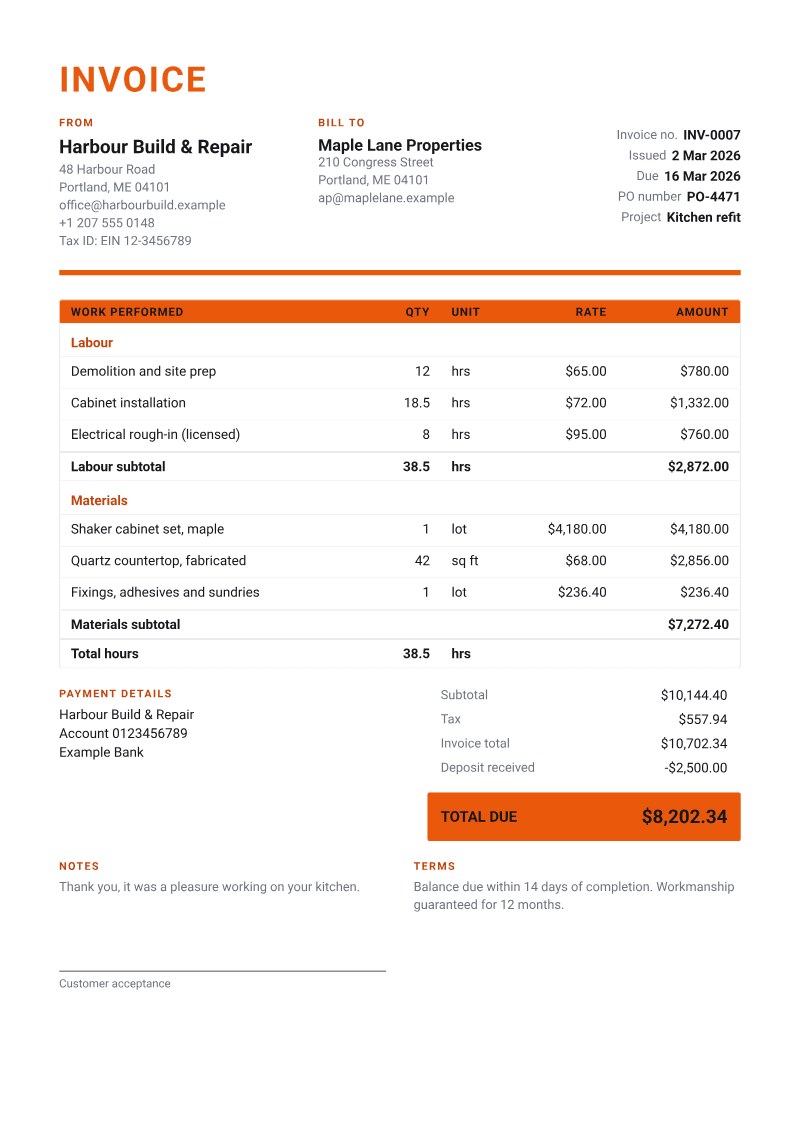
Labour and materials in sections with subtotals, units and total hours, plus a sign-off line.

The Minimal invoice template, shown on a sample invoice

Minimal

Generous whitespace, hairlines and a single quiet accent.

Make this invoice with your own details

Add your business, your client and your own rates, then send it to your client as a PDF.