Child care invoice: rates and receipts

Nnabuike Okoroafor ·
On this page · 10 sections
Billing for child care is not like billing for a logo. The client is a family you see twice a day, and the work is their child. A good child care invoice has to do two jobs at once: ask for money clearly, and keep a warm relationship warm.
This guide is for independent childminders, nannies, babysitters and small home daycares. It covers rates, dates and hours, extra fees, sick-day and holiday wording, and what a child care invoice needs to show if parents claim a tax credit or a dependent care account. There is a worked example with illustrative numbers.

General information, not tax or legal advice. Tax and employment rules differ by country and by state or province, and they change. Where we mention a rule, we quote and link the official page we read on 23 October 2026; for your own situation, ask an accountant or lawyer.
Invoice or payslip? Check this before you send a nanny invoice#
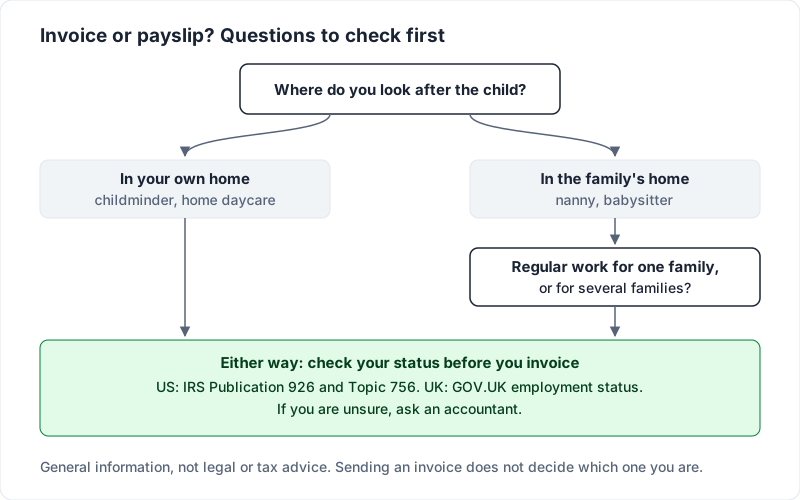
Some people who look after children are paid through payroll as an employee rather than by invoice. Which one you are is a question about your employment status, not about the invoice, and this post cannot answer it for you. The official pages are the place to start, quoted as of 23 October 2026:
- US: IRS Publication 926, Household Employer's Tax Guide says: “A worker who performs childcare services for you in their home generally isn’t your employee.” It also gives an example of a babysitter working in the family's home who “is your household employee”. Topic 756 is the IRS's short summary of household employment.
- UK: GOV.UK's employment status guidance describes self-employed people as those who “run their business for themselves and take responsibility for its success or failure.”
Sending an invoice does not decide your status. If you work regularly for one family in their home, read those pages or ask an accountant before you start invoicing. If you already invoice families for care, the rest of this guide is for you.
What every child care invoice needs#
The basics are the same as any invoice (the full list is in what actually belongs on an invoice). These are the child care versions of them:
- Your name or business name, address and contact details. Parents claiming tax relief will need your name and address exactly as you would give it to a tax office.
- The parent who pays, and the child’s name. Address it to the adult who pays, and name the child in the description, which matters when you care for siblings.
- An invoice number and the issue date. One number per child care invoice, never reused.
- The care period. “Care for 2 to 27 November 2026” is clearer than “November”.
- The rate and what it buys. “Weekly rate, full time, Monday to Friday, 7:30 am to 5:30 pm” tells the parent exactly what the $260.00 covers.
- Extras on their own lines. Late pick-ups, extra hours, meals or an outing fee, each dated.
- The total and the due date. An actual date, not only “due on receipt”.
- How to pay you. Bank details or your payment link, and the reference you want them to use.
Choosing how you charge: hourly, daily, weekly or a held place#
Pick the rate structure before care starts, write it into your agreement, and use the same wording on every invoice. The amounts below are examples only.
| Rate type | Suits | Example line | Watch out for |
|---|---|---|---|
| Hourly | Babysitting, occasional evenings, after-school pick-ups | Babysitting, Saturday 7 November 2026, 6:00 pm to 11:30 pm, 5.5 hours at $18.00 | Agree how you round part hours, and whether a minimum booking applies |
| Daily | Part-time places, a set number of days a week | Day care, Tuesdays and Thursdays, 3 to 26 November 2026, 8 days at $55.00 | Say what happens when a booked day falls on a holiday |
| Weekly | Full-time places | Weekly care, full time, weeks of 2, 9, 16 and 23 November 2026, 4 weeks at $260.00 | Say whether the rate is the same in weeks with a holiday or absence |
| Held place (retainer) | Keeping a place open while a family is away, such as over the summer | Place held for Leo, 6 July to 14 August 2026, 6 weeks at $130.00 (50% of the weekly rate) | Describe it as a fee for holding the place, not as care |
A weekly or monthly rate is the most predictable for both sides, and it reflects what the family is paying for: a reserved place, whether or not the child comes in on a given day. Say so plainly in your agreement, because it is the rule most likely to surprise a new family.
Dates and hours: what to list on a babysitting invoice or a daycare invoice#
The test is simple: could the parent check the invoice against their own calendar without asking you anything?
- Hourly work: list each date with start and end times, then the hours. A babysitting invoice for three evenings is three lines, not one.
- Daily work: list the days in the period, or the pattern (“Tuesdays and Thursdays”) plus the count.
- Weekly or monthly work: state the period with start and end dates.
- Anything outside the usual pattern: its own dated line, whether it adds money (an extra Saturday) or removes it (a day you closed).
Dates are also what tax and benefit claims are built on. A daycare invoice that only says “October tuition” leaves the parent to rebuild the dates themselves.
Extra fees: late pick-up, registration and supplies#
Fees are where relationships get tested. Agree them in writing before care starts, then show them on the child care invoice as their own lines, with the date and the reason.
- Late pick-up. “Late pick-up, 14 October 2026, collected 6:10 pm (closing 5:45 pm), $15.00.” The date and time make it a record, not an accusation. Late fees on invoices covers why a fee that first appears on an invoice rarely lands well.
- Registration or enrolment fee. A one-time charge on the first invoice, named as such. If it secures the place and is set against later fees, say so on the invoice; deposit invoices: how they actually work shows how that reads.
- Meals, nappies (diapers), outings. Either include them in the rate and say so (“rate includes lunch and snacks”), or itemise them. Do not do both.
Sick days, holidays and closures: write the rule once#
Most awkward billing conversations are about days when care did not happen. The fix is a written policy the family signed, repeated in one line on the invoice. Sample wording you can adapt:
For a weekly rate that does not change:
Fees are charged for the place, so the weekly rate stays the same when your child is off sick or on holiday. When I close (training days, my own holiday), those days are not charged.
For paid public holidays:
Public holidays that fall on a contracted day are paid at the usual rate. This year they are 26 November and 25 December.
On the invoice, one short line is enough (the worked example below shows one). A policy the family agreed to is much easier to point to than one they meet for the first time on an invoice.
A worked child care invoice example#
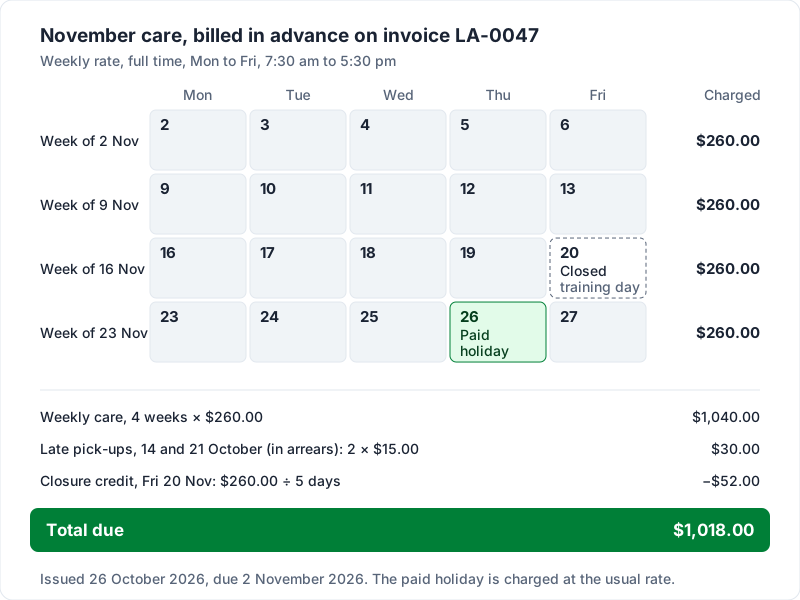
Here is an illustrative monthly invoice from a home childminder, billed in advance for November with October’s extras added. The business, family and amounts are invented.
Little Acorns Home Childcare — Invoice LA-0047, issued 26 October 2026, due 2 November 2026. Billed to Ana and David Moreno, for Leo Moreno.
| Description | Qty | Rate | Amount |
|---|---|---|---|
| Weekly care, full time, Mon to Fri, 7:30 am to 5:30 pm, weeks of 2, 9, 16 and 23 November 2026 | 4 | $260.00 | $1,040.00 |
| Late pick-up, 14 and 21 October 2026 (after 5:45 pm) | 2 | $15.00 | $30.00 |
| Provider closure, Friday 20 November 2026 (training day), not charged | 1 | -$52.00 | -$52.00 |
| Total due | $1,018.00 |
Notes printed on the invoice:
- Thanksgiving, 26 November, is a paid holiday as agreed.
- Please pay by bank transfer with the reference LA-0047.
- The weekly rate covers lunch and two snacks.
The closure is a credit line rather than a smaller weekly figure, so the parent sees the full rate, the closure and the result. The $52.00 is the weekly rate divided by five: a rule worth writing into the agreement so nobody has to guess.
Here are the same rules as a fee table, with the example figures used in this guide:
| Item | Example amount | How it is worked out | How it shows on the invoice |
|---|---|---|---|
| Full-time weekly rate | $260.00 a week | Agreed in advance: Mon to Fri, 7:30 am to 5:30 pm | One line for the period, with the weeks listed |
| Late pick-up | $15.00 each time | Collected after 5:45 pm closing | Its own line, with the dates |
| Provider closure | −$52.00 a day | Weekly rate ÷ 5 | A dated credit line |
| Child off sick or on holiday | No change | Fees are for the place, not attendance | No line; the weekly rate stays the same |
| Public holiday on a contracted day | Usual rate | As set in your written policy | A note, such as “Thanksgiving, 26 November, is a paid holiday” |
| Held place over the summer | $130.00 a week | 50% of the weekly rate | Described as holding the place, not as care |
Child care invoice for taxes: what parents need from you#
Parents who claim help with child care costs through the tax system or an employer benefit make the claim themselves, but they need details from your records. Here is what the official pages say, quoted as of 23 October 2026, as information only. Parents should check the current page for their own claim.
| Where | What the official source says the parent needs | Source |
|---|---|---|
| US: child and dependent care credit | Publication 503 lists ways to get the provider's details, including Form W-10 and “A recently printed letterhead or invoice that shows the provider's name, address, and TIN.” | IRS Publication 503, About Form W-10 |
| US: dependent care FSA | Each employer’s plan sets its own rules, so parents should check their plan's claim form. One example is New York City’s 2026 DeCAP claim form. | NYC DeCAP claim form, 2026 |
| Canada: child care expenses deduction | The provider gives the parent “a receipt indicating the services provided”, and if an individual provided the care, the receipt should show the individual's “social insurance number”. | Canada Revenue Agency |
| UK: Tax-Free Childcare | Parents pay from an online childcare account, so the provider “must be signed up to the Tax-Free Childcare scheme” as an approved or registered provider. | GOV.UK: Tax-Free Childcare, GOV.UK: provider sign-up |
What that means for your records, in practice:
- Keep your name and address identical on every invoice and receipt.
- Decide how you share your tax number. An individual provider’s number is often their Social Security or social insurance number. You may prefer to give it once, on a Form W-10 or a year-end receipt, rather than print it on every invoice.
- Show dates of care, not only dates of payment. On prepaid care, IRS Publication 503 says expenses count “only in the year the care is received”, so dated lines help the parent match each invoice to the right year.
- Keep fees separate from care. Publication 503 says “a forfeited deposit isn't for the care of a qualifying person if care isn't provided.” Separate lines let the parent and their accountant sort it out.
- Offer a year-end receipt. One page per family: your details, the parent’s name, the child, the care dates, and the total paid in the year. The difference between invoice and receipt explains why an invoice alone is not proof of payment. Our invoice receipt template guide lists what a receipt usually shows, and a free Word receipt template (also in Excel) gives you a page to fill in.
Whether a fee or a held-place charge qualifies is the parent’s question, for their own adviser. Your part is clear, dated records.
How often to invoice, and whether to bill in advance#
Weekly invoicing suits hourly work and new families; monthly suits settled, full-time places. A common pattern is regular care in advance and extras in arrears, as in the example above. Whatever you choose, send each child care invoice on the same day each cycle so parents can plan around it.
Scheduled invoices and automatic reminders help here, whichever tool sends them. Reminders matter in child care. A reminder that arrives on schedule is easier on a relationship than raising money at the door during pick-up. If you do have to chase, keep it as calm as the invoice: a short note, the invoice number, the amount and a thank-you.
Where Charming Invoices fits, and where it does not#
If you send the same families an invoice every week or month, recurring invoices in Charming Invoices raise a draft for each cycle on a weekly, monthly, quarterly or yearly schedule, with your lines and the family’s details filled in. The draft is never issued or sent for you, so you can add the late pick-up or closure credit first, then issue it, download the PDF or copy its private link, and send it to the family however you like. Your business details can include a Tax ID that prints in the invoice header when your template shows it, and default terms (your sick-day and holiday line, for example) are copied onto each new invoice.
The catches, stated plainly. Recurring invoices are on the paid plans (from Individual, $29 once), not the free plan, and there is no fortnightly schedule. Generated drafts are due 14 days after the issue date unless you change it. Charming does not email invoices or reminders to families, so send them from your own email or messages. Charming does not produce a year-end child care receipt for you; you write that yourself. Families pay you directly, by bank transfer or your own payment link, because Charming does not take card payments, and you mark each invoice paid yourself. Free invoices carry a small “Sent with Charming Invoices” line in the footer. How recurring invoices work has the full detail.
Whatever you use, the child care invoice that keeps a family relationship easy is the one with no surprises on it: the rate you agreed, the dates they can check, and the policy they already signed. Create a free invoice when you are ready to send the first one.
Free downloads
No sign-up and no email address. More on the free templates page.
- Download .docx: Receipt template for Word
Receipt template for Word
Word .docxThe same receipt as a Word document, for people who would rather type than use cells.
- Download .xlsx: Receipt template for Excel
Receipt template for Excel
Excel .xlsxConfirm a payment: paid in full, a part payment against an invoice, or a cash sale with change.