Invoice examples: 9 sample invoices, annotated

Nnabuike Okoroafor ·
On this page · 14 sections
You know roughly what an invoice is. What you want is to see one: a real-looking invoice for the kind of job you just finished, with numbers that add up, so you can copy the shape and get on with sending yours.
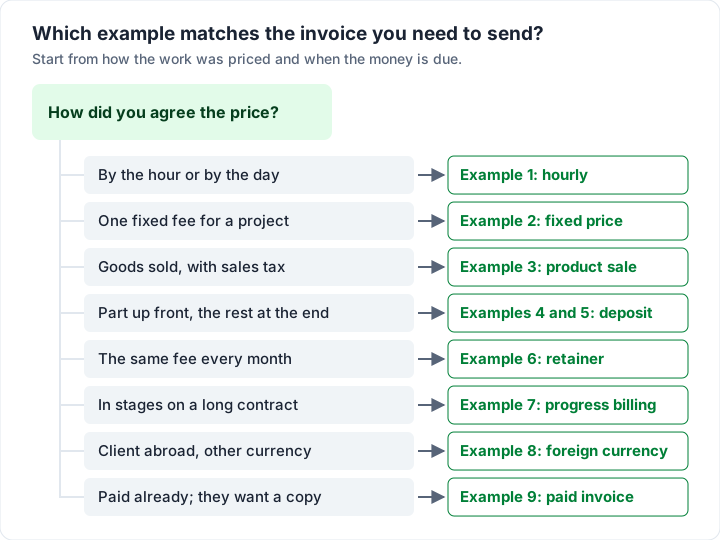
This page is a set of invoice examples, one for each common way of charging: by the hour, a fixed fee, goods with sales tax, a deposit and then the balance, a monthly retainer, progress billing with retainage, a client abroad paying in another currency, and an invoice once it has been paid. Each sample invoice is laid out as a table you can read top to bottom, and each one comes with a short note on why it is written the way it is.
Every business, client, number and date below is invented and labelled illustrative. The arithmetic is real: every line and total was re-added, and every date falls on the weekday shown.
Two related guides go deeper on single questions, and we point to them rather than repeat them. For every field explained with its edge cases, read what actually belongs on an invoice. For the process from blank page to sent, read how to make an invoice, step by step.
This is general information, not legal or tax advice. Tax rates in the examples are illustrative, and what an invoice must show differs by country.
In short#
- The standard invoice format has six blocks, in this order: header, bill to, line items, totals, how to pay, notes and terms.
- Every line is checkable: quantity × rate = amount, and the lines add up to the subtotal.
- The due date is a date, with the terms beside it: “Mon 19 Oct 2026 (Net 14)”.
- Deposits, retainage and earlier payments are subtracted by name, never folded silently into a smaller total.
- Name the currency (“USD”, “EUR”), especially for a client abroad.
- Pick the example that matches how you priced the job, then copy its shape.
The standard invoice format, block by block#
Before the examples, the layout they all share. Search for invoice format or invoice layout and you will find hundreds of designs, but almost all of them put the same six blocks in the same order, because that is the order a client's accounts team reads in: who is this from, is it for us, what is it for, how much, how do we pay.
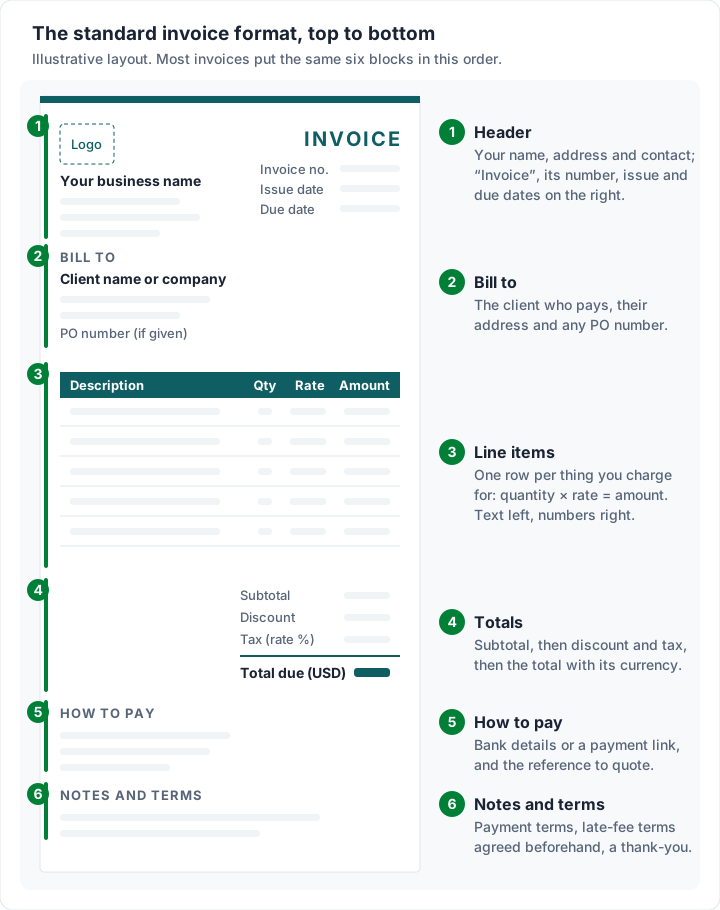
| Block | What goes in it | Layout habit worth copying |
|---|---|---|
| 1. Header | Your name or business name, contact details, logo; the word “Invoice”, its number, the issue date and the due date | Identity on the left, the invoice's own details on the right |
| 2. Bill to | The client who pays, their billing address, the person or department, any PO number | Directly under your details, so “from” and “to” sit together |
| 3. Line items | One row per thing you charge for: description, quantity, rate, amount | Words left-aligned, numbers right-aligned so the decimal points line up |
| 4. Totals | Subtotal, then any discount, then tax with its rate, then the total with its currency | Under the Amount column, with the total visually heaviest |
| 5. How to pay | Bank details or a payment link, and the reference to quote | Near the total, where the eye already is |
| 6. Notes and terms | Payment terms, any late-fee terms agreed before the work, a thank-you | Last, and short |
That is the format; the content of each block is what the examples change. If you want the reasoning behind each field (when a tax number is needed, what counts as a good description), the invoice field checklist covers it, and how to number invoices covers the number in block 1.
The need for this is common. Someone asking in a public online discussion how to bill for an event they had photographed put the question every first-time invoicer has. They are not a Charming customer; the quote comes from research we did into public discussions before building the product:
how should i submit a professional invoice? is there a generally accepted format, or software, that I can use as an amateur?
The honest answer is yes: the six blocks above are the generally accepted format, and any tool that produces them, from a Word file to an app, is fine. If you want the format to look good as well as read clearly, invoice design: principles, layouts and examples covers visual hierarchy, fonts and six layout styles.
Example 1: an hourly freelance invoice#
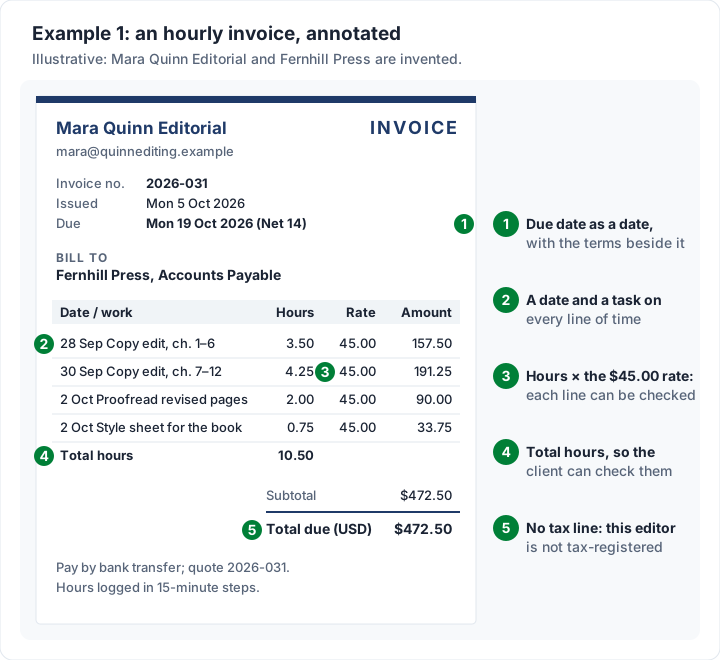
The job: a freelance copy editor billing a small publisher for editing and proofreading, at an agreed $45.00 an hour, in 15-minute steps. Illustrative names throughout.
| Field | Example |
|---|---|
| From | Mara Quinn Editorial, [email protected] |
| Invoice number | 2026-031 |
| Issued | Monday 5 October 2026 |
| Due | Monday 19 October 2026 (Net 14) |
| Bill to | Fernhill Press, Accounts Payable |
| Date and work | Hours | Rate | Amount |
|---|---|---|---|
| 28 Sep: copy edit, chapters 1 to 6 | 3.50 | $45.00 | $157.50 |
| 30 Sep: copy edit, chapters 7 to 12 | 4.25 | $45.00 | $191.25 |
| 2 Oct: proofread revised pages | 2.00 | $45.00 | $90.00 |
| 2 Oct: style sheet for the book | 0.75 | $45.00 | $33.75 |
| Total hours | 10.50 | ||
| Total due (USD) | $472.50 |
Why it is written this way:
- A date and a task on every line. The client can check the time against their own memory of the project, which is the first thing an hourly invoice gets checked for.
- Hours as decimals. 4.25 hours is four hours and fifteen minutes. Writing “4:15” in a quantity column breaks the multiplication.
- Total hours. Not required, but it answers the client's next question before they ask it.
- No tax line. In this example the editor does not charge tax, so there is no tax line at all. A tax line for tax you are not collecting only puzzles the client.
If you bill by the hour, how to invoice as a freelancer covers rates, terms and the first-invoice nerves, and our hourly invoice template has a worked sample and a blank PDF to print. If you bill companies as a 1099 contractor, the independent contractor invoice template adds a filled sample and where the W-9 fits.
Example 2: a fixed-price project invoice#
The job: a small web studio billing a physiotherapy clinic for a website at the price agreed in a written quote, plus one extra page the client asked for along the way.
| Field | Example |
|---|---|
| From | Studio Aldane |
| Invoice number | SA-0112 |
| Issued | Wednesday 14 October 2026 |
| Due | Friday 13 November 2026 (Net 30) |
| Bill to | Kestrel Physio, attn. Practice Manager |
| Description | Qty | Rate | Amount |
|---|---|---|---|
| Website design and build, five pages, as quoted in Q-118 | 1 | $3,200.00 | $3,200.00 |
| Booking-link and contact-form setup, as quoted in Q-118 | 1 | $250.00 | $250.00 |
| Additional “Our team” page, change request approved 29 Sep | 1 | $400.00 | $400.00 |
| Total due (USD) | $3,850.00 |
Why it is written this way:
- Quantity 1 at the agreed price. A fixed fee is still a line item; it just has a quantity of one.
- The quote number on the line. The client's approver will compare the invoice with the quote. Naming it saves them the search.
- The extra page is its own line, with when it was approved. A higher-than-quoted total with no explanation turns an invoice into a negotiation. A named, dated change request does not.
A fixed-price job is the classic service invoice. If you want the difference between that and a sales invoice for goods, service invoice vs sales invoice sets the two side by side.
Example 3: a product sale with sales tax#
The job: a furniture maker selling a table and bench to a private buyer, with delivery. The 7% rate is illustrative only. Sales tax rates, and what is taxable (delivery charges included), vary by place and change, so check your own state or local revenue department rather than copying this rate or this treatment of the delivery line.
| Field | Example |
|---|---|
| From | Ashgrove Joinery, sales tax permit number shown here if you hold one |
| Invoice number | AJ-2026-019 |
| Issued | Tuesday 6 October 2026 |
| Due | On receipt |
| Bill to | Dana Whitfield, delivery address 41 Orchard Row |
| Description | Qty | Unit price | Amount |
|---|---|---|---|
| Walnut dining table, 180 × 90 cm, oil finish | 1 | $1,850.00 | $1,850.00 |
| Matching walnut bench, 150 cm | 1 | $620.00 | $620.00 |
| Delivery and placement | 1 | $75.00 | $75.00 |
| Subtotal | $2,545.00 | ||
| Sales tax at 7% (illustrative rate) | $178.15 | ||
| Total due (USD) | $2,723.15 |
Why it is written this way:
- The tax line names its rate, so the client can check $2,545.00 × 7% = $178.15.
- Tax comes after the subtotal, not folded into the unit prices. Showing it separately is what makes it checkable, and it lets the client see exactly how much tax they paid.
- The goods are described specifically enough to identify them (wood, size, finish), which matters if anything is ever returned or disputed.
If you charge VAT or GST rather than US sales tax, tax authorities usually list extra details for the invoice. What is a tax invoice points to the official UK, Australian and EU guidance.
Examples 4 and 5: a deposit invoice, then the final balance#
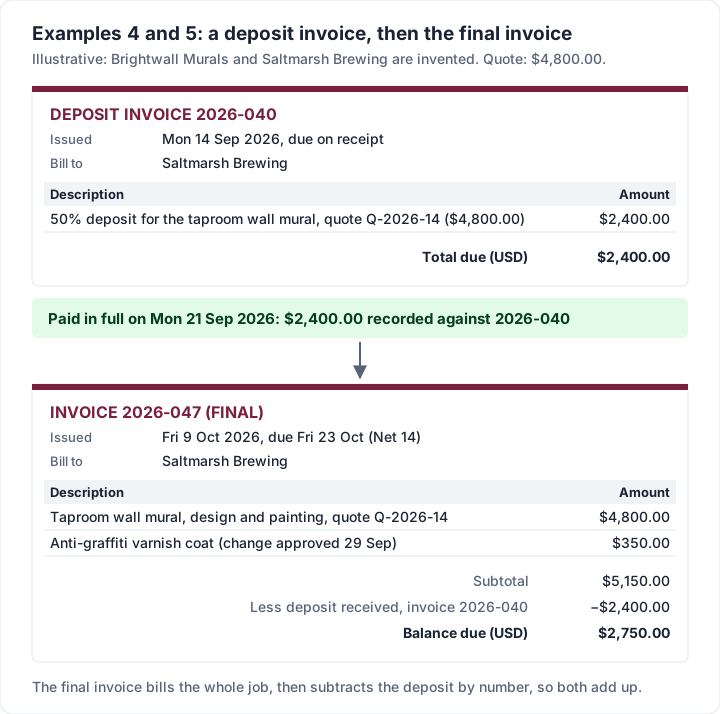
The job: a muralist painting a brewery's taproom wall for an agreed $4,800.00, with half up front. This takes two invoices: a deposit invoice before the work, then a final invoice that bills the whole job and subtracts the deposit.
Example 4, the deposit invoice:
| Description | Amount |
|---|---|
| 50% deposit for the taproom wall mural, quote Q-2026-14 (total $4,800.00) | $2,400.00 |
| Total due (USD), on receipt | $2,400.00 |
Invoice 2026-040, issued Monday 14 September 2026 and paid in full on Monday 21 September.
Example 5, the final invoice:
| Description | Amount |
|---|---|
| Taproom wall mural, design and painting, quote Q-2026-14 | $4,800.00 |
| Anti-graffiti varnish coat, change approved 29 Sep | $350.00 |
| Subtotal | $5,150.00 |
| Less deposit received, invoice 2026-040 | −$2,400.00 |
| Balance due (USD) | $2,750.00 |
Invoice 2026-047, issued Friday 9 October 2026, due Friday 23 October (Net 14).
Why it is written this way:
- The deposit invoice names the full price, so it is clear the $2,400.00 is a part payment, not the job.
- The final invoice shows the whole job, then the deposit as a minus line with the deposit invoice's number. Anyone can trace the two documents together, and the totals across both add up to exactly what was agreed plus the approved change.
- The extra is billed on the final invoice, not slipped into the deposit.
Our guide to deposit invoices covers how much to ask for, refundable or not, and the one-invoice alternative.
Example 6: a monthly retainer invoice#
The job: a social media manager on a fixed monthly retainer of $1,200.00 for an agreed scope, billed at the start of each month, with hours over the cap billed the following month at an agreed $60.00 an hour.
| Field | Example |
|---|---|
| From | Ines Barros Social |
| Invoice number | IB-2026-10 |
| Issued | Thursday 1 October 2026 |
| Due | Thursday 8 October 2026 (Net 7) |
| Bill to | Tidewater Yoga |
| Description | Qty | Rate | Amount |
|---|---|---|---|
| Social media retainer, October 2026: 12 posts, weekly stories, monthly report (up to 20 hours) | 1 | $1,200.00 | $1,200.00 |
| Additional hours, September: paid ad setup, 3 hours over the 20-hour cap | 3 | $60.00 | $180.00 |
| Total due (USD) | $1,380.00 |
Why it is written this way:
- The month is in the description. On a retainer, the period is what distinguishes one invoice from the next.
- The scope and the cap are restated. It costs a line of text and settles in advance what the fee covers.
- Overage is billed in arrears, on its own line, with the month it belongs to. The retainer is for the month ahead; the extra hours are for the month just gone.
The different kinds of retainer (monthly, drawdown, evergreen) bill quite differently. Our retainer invoice guide has a worked example of each.
Example 7: a progress invoice with retainage#
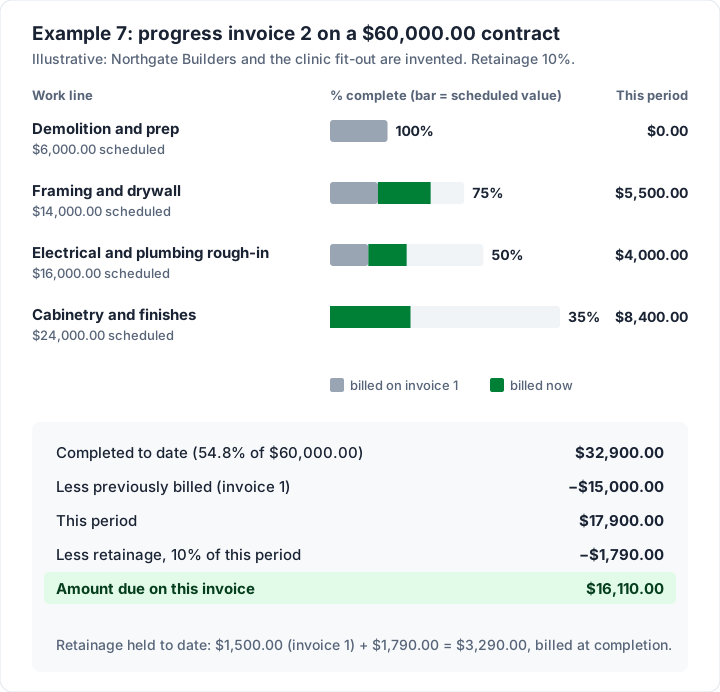
The job: a builder on a $60,000.00 clinic fit-out, billing monthly by percentage of each part of the work completed, with 10% retainage held back by the client until completion. This is the second progress invoice; the first billed $15,000.00.
| Work line | Scheduled value | Complete | Completed to date | Billed before | This period |
|---|---|---|---|---|---|
| Demolition and prep | $6,000.00 | 100% | $6,000.00 | $6,000.00 | $0.00 |
| Framing and drywall | $14,000.00 | 75% | $10,500.00 | $5,000.00 | $5,500.00 |
| Electrical and plumbing rough-in | $16,000.00 | 50% | $8,000.00 | $4,000.00 | $4,000.00 |
| Cabinetry and finishes | $24,000.00 | 35% | $8,400.00 | $0.00 | $8,400.00 |
| Totals | $60,000.00 | $32,900.00 | $15,000.00 | $17,900.00 |
Then the summary at the foot of the invoice:
| Line | Amount |
|---|---|
| This period | $17,900.00 |
| Less retainage, 10% of this period | −$1,790.00 |
| Amount due on this invoice (USD) | $16,110.00 |
Invoice NB-2026-22, issued Tuesday 6 October 2026 for work to Wednesday 30 September, due Thursday 5 November (Net 30). Illustrative names: Northgate Builders billing the clinic's owner.
Why it is written this way:
- Every line shows completed to date and billed before, so the client can see that nothing is billed twice.
- Retainage is a visible minus line, worked out on this period's amount at the agreed 10%. The client keeps it until completion; the invoice says how much.
- The running total of retainage is worth noting too: $1,500.00 from invoice 1 plus $1,790.00 now, or $3,290.00 to be released at the end.
Progress billing has more moving parts than any other invoice here. Progress invoicing, with a worked example walks through a whole job from first invoice to final, including retainage release.
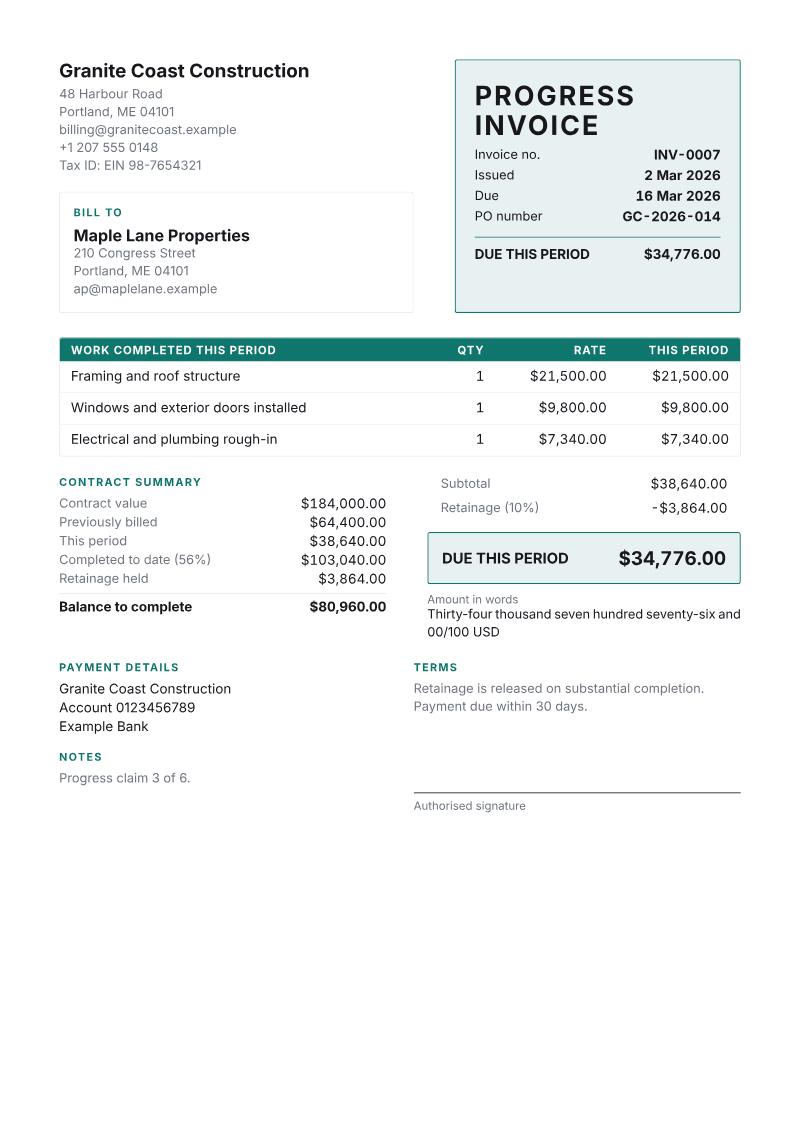
Charming has a Progress Billing template built for this layout. Here is its thumbnail, shown with the template's own sample data:
Example 8: an invoice to a client abroad#
The job: a UK-based illustrator, not VAT registered, billing a German publisher in euros, the currency agreed in the contract.
| Field | Example |
|---|---|
| From | Ada Okafor, trading as Ada Okafor Illustration, full postal address, United Kingdom |
| Invoice number | AOI-2026-014 |
| Issued | Monday 12 October 2026 |
| Supply date | Artwork delivered Friday 9 October 2026 |
| Due | Wednesday 11 November 2026 (Net 30) |
| Bill to | Bergmann Verlag GmbH, Germany, attn. Accounts |
| Currency | EUR |
| Description | Qty | Rate | Amount |
|---|---|---|---|
| Book cover illustration, final artwork, as per contract of 3 Aug 2026 | 1 | €1,500.00 | €1,500.00 |
| Interior spot illustrations | 6 | €120.00 | €720.00 |
| Total due (EUR) | €2,220.00 |
Payment details: IBAN and BIC printed in full. Note on the invoice: “Please pay the full amount in EUR. Bank charges are paid by the sender.”
Why it is written this way:
- One currency, named, on the whole invoice. The rate, the lines and the total are all in euros, and the total says “EUR”. A symbol alone is ambiguous across countries. Invoice currency covers how to choose it and who carries the exchange-rate risk.
- International bank details. An IBAN and BIC (SWIFT code) let a bank abroad pay you without a phone call.
- Who pays the transfer fees is stated. Otherwise the fee may come off what arrives, and you will be chasing a short payment.
- The supply date is shown. GOV.UK's page on what an invoice must include (as of 23 October 2026) lists “the date the goods or service were provided (supply date)” alongside the invoice date.
- No VAT line, because in this example the illustrator is not VAT registered. The same GOV.UK page lists “VAT amount if applicable” among the items and says: “You must use VAT invoices if you and your customer are VAT registered.” Whether and how VAT applies to work for a client abroad depends on your circumstances and changes over time, so check HMRC's guidance or ask an accountant before you copy this layout.
Example 9: a paid invoice#
The job: Example 1, two weeks later. Fernhill Press paid $472.50 by bank transfer on Friday 16 October 2026, and asks for a copy marked paid.
| Line | Amount |
|---|---|
| Total (invoice 2026-031) | $472.50 |
| Paid on Fri 16 Oct 2026, bank transfer, reference 2026-031 | −$472.50 |
| Balance due | $0.00 |
Plus a clear PAID mark near the total. Everything above it stays exactly as sent: same number, same lines, same issue date.
Why it is written this way: a paid invoice is the original invoice with the payment added, not a new document. Changing anything else would leave you and the client with two different versions of invoice 2026-031. Our guide to the paid invoice has a fuller annotated example with several part payments, and what to send the client (a receipt, a paid copy or a confirmation email).
Mistakes these invoice examples avoid#
Every example above sidesteps the same handful of problems. They are the reasons invoices come back with a question instead of a payment.
| Mistake | What it looks like | What the examples do instead |
|---|---|---|
| A line nobody can check | “Services rendered: $3,850.00” | Name the deliverable, the quote and any change (Example 2) |
| Hours that do not multiply | “4:15” in the quantity column | Decimal hours, 4.25 (Example 1) |
| A due date the client has to calculate | “Net 30” with no date | A date, with the terms in brackets (every example) |
| A deposit that vanishes | A smaller total with no explanation | A minus line naming the deposit invoice (Example 5) |
| Retainage folded into the total | A lower amount due with no breakdown | A visible 10% minus line (Example 7) |
| An unnamed currency | “$” on an invoice to a client abroad | “EUR” on the total and the lines (Example 8) |
| Tax for a registration you do not have | A tax line on an unregistered invoice | No tax line at all (Examples 1 and 8) |
| A rewritten paid invoice | New lines or a new number when it is paid | Same invoice, payment added, PAID mark (Example 9) |
Invoices are also records. The IRS page on what kind of records to keep lists invoices among the documents for gross receipts and says: “You should keep supporting documents that show the amounts and sources of your gross receipts.” (as of 23 October 2026). How long to keep them, and in what form, depends on where you are, so check your tax authority's guidance or ask your accountant.
Make your own from these examples#
You have three practical ways to turn one of these invoice samples into your own invoice.
A free Word or Excel file. Download the free Excel and Word invoice templates: blank files, no sign-up. What is actually in the invoice ones:
- The Excel invoice template (invoice-template.xlsx) has 15 line rows where amount = quantity × rate by formula, then subtotal, a fixed-amount discount, one tax rate (worked out to the cent), total, amount paid and balance due, all calculated. The due date is the invoice date plus your payment terms in days (30 to start with). It has a Reference / PO number field and a payment details block. It suits Examples 2, 3 and 5.
- The hourly Excel template (hourly-invoice-template.xlsx) adds a date to each of its 15 lines, bills hours × hourly rate and adds up the total hours: Example 1 is its shape.
- The Word invoice templates (invoice-template.docx and service-invoice-template.docx) are for typing into. They do not calculate: you work out the totals yourself, and a short note in each file reminds you how. The service version has a description-of-work block (job, site address, dates, work performed), a labour and materials table and a “Less deposit paid” line before the balance due, which fits Example 5.
Each file ends with one line naming Charming Invoices, which you can delete. None of them handles retainage or a schedule of values, so for Example 7 you would add those rows yourself. Our Excel invoice template guide explains every cell and formula in the spreadsheet versions.
A blank to print. If you write invoices by hand, our blank invoice template guide covers the printable options and how to fill one in.
A trade-specific sample. For filled examples in specialist fields, see our medical invoice template, dental invoice template and legal invoice template guides. For creative and freelance work, there are filled samples in our translator invoice template, graphic design invoice template and musician invoice template guides.
The app. If you send invoices like these every month, the copying is what goes wrong first. Charming Invoices has 60 invoice templates, including Progress Billing, Retainer, Timesheet and Contractor layouts, and handles deposits, progress billing with retainage and retainer draws on the invoice itself. It numbers each invoice for you, works out the totals as you type, invoices in 16 currencies (some currency symbols print as their ISO code on the PDF) and puts a PAID mark on the PDF once you record the payment. You issue each invoice, then download the PDF or copy its private link and send it however you like. The catches: Charming does not email invoices or send reminders for you; payment tracking is manual, so an invoice shows as paid when you record the payment, not when the bank sees it; clients cannot pay by card through Charming, so your bank details or your own payment link go on the invoice; the free plan covers 1 business, and its invoices carry a small “Sent with Charming Invoices” line. The 60 templates are designs inside the app, not files to download.
Sign up free for the 60 in-app templates, make the first one from whichever example above matches your job, then download the PDF and send it your way.
Questions people ask about invoice examples#
What is a sample invoice?#
A sample invoice is a filled-in example with invented details, meant to show what a finished invoice looks like before you make your own. Every example on this page is one. A template, by contrast, is the blank version you fill in.
What format should an invoice be in?#
The content follows the six-block format above. The file you send is usually a PDF: it looks the same on every device and cannot be changed by accident. Send the editable Word or Excel file only if the client asks for it.
Is there one correct invoice layout?#
No. Within the six blocks, design is yours: colours, fonts, logo, whether the invoice details sit on the left or the right. What clients care about is that they can find the number, the total, the due date and how to pay in a few seconds.
Do I need a different invoice for each type of job?#
You need a different shape of line items, not a different kind of document. An hourly job needs dates and hours, a deposit needs a minus line, a progress claim needs completed-to-date columns. The header, bill to, totals and payment blocks stay the same. For when a different document really is needed, such as a proforma or a credit note, see the types of invoices; for how much line detail to show, see itemized invoices.
Should an invoice example include tax?#
Only if you charge tax. Examples 1 and 8 have no tax line because, in these examples, the sellers do not charge tax; Example 3 shows how a sales tax line looks with an illustrative rate. Whether you need to charge tax, and how it has to appear, depends on where you are: check your tax authority's guidance or ask an accountant.
The short version#
Pick the example that matches how you priced the work, keep the six blocks in their usual order, make every line checkable, put a real date on the due date, and subtract anything already paid by name. Then send it as a PDF. Whether you start from a free Excel or Word file or from an app, the invoice that gets paid without questions looks a lot like the ones above.
Free downloads
No sign-up and no email address. More on the free templates page.
- Download .xlsx: Invoice template for Excel
Invoice template for Excel
Excel .xlsxThe general-purpose invoice: products, services or a mix, priced by quantity and rate.
- Download .xlsx: Hourly invoice template for Excel
Hourly invoice template for Excel
Excel .xlsxFor time-based work: one line per day or task, billed by the hour.
- Download .docx: Invoice template for Word
Invoice template for Word
Word .docxThe general invoice as a Word document, for people who would rather type than use cells.
- Download .docx: Service invoice template for Word
Service invoice template for Word
Word .docxFor a job: what you did, where and when, then labour and materials.