An HVAC service invoice with refrigerant, parts and the agreement

An air conditioner that quits in July produces a particular kind of customer: hot, relieved you came, and suspicious of anything on the bill they do not understand. Refrigerant is the line they question most, because they cannot see it and have heard it is expensive. This HVAC invoice template makes the invisible parts concrete. The sample is a residential repair: a diagnostic visit, a failed run capacitor and contactor replaced, two pounds of R-410A added after a leak check, and the customer signing up for an annual maintenance agreement on the spot. It records the equipment model and serial number, the refrigerant type and amount, and the technician's EPA certification, so the invoice doubles as the service record the next technician will want. For how HVAC fits alongside other home-service billing rhythms, see the home service invoicing guide; this page is the template.

Updated

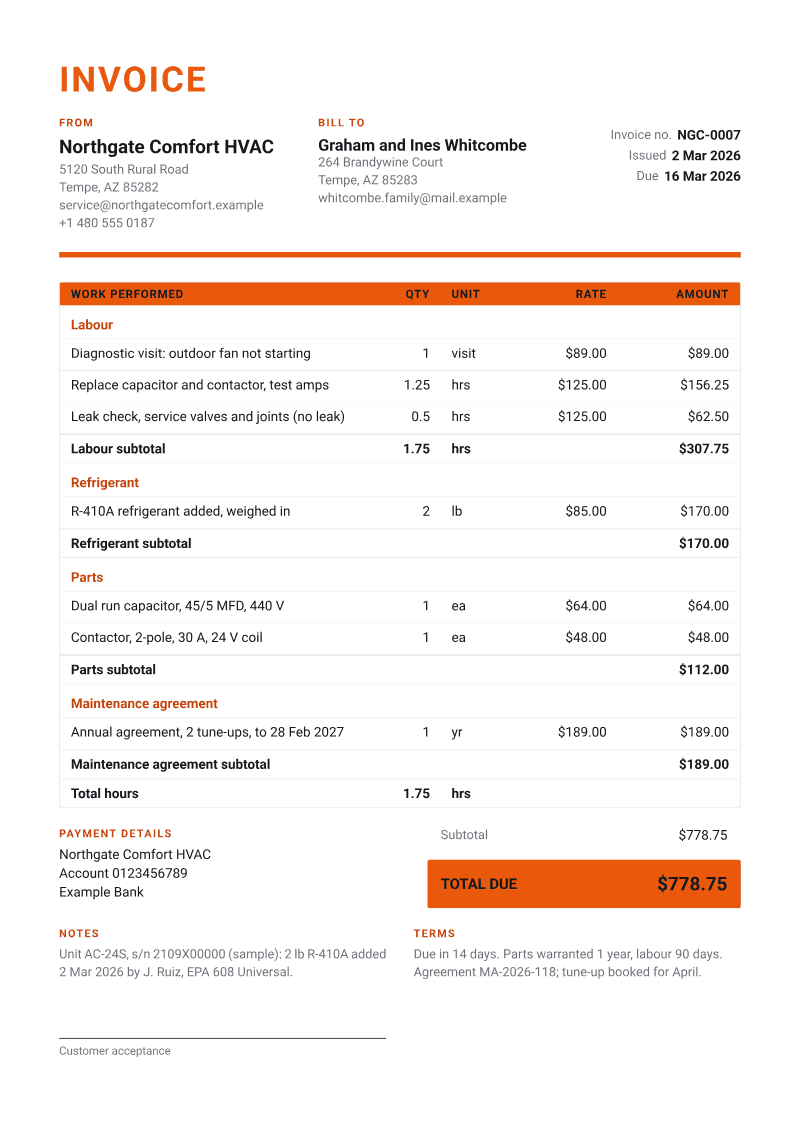
Sample HVAC invoice on the Contractor template, with invented business, client and prices

Job details

Equipment
Outdoor unit model AC-24S (sample), serial 2109X00000
Refrigerant
R-410A; 2 lb added; nameplate charge 7 lb 4 oz
Technician
J. Ruiz, EPA 608 Universal (sample)
Service agreement
MA-2026-118, renews 1 Mar 2027
Shown on the Contractor template. Rendered by the same engine that builds the PDFs Charming sends. Business, client and prices are invented for illustration.

Line items for HVAC invoices

Starter line items for HVAC invoices, prices left blank
DescriptionQtyUnitPrice
Diagnostic visit
Diagnostic or service visit (symptom reported)1visitLeft blank
Labour
HVAC technician labour (name the repair)1hrsLeft blank
Leak search or pressure test1hrsLeft blank
Refrigerant
Refrigerant added (state type, e.g. R-410A)1lbLeft blank
Refrigerant recovered for repair or disposal1lbLeft blank
Parts
Capacitor (rating in MFD and volts)1eaLeft blank
Contactor, relay or control board1eaLeft blank
Air filter (size stated)1eaLeft blank
Maintenance agreement
Maintenance agreement (term and visits included)1yrLeft blank

Prices are left blank on purpose. Use your own rates.

What HVAC invoices should include

Equipment make, model and serial number
Manufacturer warranties are claimed by serial number, and a part that fits one model year may not fit the next. With the serial on every invoice, the customer has the equipment history in one place, and so does whoever services it next.
Example: Outdoor unit AC-24S, serial 2109X00000; furnace serial noted separately
Refrigerant type and amount
Charging refrigerant by the pound and naming the type is the clearest way to justify one of the bigger lines on the bill. For larger commercial systems, EPA rules require the person adding refrigerant to give the owner a record of how much and what type, so the invoice can carry that record too.
Example: R-410A, 2 lb added, weighed in
Technician name and certification
Only certified technicians (or apprentices they closely supervise) may open the refrigerant circuit, and most refrigerants are sold only to certified technicians or their employers, so naming the technician and their Section 608 certification type shows the work was done by someone allowed to do it. No federal rule requires the certificate number on the invoice; printing it is a courtesy, not a duty.
Example: J. Ruiz, EPA 608 Universal
What was found, not just what was fixed
"Replaced capacitor" tells the customer what you did; "outdoor fan not starting, capacitor out of tolerance" tells them why. The diagnosis is what makes the repair believable and is the part a second-opinion technician will ask about.
Example: Fan motor not starting; capacitor reading 31 MFD against a 45 MFD rating
Service agreement number and term
When a visit is covered by a maintenance agreement, the invoice should say so, with the agreement number and what is included. It stops a covered tune-up being billed by mistake and reminds the customer what they are paying for each year.
Example: MA-2026-118: two tune-ups a year, renews 1 Mar 2027
How HVAC work is usually billed

Maintenance agreements

Many HVAC companies sell an annual agreement: one price for a cooling tune-up in spring and a heating tune-up in autumn, often with priority booking or a parts discount. Bill it once a year as a single line with the term and the visits included, then show each covered visit at no charge on its own invoice. A yearly agreement billed on a schedule is a recurring invoice rather than a subscription; recurring invoices are not subscriptions explains the difference and why it matters for how customers pay.

Repair now or replace

On older equipment the technician often prices two options: repair the failed component or replace the system. Whichever the customer chooses, the invoice should reflect that decision in plain words, for example "Customer chose repair; replacement quote Q-0412 left on file". It shows the customer was given the choice and helps if the same unit fails again in a month.

Seasonal and emergency rates

Demand bunches up around the first heat wave and the first hard freeze. Some companies charge more for evening, weekend or same-day emergency visits; others keep one rate and give agreement members the first slots. If you use a premium, put the rule in your terms and the time of the call on the diagnostic line, so the customer can see which rate applied.

Rules and good practice

United States (EPA): certified technicians only, for service and for buying refrigerant
Rule

Under the Clean Air Act Section 608 rules, anyone who could reasonably be expected to break into the refrigerant circuit while maintaining, servicing, repairing or disposing of equipment must pass an EPA-approved certification exam; there are Type I, II, III and Universal certifications. Most stationary refrigerants, including HFCs such as R-410A, can be sold only to certified technicians or businesses that employ one. EPA itself does not issue the cards; approved programs do.

United States (EPA): service records for larger systems
Rule

Two federal rules require whoever adds or removes refrigerant to give the owner documentation at the end of the service, including the appliance's identity and location, the date, the parts serviced, the work done, who did it, and the amount and type of refrigerant added. One applies to appliances holding 50 pounds or more of an ozone-depleting refrigerant such as R-22. The other, under the AIM Act, applies from 1 January 2026 to appliances holding 15 pounds or more of an HFC or certain substitutes, but excludes the residential and light commercial air conditioning and heat pump subsector. Records under both are kept for at least three years. A typical house system like the one in the sample falls outside both, but the invoice is a convenient place to carry the record when a job is covered.

Weigh it in and write it down, even when no rule asks

On residential systems, recording the refrigerant type, the amount added and the nameplate charge is a habit rather than a legal duty. It pays off the second time you are called back to the same unit: two pounds this year and three next year is a leak, and the invoice history is the evidence the customer needs to approve a proper leak search instead of another top-up.

General information, not tax or legal advice. Rules vary by place and change; check the current official guidance.

Making HVAC invoices in Charming

In Charming each line takes a unit (visit, hrs, lb, ea, yr) and a section label, and consecutive lines with the same section print under one heading with a subtotal, so refrigerant, parts and labour total separately as in the sample on the Contractor template (on other templates, such as Modern, switch on section grouping and the Unit column in the Template Studio). On a paid plan, a maintenance agreement can be set up as a recurring schedule: each cycle Charming creates a draft invoice for you to review and issue, and nothing is sent automatically. If a customer pays in instalments, each payment is recorded against the invoice and the balance updates. The line items above are also a starter kit in the app: on a new invoice with no lines yet, choose Start from a kit, then "HVAC service visit" under Trades. Prices start at 0.00 for your own rates.

Recurring schedules are not on the Free plan, and they create drafts rather than charging a card: Charming does not take card payments from the invoice, and you mark payments yourself. There is no equipment or service-history record, so serial numbers live in the line descriptions or notes, there are no quotes for repair-or-replace options, one tax rate covers the whole invoice, and Free-plan invoices show a small "Sent with Charming Invoices" line.

Questions

How should refrigerant be charged on an HVAC invoice?
By the pound, with the refrigerant type named, as its own line or section. Weigh what goes in rather than estimating, and write the amount on the invoice. A separate refrigerant line also makes it obvious to the customer that a top-up is a different charge from the labour to find and fix a leak.
Do I need to put my EPA 608 certification number on the invoice?
No federal rule requires the certificate number on an invoice. The service-record rules for larger systems require the name of the person who did the work, and certification itself is mandatory for anyone opening the refrigerant circuit. Printing the technician's name and certification type anyway costs nothing and answers the question before a commercial client asks it.
How do I invoice a visit covered by a maintenance agreement?
Bill the agreement itself once, for its full term, and then send each covered visit as an invoice showing the tune-up at no charge with the agreement number on it. Any repairs found during the visit go on the same invoice at your normal or member price. That way the customer sees the value of the agreement every time you come.
What should an HVAC invoice say if the customer declines a recommended repair?
Note the finding, the recommendation and that the customer declined it, for example "Cracked heat exchanger suspected; replacement recommended; customer declined". It protects you if the equipment fails later and gives the customer a clear record to act on. Keep the wording factual and avoid alarming language you could not back up.

Template designs

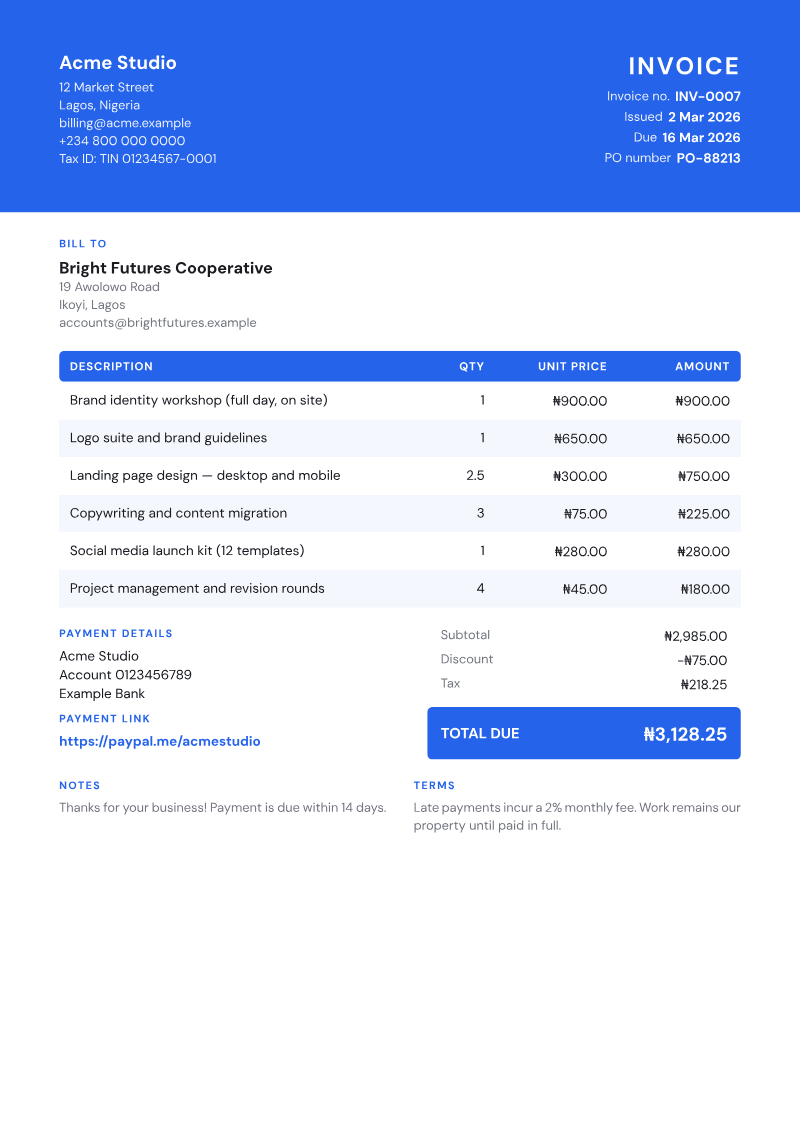
The Modern invoice template, shown on a sample invoice

Modern

Full-bleed colour band header and a filled total.

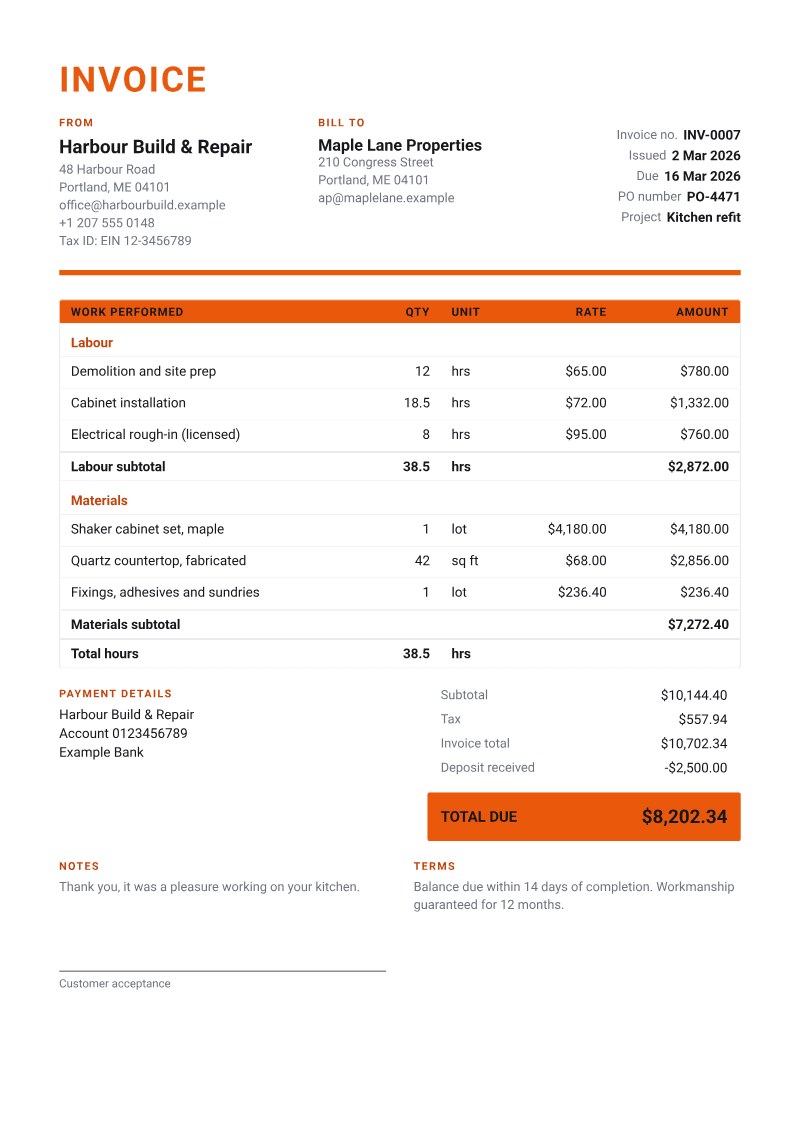
The Contractor invoice template, shown on a sample invoice

Contractor

Labour and materials in sections with subtotals, units and total hours, plus a sign-off line.

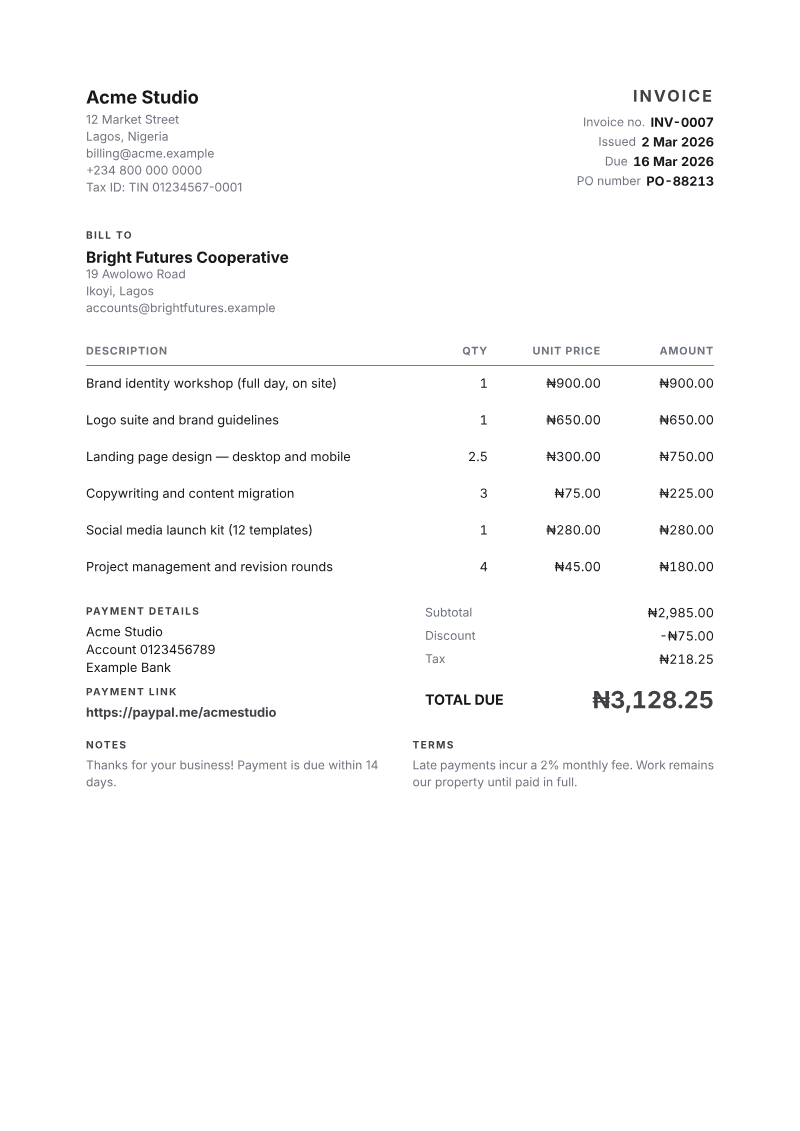
The Minimal invoice template, shown on a sample invoice

Minimal

Generous whitespace, hairlines and a single quiet accent.

Make this invoice with your own details

Add your business, your client and your own rates, then send it to your client as a PDF.